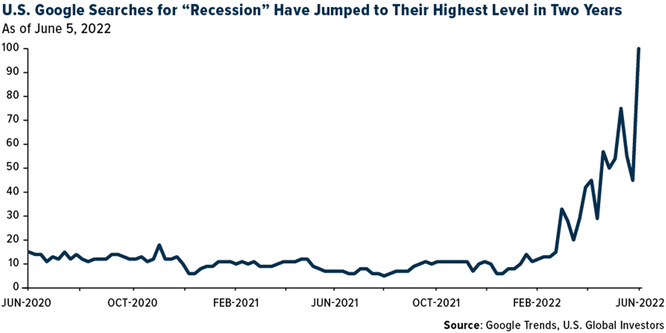
Recession. If you feel like this word is everywhere at the moment and everyone is talking about it, you would be right. Google searches for the term have spiked and every finance program and publication is covering it. So, let’s take a look.
So, what exactly is a recession?
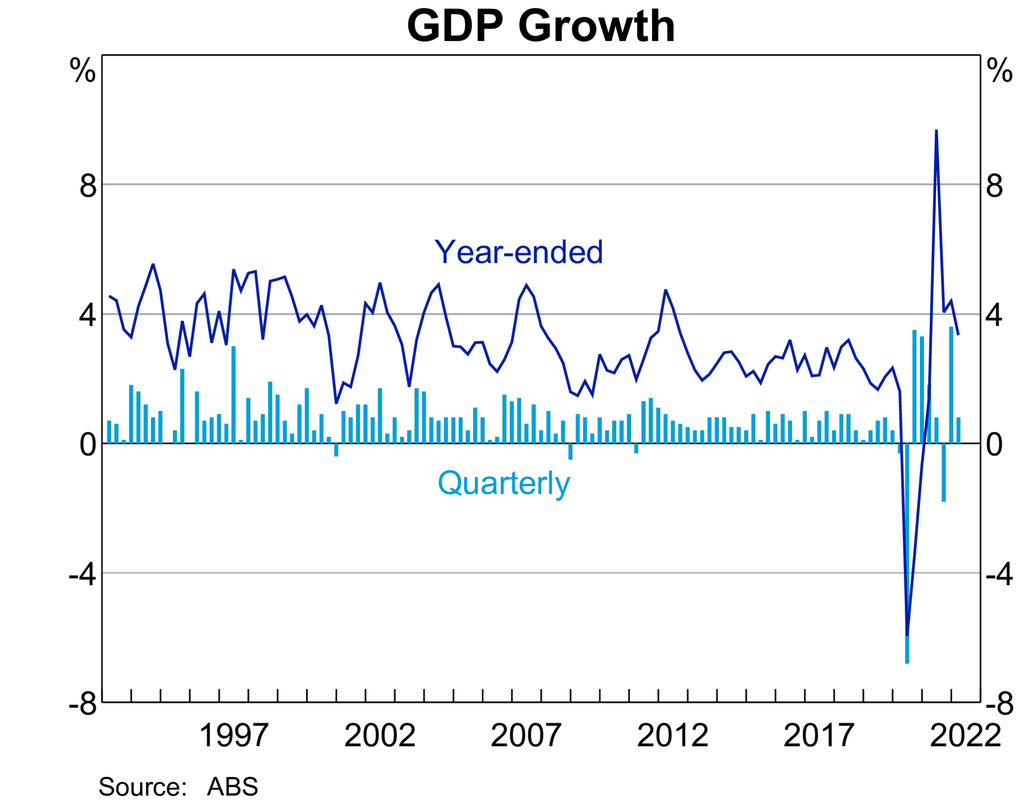
There is no single definition of recession. The most common definition used in the media and textbooks is a ‘technical recession’, in which there have been two consecutive quarters of negative growth in real gross domestic product (GDP).
This is a somewhat arbitrary and abstract definition with the oxymoron of “negative growth” thrown in for fun. What tends to happen during a recession is the more important factor to consider.
Let’s start with what “real GDP” is. Real GDP is an inflation-adjusted measure that reflects the value of all goods and services produced by an economy in a given period of time. Two consecutive quarters in which real GDP decreases reflects an economy going backwards by producing fewer goods and services than before. Following this through, if fewer goods and services are being produced then this generally implies there is reduced demand for them. If businesses are experiencing less demand and therefore producing/supplying less, they require less labour to do so. This manifests in workers receiving fewer hours or being laid off and therefore higher underemployment and unemployment. This is a key characteristic of recessions alongside depressed levels of household spending and business investment.
What causes recessions?
Recessions have many different causes. For example, the 1974-75 recession was caused by, among other things, the global oil price shock which saw prices approximately quadruple. This resulted in significant increases in the cost of production, leading to increased prices and reduced consumer demand which fed back to reduced output.
Crude Oil Nominal Price (USD)
The 1991-92 recession (the recession Australia famously “had to have” and our last technical recession) was caused by high interest rates which were put in place to reduce speculative behaviour in the commercial property market and address high levels of inflation. Elevated interest rates (cash rate of 17.5% in 1990) flowed through to increased mortgage and business loan repayments which reduced consumer disposable income and business investment. This led to reduced demand in the economy for goods and services and thus reduced output.
Finally, if we go by gross GDP, the most recent recession was caused by the arrival of Covid-19; gross GDP falling -0.3% and -7.0% respectively in the March and June 2020 quarters. Management of the public health crisis resulted in governments mandating suspension of large swathes of the economy for prolonged periods of time which prevented them from producing goods and services, leading to a reduction in output. In fact, the June 2020 quarter falling by -7% is the largest quarterly decline since records have been kept.
How long do they typically last?
Over time in Australia recessions have tended to last for shorter periods of time and be less severe as can be seen in the charts below. Many factors have contributed to this and the Australian economy’s increased resilience, including; avoiding recession during the Asian Financial Crisis of the late 90s; the tech wreck of the early 2000s and of course the Global Financial Crisis of 2008. Some of these factors include floating of the dollar (1983); banking sector reform; labour market reform and more transparent conduct of monetary policy.
Note the dates above.
How do they affect the share market?
There is no sugar coating it, recessions are negative for the share market. Reduced demand leads to reduced profits and profitability. In turn this results in a decrease in share prices. As this tends to be economy wide, recessions are usually associated with bear markets, a term used to describe a decline in a share market index of at least 20% or more from its most recent peak.
Of course, within the overall decline there can be opportunities which see individual companies experience increasing share prices. The most important takeaway from the below charts tracking the share market across various recessions since 1875 is that it has always recovered to a new high subsequently. EVERY. SINGLE. TIME. Recessions are temporary; the wealth creating effect of the market is enduring.
So, are we headed for recession in 2022/2023?
The short answer? We don’t know and neither does anyone else for that matter. The pandemic resulted in disruptions to supply chains as manufacturing and transportation around the world was affected by differing government policies and restrictions in addition to workforce issues resulting from illness and/or fear of the virus.
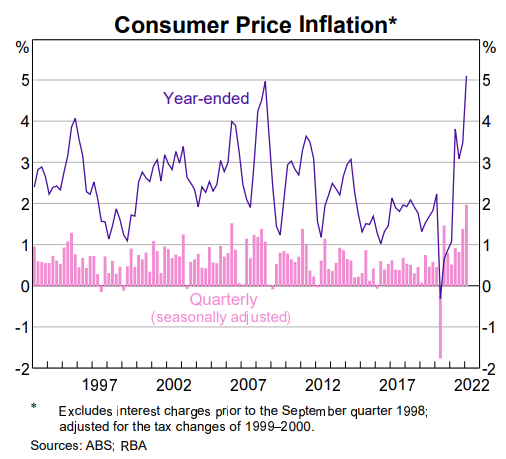
This had the expected effect of reducing the supply of goods and services. Simultaneously governments, particularly in the western world, unleashed a torrent of short-term direct stimulus which in many cases fully replaced (and them some) the income of workers affected by closure of parts of the economy. Longer term stimulus was also enacted, think the Home Builder Grant. The twin effects of reduced supply and increased demand have resulted in inflation not seen in decades (see below).
This has been exacerbated by the war in Ukraine which has led to higher energy prices. Central banks likely assumed that as the pandemic came under control, supply would normalise to meet demand and inflation would slow down. This has not proven to be the case and central banks around the world are now “behind the curve” in controlling inflation (USA 2% target vs 8% currently and Aust. 2-3% target vs 5% currently) resulting in them increasing interest rates aggressively. A war that affects global energy and food prices was the last thing needed. As mentioned above, high interest rates were partly the cause of the early 1990s recession and an oil price shock the cause of the 1970s recession. The fear is that history will repeat. Central banks are hopeful they can increase rates enough to dampen demand and reduce inflation without causing a recession (i.e. a soft landing).
Will they succeed? Only time will tell but history suggests they have their work cut out for them.
This week we look into the efficacy of the RBA raising interest rates to combat inflation and the subsequent impact on Australian property prices.
Australia’s penchant for property is about to be tested as the Reserve Bank of Australia (RBA) embarks on raising interest for the first time since 2009. In a rare interview with the national broadcaster, Governor Philip Lowe said the RBA would expedite the cash rate back to a normalised level of 2.5% to tame inflation. This came after the RBA shocked the market when it raised the cash rate by 50bps to 0.85% in June.
The notable shift in rhetoric from Lowe and the RBA is in stark contrast to the commentary given in October where it was implied rates wouldn’t rise until 2024. Now it seems the RBA will be unrelenting in its pursuit of demand destruction to bring inflation under control.
“…we will do what is necessary, we are not going to let inflation persist at these very high rates”
- Philip Lowe, June 22
All else equal, rising rates typically result in lower house prices. The ability of households and businesses to service existing or acquire new debt falls, leading to a reduction in demand for property.
ANZ expects national prices to fall 5% in 2022 and a further 10% in 2023. CBA forecasts prices to fall 18% in both Sydney and Melbourne over the next eighteen months, with a 15% national decline. Given property prices increased 25% since the onset of the pandemic, both estimates leave the vast majority of households better off.
A blunt instrument
However, the market believes further rises will be needed given the strength of households. Australians have more than $200bn in extra savings stashed away while the income-to-savings ratio is nearly double pre-pandemic levels. Per the Financial Stability Review, just 5% of loans have a loan-to-value ratio of more than 75%, compared to 25% before the pandemic. Subsequently, the market is expecting a 3.72% cash rate by year-end to bring inflation back.
It’s highly improbable the cash rate reaches that number by year-end. But even if it did, its impact would be diminished. 30% of households don’t have a mortgage at all. Of the 37% with mortgages, around 40% remain on fixed-rate loans. Most of these will roll off in the next eighteen months but that still leaves a sizeable chunk of the population with little incentive to curb spending. In fact, households with strong balance sheets may capitalise on the price dip, entrenching housing inequality.
One offsetting segment is the 31% of households that rent. With supply restricted and borrowing costs on the rise, it’s likely this segment will feel the heat most.
The other big issue is that much of the inflation problem is largely supply, not demand-driven. Sure, the pandemic brought forward some discretionary spending. But rising oil and energy prices, Russia’s invasion of Ukraine, supply chain bottlenecks and a global food shortage are all outside of the RBA’s direct control.
Get the hint
Lowe is acutely aware of the strong economic backdrop. Part of his recent uptick in public appearances is to paint a dim outlook to the public and discourage excess consumption without needing to actually change rates. If Lowe can shock the market into thinking the RBA will raise rates aggressively, this will curb spending and give the RBA some wiggle room to slow future increases.
The RBA has been somewhat successful so far, with the latest Westpac-MI consumer confidence survey indicating that sentiment had reached its third-lowest point since 1994. The only two times confidence had gone lower were in the Global Financial Crisis and at the start of the pandemic. Meanwhile, construction activity has begun to fall, a lead indicator of economic confidence.
While the majority of households are well-equipped to weather rises, newer buyers could be in for a shock. APRA’s latest data indicated that 24 per cent of new mortgages had a debt-to-income ratio of six times or more, which is considered risky by the banking regulator. Most took out these loans on the basis that interest rates wouldn’t increase until 2024. One mitigating factor may be unemployment, which is at a record low level of 3.9%. As long as borrowers remain employed, defaulting on home loans is usually the option of last resort.
Where to from here?
Given the resilience of households, Lowe will keep his foot on the pedal for time being. A Goldilocks scenario would entail households getting the hint, demand falling enough to offset the supply-side challenges and inflation returning towards the RBA’s desired upper bound of 3%. In this case, Lowe likely won’t need to raise rates by 2.5% and house prices fall around 10%.
The more likely outcome is that between now and 2.5% Lowe pauses to assess the impact of cash rate rises on the economy. If arrears and unemployment remain low but inflation is still persistent, he likely sends the cash rate to 2.5% and inflicts a ~15% correction in home values in line with ANZ’s forecast.
Should inflation still persist, the risk of a more material housing downturn emerges. Lowe may be forced to increase the cash rate as unemployment rises, thus sending Australia’s economy into a recession. However, by this point, the elevated inflation numbers will be cycled. This means the supply-side challenges like energy and food shortages would need to worsen further for inflation to remain elevated.
Overall, for the overwhelming majority of households, the initial interest rate rises will be manageable. Normalising the cash rate will also be beneficial in the long run, as it will give the RBA ammunition to support the economy in future downturns. The elephant in room is how much demand destruction is required to rein in inflation and if the RBA needs to go beyond its stated neutral rate of 2.5% to achieve this.
This week we continue to look at investing in needs and not wants, highlighting two stocks in our portfolios. Following the volatility in markets this year we have been extensively reviewing our portfolios and looking for companies that have steady earnings, inflationary protection and a service/product that is a necessity and is immune to the central banks attack on consumer spending.
Williams Companies (WMB.NYSE)
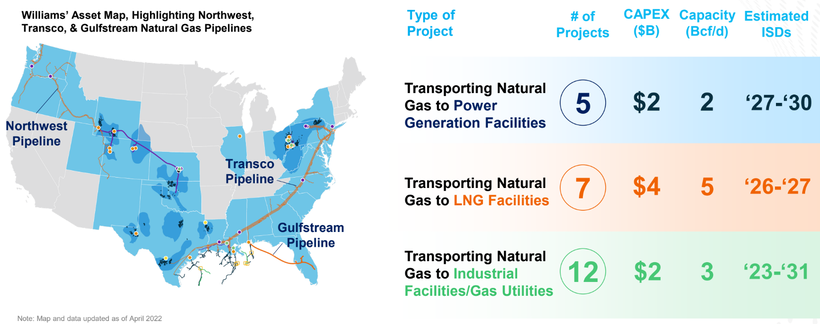
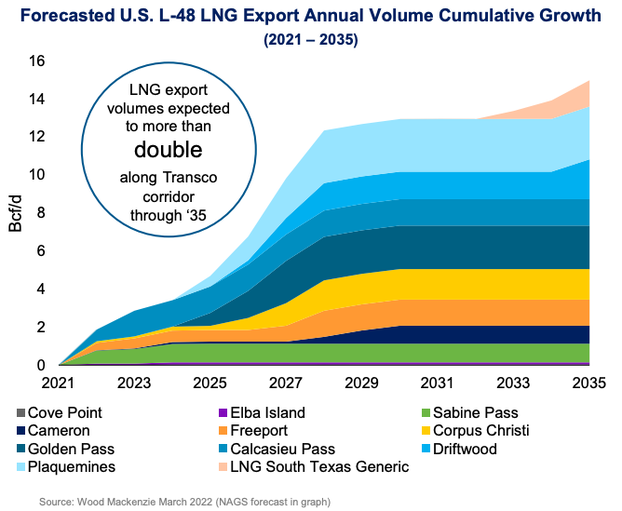
The Williams Companies, Inc., is an American energy company based in Tulsa, Oklahoma. Its core business is natural gas processing and transportation, with additional petroleum and electricity generation assets. Williams Companies is one of the largest natural gas-focused midstream companies in the United States, handling 30% of the gas used in the nation. The company is embarking on a number of projects meant to increase its capacity to supply gas to LNG producers and power plants along the East Coast. This will allow the company to continue their recent track record of steady cash flow growth.
Source: WMB company filings
The continuing conflict in Ukraine has put energy in the spotlight and, as much as society wants to move away from fossil fuels, we are finally starting to accept how critical oil and gas are going to remain during the transition period (regardless of where you stand on this being due to a short-sighted bungling of this transition over the past decade or so or not). As it currently stands, the pipelines that transport oil and gas are essential pieces of infrastructure. Without them homes would struggle to keep the lights on.
The company’s flagship pipeline system is the Transcontinental Gas Pipe Line (Transco), which is one of the major suppliers of natural gas to the highly populated Northeast. The Williams Companies has begun a $1.4bn capital spending program in order to expand the capacity of the Transco pipeline system to satisfy demand.
Williams are in a unique position to capitalise on the dire energy situation that New England currently finds itself in. New England have closed down their nuclear power plants and have limited access to LNG. Due to the treacherous winter they face, solar panels are made redundant by snowfall and the icy cold conditions only increase the demand for the warmth that LNG provides households.
Last winter the region, which has limited ability to bring natural gas via pipeline from neighbouring states in the prolific Appalachian Basin, burned the most oil to generate electricity in over a decade. If the Northeast continues to consume more oil to produce power, emissions are likely to rise. More urgently, virtually every attempt to expand the region’s natural gas pipeline infrastructure has been delayed, blocked, or abandoned. The book Shorting the Grid by Meredith Angwin discusses this issue in great detail.
Source: WMB company filings
Williams are set to increase their EBITDA by +38% this year and are currently sitting on a dividend yield of 5.3%. The barriers to entry are high and the demand for Williams’ infrastructure is rising. The rise of ESG has deterred spending for further development of oil & gas resources and without companies investing in new supply we will continue to see energy shortages. William’s ticks all our boxes when looking for stocks that people need. It has a monopoly over the northeast pipelines, high barriers to entry with regulatory authorities unwilling to approve new pipelines and delivers a service that we need now more than ever.
Singapore Exchange Ltd (S68.SGX)
Headquartered in Singapore, about 40% of companies and over 80% of bonds listed on the exchange originate outside Singapore. Singapore’s stock exchange is arguably Asia’s most international and connected exchange. The SGX comprises of 673 listed companies with a total market capitalisation of US$658bn. SGX famously tried to takeover the ASX back in 2014 and there were also rumours that the SGX was in talks with the London Stock Exchange regarding a transaction.
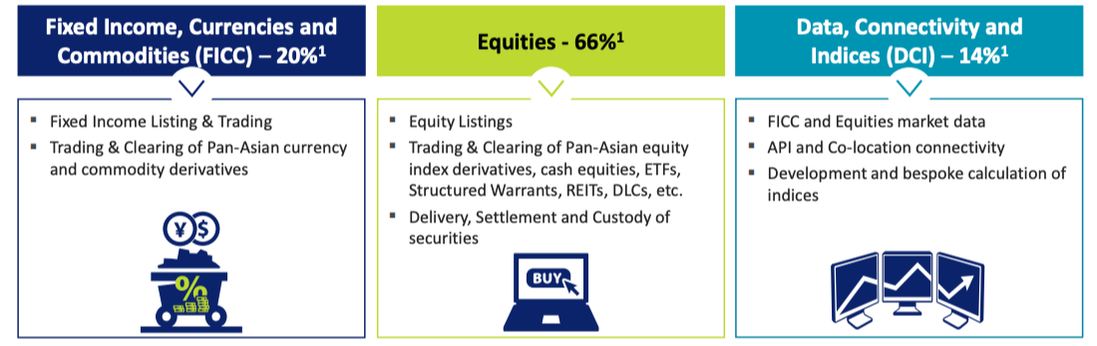
The Singapore stock exchange has three main businesses:
Fixed income, currencies and commodities
Equities
Data connectivity and indices
Source: S68 company filings
Singapore Exchange is somewhat of a hidden gem among the “needs not wants” crowd. They have a monopoly in one of the biggest financial hubs in the world, their revenues are stable and they provide an essential service. How else is everyone going to panic sell all their shares right now? Most wouldn’t categorise a stock exchange as an infrastructure-like holding, however we view it as a piece of systemically important financial infrastructure. Without exchanges markets will fail.
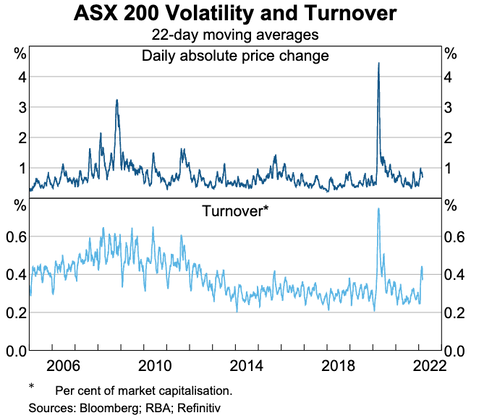
With markets taking a tumble, one might reasonably assume that owning an exchange would be a huge loser. The IPO market is a contributor, yes, but it only makes up 5% of the equity segment’s revenues. Trading and clearing make up most of the revenue for S68’s equities segment. With a Daily Average Trading Value (DAV) of S$1.4bn, S68’s average clearing fees for Cash Equities (includes ordinary shares, REITs and business trusts) was 2.73 basis points (Annual Report 2021). When markets are volatile we often see a spike in trading, this was evident in March 2020 with the initial pandemic crash. Just this week we saw the ASX fall in excess of -4% on the 14th of June, this saw a 70% increase in trading volume on the previous trading day. It’s simple, more trading = more fees.
Source: ABS
S68 should also be a beneficiary of higher interest rates, their Treasury income has suffered under lower rates. S68 reported a S$12bn float from collateral posted by derivative traders. These balances are invested in bank deposits, meaning interest income. The majority of this is going to derivative clearing members but a portion is retained by SGX. In FY21 this brought in S$72m of interest income, representing 13% of FY21 operating profit. On the back of big rate rises from central banks around the world, this income will grow substantially.
Singapore Exchange has been able to maintain its expense guidance for FY22 despite inflationary pressures. Their EBITDA margins are high at 57% and they have a 5-year CAGR of 4.9%, seeing steady growth in revenues.
There are a number of potential tailwinds for S68 moving forward. Companies in China will be eyeing listings in Singapore to hedge political risks. If some of these companies are forced to delist from US exchanges the SGX is a logical destination with ongoing concerns over Hong Kong’s autonomy going forward. Commodities and forex derivative volumes are rising as demand for risk management instruments (hedging) surges, this will only be exacerbated through central bank rate hikes. On the other side, building a stock exchange obviously has significant barriers to entry and is a highly regulated space, it’ll be tough for a genuine competitor to spring up. S68 is one of few stocks to hold up so far this year, up approx. +3% YTD.
Disclaimer: Williams Companies (WMB.NYSE) and Singapore Exchange (S68.SGX) are both currently held in the TAMIM Fund: Global High Conviction portfolio.
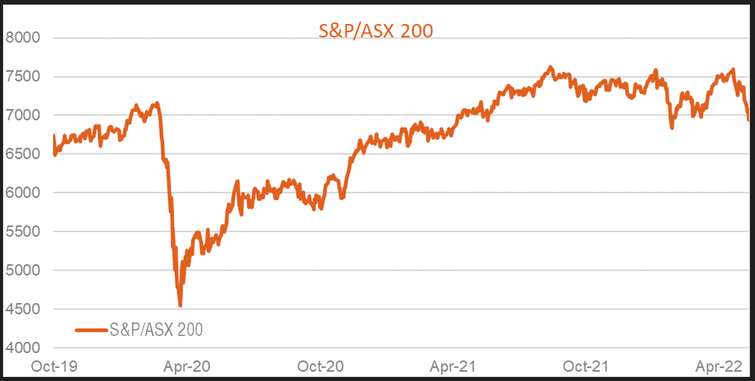
This week we visit a topic that has been all the rage in 2022. Inflation. A word we perhaps hadn’t heard of in a couple of decades but has saturated every headline this year. As we write the ASX has given back around 14% from its peak in 2021 and the ASX Small Ordinaries down over 25%, officially entering a correction, and there seems to be no respite. With that context in mind, we take a step back as is always best in scenarios like this.
We will look to briefly address a few things in this article. First, what actually is inflation and how is it calculated? Second, why has this thrown the markets off to the extent it has? Third, has the market been rational in its reaction (here we focus on equity markets)? And finally, how do we allocate given the current environment?
Keeping with tradition, we begin with the conclusion. Despite the apparent conflict of interest here given we are a funds management firm, we fundamentally believe that equities remain the place to be. This with the caveat that a well diversified portfolio has never hurt investors.
Inflation: An Overview
Let’s begin with what inflation is. Simply put, it is the general (or overall) increase in the prices of goods and services in an economy. Sounds simple enough but the question then becomes how does one measure it? The most common method and one used by central banks when determining monetary policy is CPI or Consumer Price Index. This is the price index anchored to some base year (which would have a value of 100). From here we move onto another fundamental problem, how does one aggregate this given the complexity of an economy. For example, accounting for the addition of a new technology or the fact that not all goods or services have the same weighting in a consumer’s overall expenditure (not to mention the changes that occur over time here). The easiest illustration of this is simply that something like rent accounts for a far larger portion of household expenditure than new shoes (we hope).
With the above simplistic explanation, we hope that you were able to pick up on the first point about these numbers. They are open to interpretation and by their very nature are estimates. Moreover, such ambiguity also allows some artistry, especially given the political nature of what the measure may imply. For example, the last major change Stateside came in 1990 when the federal government decided to move toward a chain-weighted measure with the intention of explicitly reducing cost of living adjustments to social security recipients and allowing for significant reductions to the deficit. Another is the accounting for so called utility. In this scenario an example may be nominal increases in the price of mobile phones but, given the increase in functionality of said devices over time, prices can in fact be adjusted and revised downwards. To give some context into how much this can impact the headline figures, if one were to use 1980 measures in terms of calculations, inflation should be averaging 4-6% over the past two decades and should be around 10.65% (as opposed to the US’ recent 8.6%, a forty year high).
Why does this second aspect matter for the investor? Firstly, it pays to be a little more cynical towards what the figures represent. Second and perhaps more importantly, the same data can have real world consequences. This is primarily through monetary policy and, by extension, the real world cost of capital. Despite the flaws in actual methodologies, it is somewhat irrelevant as long as the bond markets continue to believe it and premise their pricing on said data. What we mean to say (rather controversial perhaps), using the 1980s methodology could imply that real yields have been negative for a lot longer than the years since the GFC.
Which brings us to the now. The current (and here we are speaking of Australia) weights are as follows: Housing (23.24%), Food & Non-Alcoholic Beverages (16.76), Transport (10.58%), Alcohol & Tobacco (9.01%), Clothing & Footwear (3.3%), Furnishings Household Equipment (9.16%), Health (6.47%), Communication (2.41%), Recreation & Culture (8.64%), Education (4.63%), Insurance & Financial Services (5.80%).
You may wish to look to the ABS website to understand the methodology and the process of apportionment, you may find it interesting. However for the sake of brevity, let’s take a look at these categories.
You may notice that some of the biggest weightings are tilted towards those that have a great degree of reliance on supply chains and energy prices. While it is easy to presume that the effect of energy is limited to transport, food prices in and of themselves are uniquely exposed (i.e. fertilisers). Similarly, housing will also be significantly impacted by the same vis-a-vis utilities bills. In one way or another, every single category with the exception of education, financial services, communication and recreation will have faced significant headwinds as a result of Covid lockdowns, China’s ongoing zero Covid policy and the Russia-Ukraine conflict.
The point? As it’s currently calculated and given the weightings listed above, we would very much expect CPI to be high at the moment. The question that begs is how many of these outsized price movements are as the result of an extraordinary event versus being systemic? Just take a look at the YoY changes to some of the US’ CPI categories in the May 2022 CPI Report:
The Market Reaction
As with many things, it’s often easier to be short-sighted. So, let’s put everything into a little context. Since the GFC and the resulting advent of unconventional policy (i.e. QE) as a tool kit, we have been beneficiaries of what can only be termed asset price inflation of epic proportions. What we mean by this is we have seen a rise in the price of financial assets without a corresponding increase in goods and services inflation for over a decade (at least by the current methodology used to measure). We have effectively seen equity returns driven primarily by multiple expansion (as opposed to earnings growth). What appears to be occurring now is an increased awareness that the latter may not be a possibility going forward.
Why?
It seems that inflation, with some significant help from Covid and fiscal expansion, has now seeped through into the real economy. This significantly limits the ability of central banks to maintain status quo arrangements and increases the possibility of significant tightening. This is the simple explanation of the selloff. Growth via multiple expansion is no longer a viable option, hence the carnage of highflying tech stocks and the NASDAQ.
Was/is the reaction rational?
In some ways, yes. But, looking through the noise, we see an alternative perspective. We base this perspective on two key notions:
1 – Assuming that the goods and services inflation is here to stay, can policy makers actually be that aggressive given the demographics across the developed world and the significant debt burden undertaken by governments since 2008 and coming to a head with Covid? The debt servicing burden and implications are significant. We say no, it may seem aggressive given the low base we are coming from but nominal rates are still likely to be below inflation. By the way, this has been a trend ever since the GFC, the below graph shows the effective Fed Funds Rate against CPI.
Source: Federal Reserve Bank of St Louis
(Given the changes to consumption patterns, excluding Food and Energy gives a better comparison. This chart shows that the effective Fed Funds Rate has been kept below rate of inflation since GFC.)
2 – Given that this is a supply shock as opposed a demand driven inflationary pressure, we see very little room for manoeuvre unless central bankers wish to hike their way into a recession. After the effort put in to avoid one over the course of the last two years, we find this implausible. That said, there is always a possibility of policy error so we cant totally rule it out.
So, here is an alternative perspective. If nominal rates continue to remain below headline inflation, real yields are in fact negative. In that environment it would be a error to go toward traditional fixed income, which leaves cash but if the underlying thesis is secular inflation then that is a surefire way to guarantee negative returns. This leaves us to consider two asset classes, equities and real assets. Equities may not see the same degree of multiple expansion but earnings (contingent on where one is looking) should be able to keep up with inflation though wage pressures may dent overall profitability. Real assets, here we are thinking commercial or agricultural property (not residential as this is one that is incredibly sensitive to even small rises in nominal rates), that have cash flows able to move in line with CPI should put investors in good stead.
So there is our perspective, its not particularly popular at the moment but it may be that the indiscriminate selling is a little overdone. The high P/E market darlings to date, warranted. But days like those we have seen recently make us think that opportunities could be just around the corner.
Does that mean we are against holding cash?
Definitely not. But one way to look at it is to view cash as a put option against the market with the decline in value in real terms as the premia. Bargains are popping up.
With rates on the rise we turn to a pressing issue facing economies the world over; global debt. What will the implications be and is there a way to prepare for it?
We begin this weeks article on global debt with a story. This is the story of Sri Lanka which has seen and continues to see significant turmoil driven in no small part by their government embarking on a series of reckless fiscal spending measures over decades. While this was ostensibly blamed on the Covid crisis, a little investigation reveals a multi-decade story of populist measures, reckless tax cuts (not accounted for), and indebtedness to foreign powers, including China. What are the results? A government that has finally realised that it is not able to meet its basic obligations, civil unrest, the resignation of a Prime Minister and cabinet with an embattled head of state unable to dig himself out of a hole. Take a step back and one can see this story starting to play out on a much grander scale.
Think Latin America, emerging markets in Africa and across South East Asia. So, why is this an issue now? Well, unprecedented Covid-related measures have seen this peak. As the US Fed reverses course after decades of largesse (along with the ECB), we see the other impact of rising interest rates; increased debt servicing costs. This is likely to lead to austerity.
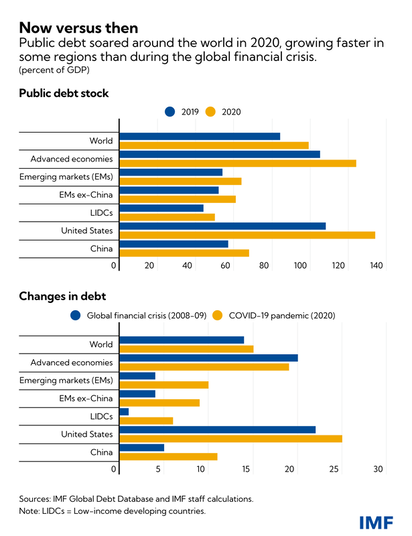
2020 marked the largest one-year debt surge since WWII, Global public debt rising to approx. US $226tn (global GDP was $94.935tn in 2021). Was this Covid and was it inevitable?
Looking at the rationale for government expenditure, current wisdom (decidedly Keynsian) formulated following the Great Depression asked a simple question: Can governments intervene to smooth out business cycles and, if so, how? The solution posited is simple, save during good times via increased tax receipts and budget balance, which allows the economy to not overheat and consequently cause inflation, while the converse is true during recessionary periods. Expenditure in this sense implies creating money supply in whatever form, the famous quote in Keynes’ General Theory of Employment, Interest and Money is:
”If the Treasury were to fill old bottles with banknotes, bury them at suitable depths in disused coal mines which are then filled up to the surface with town rubbish, and leave to the private enterprise…to dig the notes up again…there need be no more unemployment and, with the help of the repercussions, the real income of the community…would probably become a good deal greater than it is.”
It seems that governments have taken this to heart in a literal sense (which may not have been the intention). What seemingly wasn’t taken onboard is the prescription for the good times. This led to a scenario where even the now so-called glorious 80s where, for example, US Federal Government deficits averaged around 4% p.a. (compared to 2% in the previously inflationary period). More recently, the tax cuts announced under the Trump administration (in the middle of one of the longest economic expansions we’ve seen) saw gasoline added to the fire. Is this a purely American phenomenon?
Definitely not. This was a truly global trend that peaked in the 2020 period. It also happened to be true that the inequities of the financial system were clearly visible, emerging markets continued to face financing restraints that were not felt by their developed counterparts despite seemingly similar irresponsible fiscal policies (with the exception of the GFC/Great Recession, where it was somewhat warranted). The below chart shows the actual composition of public sector debt.
Source: IMF
Assuming that developed economies, and the elephant in the room the Federal Reserve, were to go on a hiking cycle with concerns around inflation, what is the outcome? The results are arguably not equal. Ask yourself why, despite a high inflationary print, US treasuries continue to hold their safe-haven status? Public sector debt is not the same as private after all, not when that debt is issued in your own currency. It’s the reason Chinese corporates feel significant pain every time the Fed raises rates or EMs face even greater pain overall.
We come to our first point. The answer to whether increases to the Fed Funds Rate or raises by the ECB reduce overall debt is not in fact clear. Unless nations move toward austerity, which doesn’t conversely impact their GDP in a way to significantly reduce tax receipts, all we may see is a ballooning of deficits. This is especially true of asymmetric relationships like Italy or Spain in the Eurozone or LATAM nations with US denominated issuance. They may just be faced with both inflation and ballooning deficits. A double whammy.
Following on from this, we can see a caveat. Debt may decrease via an avenue that may be unpalatable to most central banks, default. Unlike the GFC, this is not private sector but sovereign default risk. Even for those markets that have issued debt in their own currency, there is a great degree of risk that yields may skyrocket beyond manageable levels so that ever increasing issuance is required, adding to inflation. And so it goes in a vicious cycle (the most recent and obvious example of this being Turkey).
The above is the likely story of EMs and developing economies but what about so-called developed economies like the US, Eurozone and Australia.
Here the outcomes are a little more nuanced. Take the US for example, an increase in the Fed Funds rate may increase debt servicing costs but, because of the dynamics above, it may be that the subsequent rise in the USD (remember fiat is a relative game) might lead to further deterioration of the trade balance (by making imports cheaper). Thus exacerbating unemployment and assuming a further feedback loop into the political space, faced with two year election cycles, increase public sector deficits which may then perversely create further inflation.
In Australia the situation may require an even better and more nuanced dance. The majority of the debt in this country is household, driven by the residential market. Even incremental increases to the cash rate can have disproportionate impacts upon debt servicing abilities. Even assuming lenders have adhered to the golden rule of ensuring that mortgage payments only make up 28% of the households disposable income, a 50% increase in this cost (i.e. what an increase of 3% to 4.5% in the mortgage rate) would be seriously detrimental to overall consumer health.
So, will debt decrease? Under the current trajectory and policy environment (which should theoretically decrease it), on a balance of probabilities, we are likely to see an increase. This is with the cherry on top that it may not actually tackle inflation as hoped.
Is there a way out?
Using history to try navigate in uncharted territories is always a dangerous strategy. Looking to the 50s where the US, coming out of WWII, saw its debt decrease from a staggering 110% in 1945 to around 50% by 1959; how though?
Mainstream thought suggests that it was immense fiscal discipline but lets look at the numbers. The Fed effectively pegged the short rates and continued to actively cap long-term yields at 2.5% until the spring of 1951. What was the CPI over the same period? An average of 6.5% p.a.. Wage controls were dismantled and, when they kept up with rises in inflation, government receipts increased. At a deeply negative real yield for close to 15 years, it doesn’t take long before it was decreased.
But what about the global sphere?
History buffs may be familiar with the Bretton Woods Agreement that effectively ensured a certain degree of coordination between most of the so-called free markets through the maintenance of the peg to gold. This ensured that, despite the immense amount of capital required in the reconstruction effort both in Japan and Europe, that nations saw similar declines. There was no default. There was no Great Depression. What was required was great degree of coordination.
For the investor, what’s the point of knowing all that?
If we can assume that Covid measures have significantly increased risks to the global financial system in the form of sovereign default risk, debt has ballooned out and the only way is through financial repression (even if it’s not in the immediate term). Then we can safely assume which asset class provides the biggest risk: bonds (including sovereigns & Cash). At the same time, we can also look at those which provide the best possibilities for preservation of capital. We’re looking for any asset with two attributes; 1) that can take advantage of financial repression to ascertain capital cheaply (at least in real terms) and 2) have bargaining power where increases to cost of production can be passed on to consumers. On the second point we include property in the agricultural or commercial space which can generate cash-flow at pace with CPI, allocations to equities like healthcare, infrastructure, defense and consumer staples. The only exception to this, in our view, are businesses or sectors that are likely to benefit from increased government intervention Here we are looking at those linked to the green transition or transportation infrastructure as well as associated industries, including materials supply.










 Source: IMF