One of the greatest privileges of being in this business is the ability to talk to other investors on a daily basis and understand the pulse of the market. Right now the pulse seems to be confusion, not necessarily fear. Confusion breeds uncertainty which can paralyze an investor, sometimes leading to even worse results. So, what do we need to keep in mind when thinking about investing?
Before proceeding further, the inspiration for this article is what the Oracle from Omaha has been up to. That is, the continued and aggressive deployment of the massive cash pile on Berkshire’s balance sheet as the markets continue to sell off.
Berkshire has been deploying cash at an aggressive pace this year. Cash on hand has gone down by over $40bn from the beginning off the year, to around $106.3bn in March, and it seems the business has continued on its trajectory. So, what has Warren been buying? Nothing new, adding to existing outsized positions in Occidental Petroleum (OXY.NYSE), Chevron (CVX.NYSE), HP (HPQ.NYSE), Citigroup (C.NYSE), Apple (APPL.NASDAQ) and Ally Financial (ALLY.NYSE). So does this mean it’s time to forget that confusion and jump in? Certainly not if your premise is investing because arguably the greatest investor alive is doing so. Berkshire has also exited its position in Wells Fargo (WFC.NYSE) which also tells us that even the greatest of investors is not infallible. Moreover, one must also remember that Berkshire is in the insurance business and their time horizon and rate of return requirements are quite different from you or I as a result. So, what should we look to and where should we look?
The first thing to remember is this: buy for the right reason. That reason is simple, once the valuation of an underlying security fits your requirements as an investor. A selloff is simply an opportunity to buy at a more lucrative price. Whatever the market conditions may be, if your investment thesis is simply wrong then there is no better time to sell than now (hence the sale of Wells Fargo). Our greatest frustration with a bear market is not that returns are negative, only that we don’t have the opportunity to buy more at a given price. It is unfortunate perhaps that investors have the curse of liquidity, which tends to exacerbate the Keynesian animal spirits in either direction. After all, we don’t buy a residential property and promptly go on to the street in order to ask every passer-by what they might pay for that particular asset and make decisions in the space of a moment.
Using more localised examples, take the case of businesses like Zip (ZIP.ASX) or Pointsbet (PBH.ASX, which we owned way back in the ancient times of 2020). What about these businesses changed over a time frame of two years that saw them reach dizzying double digit price heights and promptly fall from their peaks by 90% and 81% respectively? This aspect is perhaps what Keynes referred to when he saw equity markets as a game of musical chairs (for no intrinsic value add to the overall economic welfare) and, while we do disagree with the notion, market gyrations without a more balanced understanding sometimes make it seem otherwise.
We are by no means suggesting that we are or aren’t in a bubble or that recent price action has been irrational. Let’s try to understand what has happened to date, from there we can then formulate a view of where this may lead.
Context
At this point we are all tired of reading about central bank policy and its impact on the market. With that in mind, we’ll aim to keep things rather simple and go back to basics. First, what the stock or price of any given security represents? It can be categorised as two things: 1) the actual value of the business or asset today; and 2) what the market expects for the future of the business. Also worth remembering is that the market price is only as good as what the last marginal investor bought their share of the business for (keeping ourselves to equities), it is not the total value of the transactions or even the amount of money that changed hands. This is why stimulus checks, which bought retail punters with a preference for a more adventurous return, created some ridiculous price action. With that return to the basics, how does a central bank actually impact this? Quite simply, liquidity and valuation.
Remembering the second factor that affects the price of a security, that the future value of the business (ultimately in the form of earnings) has to be accounted for today, we need to use a discount rate. The most obvious mechanism for this is the rate of return of cash on hand today. The lower this is, the higher the price you pay today. Aside from this mechanism, the second form is liquidity. Oversimplifying again, QE injects money into the system which allows that marginal investor to pay an ever higher price. Reverse this and the result follows, you are essentially taking away liquidity or at very least lowering the price the marginal investor is willing to pay. So yes, a reversal of central bank policy can be a fundamental shift, taking away the marginal dollar and investor. To what extent though?
That depends on the change in policy. The S&P multiple under Volcker, who had the gumption to hike the economy into recession, was around 8x earnings. Today it stands at 17.6x forward earnings. In Australia it stands at a similar 17.5x. At face value, the possibility that there is more pain to come looks likely. If you take this view then, yes, the markets are not attractive. Hold on a moment though, we posit a different argument.
Despite similarities (the 70s and 80s did have similar supply shocks), things are very different now to four or five decades ago. We are facing wage pressures but this comes after more then two decades of stagnation and, while it does become a potential headwind for corporate profitability, it does create a stronger consumer which should feed into top line growth. Second, despite Powell seemingly espousing a desire to emulate Volcker Stateside, he may have forgotten that the latter effectively ruled out the possibility of similar policy shifts given an aging demographic, which also creates immense buying pressure and liquidity for investible securities (i.e. all things equal, an effective higher multiple for longer) and a natural moderation in inflation. On the latter point, think about the age bracket for the highest expenditure (i.e. mid to late 30s/young families).
While the US may have some more flexibility given that their debt profile skews toward public in nature, we remain highly cynical that there is the political wherewithal to hike the economy into a recession (the independence of central banks will start to unravel rather quickly). Looking to Australia, there is much less wiggle room. Household debt to GDP has now ballooned to a staggering 120% of GDP, much of which has been a more than buoyant property sector. Assuming sanity prevails, we similarly doubt that policy makers fixated on inflation inadvertently cause a depression.
What does this mean?
Don’t place too great a focus on earnings multiples based on history. The policy shift is not, given current constraints, likely to be as drastic as people expect (although the days of easy money and an effective central bank put are long gone). Despite a significant and (importantly) indiscriminate buyer leaving the market, of the reasons listed above the most important is demographics, there is a longer-term bid. If one does expect the left-field 70s repeat, remember that cash wasn’t a particularly great store of wealth. There was effectively nowhere to hide aside from select agricultural and real assets. Moreover, while the market multiple may shrink, keep the first category, i.e. earnings, in mind. Company earnings are the best hedges against inflation, assuming that they have pricing power.
This brings us to the original issue, is there reason to be fearful? Potentially, yes. But has the market ever been otherwise? No. It is our view that it is precisely these environments that create the most opportunities. It is a more reasonable bet to buy investments with a thesis that holds (assuming one is cognizant of their rate of return and valuation) than to effectively time the market. The marginal investor willing to sell at a bargain is a discerning investors gain. The bargain not being fixed but only compared with an individual investor’s valuation.
Is it better to wait?
It might be. It might not be. Despite humanity’s best efforts to make it otherwise, the world has always been messy. Left field events exist and if they were easy to predict then they wouldn’t be left field events. To name a couple, we currently have a war in Europe wreaking havoc on energy markets and an pandemic still causing supply chain issues years in.
Returning to the Buffett story, the stocks being bought were existing holdings. They obviously have an investment thesis that still holds and we would assume that there was a price the Berkshire team had in mind when making the original decision; they obviously have a higher price at which they are comfortable buying and they continue to buy at a lower price. An investor can only work on a balance of probabilities based on reason. Too often we find that there is an endeavour to create a neat certainty and ascertain all potential outcomes; a tendency that ultimately begets pain via FOMO or actually missing out.
It pays to keep things simple. Two questions are fundamental: what is your expected rate of return? What is the risk you are willing to take on? We are talking about volatility here not market risk, which is the potential for something to go to zero. If there is a potential for the latter, perhaps best a road better not travelled. All volatility, or a sell off, represents then is an opportunity. Ironically, it is quite a lot more productive to be fearful in a bull market than a bear market, in the former there is a lot more to lose than the latter.
Where to next?
With all that said, we can only say that we understand the reason and nature of the recent price action. We also can reasonably say that there are secular forces at play that should prevent another GFC or a depression like scenario. On the flip side it is also just as true to say that the unprecedented level of central bank largesse (driving immensely easy returns) is now at an end, nothing is forever after all. We remain of the conviction that equities are still the best possible asset class to be exposed to, one just has to be a little more discerning than in the past. Three important metrics to consider are:
Pricing Power – Allows the business to keep ahead of, or even with, inflation;
Revenue Stickiness & Visibility – Typically this is associated with technology companies but it can be applied across the board. There are even consumer discretionary players that have almost cult like following, like Nike. It can also come in the form of healthcare or biotech players that are protected by regulatory practices (i.e. patents).
Debt on Balance Sheet – It doesn’t have to be low levels, fixed rate debt with long duration is effectively a transfer of wealth from the debt holder to the equity holder. Think about global businesses such as say Siemens (SIE.ETR, issued negative yielding) or Berkshire.
Look to those metrics when buying, the current environment has made a lot of companies even more attractive. It is a rather futile endeavour to consider whether they might get cheaper, they’re attractive now and unless you genuinely have divine attributes that enable you to see into the future then you won’t pick the bottom!
One also wonders at the hubris of our kind, who somehow believe themselves to be the exclusive consumers of information or understanding changing contexts. As though management teams or employees of our holdings are not also trying to navigate the exact same circumstances? Be it inflation or the potential for a central bank policy error or any number of variables. We are willing to concede that a CEO of Woodside (WPL.ASX) or ExxonMobil (XOM.NYSE) might have a better understanding of the future of energy markets than us and make decisions accordingly or that the management of CBA might have a reasonable understanding of RBA policy or inflation. Assuming we pick stocks with reasonable management teams, we know where we would rather park our capital.
We shall conclude with one of the more memorable quotes in investing. Baron Rothschild once boldly stated, “Buy when there’s blood in the streets”. It is curious that the second half of the quote is so often overlooked: “even if the blood is your own.”
Keep it simple. Keep it disciplined. Keep it rational.
Over the past few years investors that owned the much-coveted “FAANG” stocks would have been amongst the most popular people in the room. Fast forward to today and the NASDAQ is down -26% YTD; Facebook, now known as Meta Platforms (FB.NASDAQ), alone is down over -40% YTD. Growth stocks went on a tremendous rise to the top post-Covid however in the current environment, where fear is winning the arm wrestle against greed, those same growth stocks are being sold off heavily. So, where to allocate?
With rate hikes being implemented across the globe and even more expected over the remainder of the year, growth stocks are worth materially less than they were under lower interest rates. Their cash flows, which are further out in the future, are being discounted at a higher rate. On the other side, the stocks that already have strong cash flows and are paying steady dividends are holding up far better. We’re focusing on companies with steady cash flows, strong dividends and attractive moats in their respective industries here. These companies may seem boring but they are consistent performers with nearly unbreakable business models. We are looking for companies that provide products or services that people NEED rather than want. Central banks are raising rates in an effort to curb consumer spending. We want to position our portfolio to have a mix of companies that are critical to day-to-day lives and are irreplaceable.
The FAANG stocks have had their day in the sun. The stocks we are going to highlight here go by the mnemonic QUAKE. QUAKE is predominantly made up of infrastructure stocks which provide investors with exposure to cash flow generating assets, high earnings visibility and strong dividends. Critical infrastructure – the likes of railroads, utilities, ports and airports – typically have natural built in protection from inflation and fare well in a rising interest rate environment. They are often also seen as safe haven assets or bond proxies, this attribute could see a lot of investor capital enter the sector given the pessimistic outlook on markets today.
Quanta was founded in 1997. The company is a leading specialised contracting services company, delivering comprehensive infrastructure solutions for the electric power, energy and communications industries. This includes design, installation, repair and maintenance.
With operations throughout the United States, Canada, Latin America, Australia and select other international markets, Quanta has the manpower, resources and expertise to safely complete projects that are local, regional, national or international in scope.
Quanta is well positioned to benefit from the energy transition toward a carbon neutral economy. They offer investors exposure to favourable long-term trends such as utility grid modernisation, system hardening, renewable generation expansion and integration, electric vehicles (EV), electrification and communications/5G.
On the back of energy transition tailwinds, we continue to see strong earnings and revenue growth for Quanta. Quanta will be a significant player in America’s move towards renewable energy and the utility industry’s heavy spending programs on grid hardening. This exposure to renewable energy goes beyond just solar and wind, also including renewable diesel, hydrogen, and carbon sequestration. In addition, Quanta also participates in the rollout of 5G and in the building of necessary infrastructure for EV charging stations.
Quanta has a diverse but high quality portfolio of clients including American Electric Power, AT&T, Verizon and BP. We are seeing these companies grow their investment in capex and infrastructure. Quanta has one of the best reputations in the industry and has long term relationships with their clients, contributing to repeat work.
Source: PWR company filings
Union Pacific (UNP.NYSE)
Union Pacific Corporation, through subsidiary Union Pacific Railroad Company, operates in the railroad business in the United States. Union Pacific is the second-largest railroad in the United States after BNSF Railway. The company offers transportation services for grain and grain products, fertilizers, food and refrigerated products, as well as coal and petroleum products (amongst others).
UNP are responsible for transporting critical cargo needed to keep the lights on as well as ensure people aren’t hungry. A need, not a want. UNP holds an effective duopoly over railway shipping in the Western United States, this gives them pricing power in an inflationary environment. These railroad businesses may be mature but it doesn’t mean they aren’t also putting out spectacular numbers. In FY21, UNP’s ROE was sitting at 41.9%! For context, Amazon’s (AMZN.NASDAQ) ROE in FY21 was 28.8%. The company still has room to grow through providing more channels for distribution to other geographies. There is also potential upside in UNP utilising their existing capacity more efficiently to maximise their operating leverage. The business ticks all the boxes for us: high barriers to entry, strong cash flows, and provides a critical service.
Amada is a large Japanese manufacturer of metal processing equipment & machinery based in Kanagawa. They serve an array of markets, including construction, mining, aerospace and defence, automotive, agriculture, oil and gas, electronics/electrical components, industrial equipment, and the general consumer. The tailwind driving growth of the company is automation, which will increase efficiency and lower labour costs in turn, while development of the latest and innovative products will drive growth in the days ahead. Growth in end-use sectors such as manufacturing, aerospace and automotive is anticipated to drive the metal fabrication market over the next few years.
Amada are currently trading at an EV/EBITDA of 5.4x, they are also forecast to grow their EBITDA by +63% in FY22. Japanese companies have been notoriously overlooked by investors and are sitting on rock-solid balance sheets. Amada is sitting on a net cash position of ¥85m. As governance improves across the board in Japan we expect companies like these to get more attention. A longer-term tailwind for Amada is the urbanisation of India. India currently sits on a GDP per capita of less than $2000, their low GDP per capita means that most consumer spending goes towards food and other basic living necessities. Once GDP per capita crosses through $4000, spending on higher cost items that require metal – cars, fridges etc – will rise accordingly.
KLA Corp (KLAC.NASDAQ)
Source: IC Insights
KLA is the leading supplier of process control equipment used in the fabrication of integrated circuits. Integrated circuits are small chips that perform functions in the digital world like memory storage, timers for automated processes, amplifiers etc. Before they get installed they need to be tested. KLA focusses on this testing. The process control systems, in which KLA specialises, are used to analyse product and process quality at critical junctures (mostly the back end when the whole IC Package has been assembled) of the manufacturing process. Small increases in yields, the % of the IC package that works, are very valuable to semiconductor makers since this means huge increases in profits to them.
There is a growing need to ensure the reliability of semiconductors due to their increasing complexity. The expansion of semiconductor demand has also continuously boosted the demand for testers. The challenges of semiconductor miniaturisation, advancing complexity, and power consumption reduction have continually raised the bar for improving test efficiency. This is all good news for one of the leading companies in this field.
Due to higher costs associated with larger wafer fabrication factories (fabs), manufacturers are mostly inclined toward outsourcing semiconductor assembly and testing services to third party providers. Leading fabless companies will continue to outsource everything, including testing, assembly, and packaging. This is a huge driver for testing companies like KLA.
In FY22 KLA is forecast to grow revenue and EBITDA by +36% and +44% respectively. As Capex from semiconductor companies continues to accelerate in an attempt to close the supply deficit, companies like KLA will continue to benefit.
Enbridge (ENB.TSE)
Enbridge owns and operates the largest footprint of crude oil and liquid hydrocarbon systems in North America. They are currently responsible for transporting about 25% of crude oil produced in North America and almost 20% of natural gas consumed in the US. ENB operates the world’s longest crude oil and liquids transportation system, spanning 17,809 miles. Enbridge is the only energy infrastructure company that operates a massive pipeline network while also having its own gas utility company and large renewable energy portfolio.
The continuing conflict in Ukraine has put energy in the spotlight and, as much as society wants to move away from fossil fuels, we are finally starting to accept how critical oil and gas is (at least in the transition period). The pipelines that transport oil and gas are essential pieces of infrastructure, without them homes would struggle to keep the lights on. New England is a great example of how critical these pipelines truly are. In winter the area is largely covered by snow, making their solar panels somewhat redundant. Renewables aren’t yet as reliable as people think and, without oil and gas, New England would struggle to power its cities.
Enbridge is a secure, high-yielding dividend icon with 27 years of consecutive increases, the current dividend yield being 6.2%. Enbridge is also investing in renewable power projects, primarily wind and hydrogen, which is positioning them with a strong portfolio of critical energy infrastructure to service the world’s evolving energy needs.
Source: ENB company filings
Disclaimer: Quanta Services, Union Pacific, Amada, KLA and Enbridge are all currently held in the TAMIM Fund: Global High Conviction portfolio.
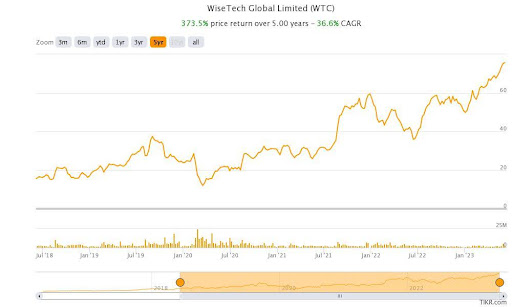
This week we will be talking about the recycling industry, a segment that we don’t believe is spoken about enough in this age of environmental reform. Similar to our recent article on tin, recycling seems to be a forgotten factor that investors are overlooking. We will highlight a recent recycling IPO that is growing fast and will be benefiting from industry tailwinds.
Recycling Industry
Author: Ron Shamgar
The hottest thematic currently dominating headlines is centred around environmental change and decarbonisation. Investors are looking for companies that will facilitate or participate in an emission-free economy. However, it seems recycling has been overshadowed by the likes of battery metals and renewable energy. Yet it is arguably more vital to our fight for environmental preservation.
Our planet endures an ever-growing waste management problem, the major source of this harmful pollution is single-use plastic. Single-use plastics are responsible for many of our pollution problems both on land and in our oceans. In order to transform our use of single-use plastics, governments around the world have implemented a plethora of policies and incentives to help curb the problem. These incentives and policies are huge tailwinds for the recycling industry.
Summary: Macro and Regulatory Tailwinds
Almost US $3tn (per year) of additional capital investment is required to meet increasing sustainability metrics
Continued high landfill rates for plastic and print consumables
Low adherence to recycling creates opportunities for companies to innovate and find solutions to increase overall recycling rates
Packaging producers/customers are examining more effective and efficient recovery and take back/re-use of valuable product resources to increase their “social license to operate”
Countries are beginning to ban exporting waste which creates a need to deal with it themselves rather than ship it to other countries that are likely not dealing with it in a environmentally safe manner
Chinese National Sword ban on importing mixed recycled plastic waste – this has a huge impact on Australian waste and means we need to find domestic solutions to deal with waste
Close the Loop (CLG.ASX)
With locations across Australia, Europe, South Africa and the US, Close the Loop creates innovative products and packaging that includes recyclable and made-from recycled content, as well as collect, sort, reclaim and reuse resources that would otherwise go to landfill. From recovering print consumables, eyewear, cosmetics, and phone cases, through to the reusing of toner and post-consumer soft plastics for an asphalt additive, CLG is focused on the future, sustainability, and the circular economy.
Close the Loop consists of the merging of two secondary business groups; Close the Loop and O F Packaging. The combining of these two entities allows for end-to-end solutions across packaging and consumables to a variety of markets, with advanced innovation in product development, as well as end of life take-back and recovery systems for complex waste streams to greatly reduce waste to landfill.
Source: CLG company filings
A circular economy is an economic system that tackles climate change, biodiversity loss, waste, and pollution. It seeks to correct the problems of the linear economy where consumers and businesses follow a “take, make, waste” process, meaning most products and resources become waste. The circular economy employs reuse, sharing, repair, refurbishment, remanufacturing and recycling to create a closed-loop system, minimising the use of resource inputs and the creation of waste, pollution and carbon emissions.
Source: CLG company filings
M&A
Close the Loop merged with O F packaging when listing late last year as part of their growth strategy. CLG are looking to acquire businesses that expand their business geographically, give them access to European markets, and provide cross selling synergies. Their recent acquisition of Oceanic Agencies strengthens Close the Loop’s bulk and commercial seafood packaging capability with strong cross-selling opportunities. CLG has a pipeline of M&A targets and they are sitting on a strong net cash position of over $6m, giving them room to lever up the balance sheet to accelerate their M&A strategy.
Source: CLG company filings
CLG grew its revenues by over 22.6% in the first half and is on track to exceed prospectus forecasts. It’s also key to note that only five months of their Crasti & Co acquisition (done earlier this year) revenue will be included in FY22 as well as only seven months from their Oceanic Agencies acquisition.
Outlook
We like CLG’s business model as it is hard to replicate and quite expensive to enter the recycling industry due to the huge startup costs. CLG has all the necessary infrastructure to operate, including over 60,000 collection sites in Australia. The business was slightly affected by covid as it is volume based and saw less volume throughout the pandemic. CLG has huge tailwinds that will further benefit their business from a macro and regulatory standpoint. On top of this, they are one of the only pure play recycling companies around. The business is profitable and trading at approximately 8x EV/EBITDA. Their future growth will be fueled by M&A and global expansion opportunities, particularly in the US and EU.
Robert Swift takes some time to look at portfolio allocation in the context of the current global climate; now focussing on investing in the ‘needs’ and not ‘wants’.
Most risk assets have had a decent fall this year. Long overdue and somewhat predictable perhaps but, as ever, it’s the most popular stocks and styles that have been hit hardest.
Author: Robert Swift
Along with the Ukraine invasion and continued Covid-induced lock downs in Asia, the rise in the US 10 year note yield has been responsible for this reappraisal of risk.
The US 10 year note yield is fast approaching 3% and the whole curve has occasionally inverted which to some ‘scribblers’ portends a recession. To put this rise in perspective, the US 10 year note yield was 0.5% in July 2020 and started this year at about 1.6%. That’s quite a loss of capital given the long duration at such low yields. Over that same 21-month period, US equities are up about +30%!
Too late, the ‘inflation is transitory’ narrative has been removed, and we now perhaps have a more aggressive tightening to endure than we would have had if action had been taken sooner? “A stitch in time saves nine” is a useful refrain to remember.
We have been told that ‘tightening’ is an imminent rise of 50 basis points in the Fed Funds rate (the short end) but also need to bear in mind that the size of the Fed balance sheet is going to be reduced. This represents an additional source of tighter monetary policy and so the effective tightening of policy is greater and quicker than most realise. This has consequences for the kinds of risk factors one should favour; put another way, a different kind of stock will do better in the next five years than in the last ten. The 30% rise of US equities compared with a 15+% fall in the value of ‘safe’ government fixed income is unlikely to continue.
We call it investing in stocks that meet needs rather than wants.
To repeat, in our view, new emerging investable themes will be: –
A) Defence, food and energy security are all now clearly priorities and are not wants but needs. The green transition couldn’t have been handled worse, as we detailed in our recent presentations (“All revolutions eat their young”). Nuclear power should be on the agenda. All this is investable.
B) De-globalisation or National Industrial Policy is on the rise as we suspected it would be. This means both a need for an increase in domestic capital investment and the involvement of government in ‘helping’ revitalise and protect strategic industries. The semiconductor industry in the USA is one such example.
C) Buy backs have to give way to capital investment incentives. This increase in capital expenditure in the name of National Industrial Policy is much needed. This inflation is different from that of the 1970s when the labour force was very powerful and not very productive (at least in the West). Then wage increases were way above inflation and fed the beast with expectations of price increases driving the next round of higher wage demands. This time it’s a dearth of supply side competition that is causing the price pressures and misguided legislation against oil companies, pipeline companies, lobbying to prevent break ups of monopolies, the shedding of defined benefit obligations, the introduction of zero hour work contracts have placed capital firmly with its throat on labour. Capital investment has been disincentivised and buy backs rewarded. This has to shift back.
D) In an era of inflation and rising mortgage rates, the consumer will become more discerning about where they spend their money since inflation has been eroding income for a long time and personal debt is high already. This again means the extrapolation of subscriber growth and price increases is naïve. Anyone for Netflix?
To us, this means one should favour basic materials, energy (pipelines are probably a better position than ‘evil’ oil?), industrials, defence, infrastructure and, increasingly, banks, especially US regional banks.
One area needs a mea culpa, one which has hurt our returns and surprised us, Japan. Japan and especially the Yen are getting sold harder than Europe and the Euro. We have been roughly benchmark weight the US and USD while being overweight Japan and the Yen and underweight Europe and the Euro. We understand that the Bank of Japan, the central bank, has signalled it won’t tighten policy and thus makes the rising yield on the USD attractive relative to the Yen, but Japan remains a massive net creditor nation and has not (yet?) displayed any excessive inflation. Meanwhile the ECB cannot raise rates for fear of sparking a new crisis in the Euro still held together by smoke and mirrors. Inflation, even in Germany, is getting serious and, at over 7% p.a. as of March 2021, is the highest since 1981.
We’ll continue with our positioning.
There is still plenty of risk and lots can go wrong with the attempt to create a soft landing. It’s not our expectation but, it’s worth bearing in mind, we can see a whole lot more intervention and confiscation.
So, be aware of risk and portfolio construction even if you wish to focus on only a few markets and sectors.
A portfolio should comprise of more than a few favourite stocks. Ten companies isn’t a diversified portfolio, nor is twenty. Probably not even thirty. Combine strategies that do different things and invest in different kinds of stocks with perhaps different holding periods; i.e. time diversification. Prepare to be content with 8% p.a. and there is still time to position away from the ‘growth at any price’ style!
For those that have read previous iterations of this exercise, you may be aware that MQG is one security that we have always insisted offers a credible (if not better) substitute for the Big Four. Very rarely do we find businesses, especially in the financial services landscape, that can maintain the culture/mentality of a small firm in a large organisation. So, with that let’s get to the numbers; which may provide answers as to why this may be the case.
BFS (Banking and Financial Services) offered up a 12% contribution to 1H22, showcasing improvements across every single service line with highlights including a +4% growth in deposits, +8% growth in home loans, +12% in car loans and a significant +4% growth in funds on platform. More important (for us), is the AUM growth in MAC (Macquarie Asset Management). This is one division that always has our attention given its highly sticky revenue and annuity like return streams. AUM grew to AU $750bn or +2% in 3Q22 while private markets grew to $160.1bn equity under management with a significant $8.1bn in equity raised during the quarter. This is another attractive proposition, private markets are simply notoriously sticky given their long duration and relative insulation from market gyrations.
Looking further, to the Commodities and Global Markets division (CGM), the business continues to maintain momentum. Given the state of the energy markets across its key markets, including gas, we should see continued momentum here especially in the structured lending side of the business. CGM currently accounts for a tidy 43% of the total 1H22 earnings. Macquarie Capital has also seen significant deal flow although this is one division we have never been fixated upon given that it is exceptionally pro-cyclical in nature.
Risk wise, MQG’s CET1 ratio has increased to 15.4% (compared to 12.6% at the time of our previous notes) and the balance sheet remains stellar. Overall, the business seems to be ticking boxes and continues to offer an attractive risk-reward proposition. Asset gathering continues to be the most attractive attribute and, given the infrastructure pipeline globally, we see a secular growth story here and an ability to maintain annuity-like revenue streams that offer an exceptional buffer. To give a little context on the opportunity set across infrastructure and the green transition, the numbers stand at approximately US $75tn according to the firm’s own briefing.
Red Flags & Risks: The big risk for Macquarie is the headwinds faced via a bullish AUD. Despite recent price action given our view on commodities, we think that there is upside risk here despite interest rate parity. The fee structures that are so attractive to shareholders could also be detrimental in the long run and risk cannibalising the book.
Expectations: MQG remains a fair substitute for the Big Four with a well-diversified business and is an arguably greater risk-reward proposition. When we wrote about this security previously, we thought it may be fairly valued at AU $149.540. At AU $200.72 per share, it continues to be expensive from a purely PE perspective. Nevertheless, investors may have to continue paying a premium given the prospects.
Dividend Yield: The current dividend yield stands at a not so exceptional 2.8%, assuming a price of $200.72 AUD. But this may be a dividend growth story.
Telstra Corporation (TLS.ASX)
When we last looked at this company we were of the opinion that, despite the historic value destruction it has brought many shareholders, this was one security that may have hit an inflection point. The major contention was that the industry-wide race to the bottom, as represented by aggressive market share acquisition strategies, may be behind the sector and that the revitalisation strategy undertaken by CEO Andy Penn ticked the right boxes. It has been proven true on all counts, if not even better than expectations. It has been a rather eventful year for the business with many surprises.
The first surprise was the mobile network sharing agreement between arch rivals TLS and TPG, whereby TPG pays the business for access to a significant portion of Telstra’s regional footprint. This not only allows incremental growth in its wholesale earnings but allows for increased quality across its metro and regional networks. Interestingly, wholesale prices will be increased by mid-year while inflation indexed pricing will be added on (this is a significant development for investors looking to find some cover against the ever increasing inflation story). This story will be the one to watch out for when looking at the business, at least with regards to the mobile division. Conversely, fixed enterprise continues to be a concern for us and this is where the business comes in direct competition with NBN. Although the company has made some strides in offering value add, it still has a way to go especially in managed data and, quite simply, evolving away from its public sector mindset.
Management-wise, we were surprised by Andy Penn’s departure. We were particularly fond of him and his overall handling of the headwinds faced by the business. He will be replaced by industry veteran and CFO VIkki Brady. The board didn’t look far and may have learnt from the Sol Trujillo fiasco; we will see what she has to offer and if it will be a substantial diversion from the Penn/T22 years. We would like to see some outside the box thinking in terms of value add. Perhaps content? Similar to the business’ American counterparts or even Optus.
Looking at the numbers, the aspirational AU $7.5 – 8bn EBITDA target for 2023 now almost looks to be a given. Financial metrics were certainly less than pleasing for 1H22 with EBITDA coming in at AU $3.5bn (down -14.8%) and NPAT of AU $700m, this masks the one-off events as a result of the restructure and the stabilisation as well as growth within the primary segments, including mobile. We have seen consistent delivery in the cost-outs as a result of the T22 strategy, which mitigated the earnings hit by AU $2.3bn. We will also see significant tailwinds in the form of market leadership in the transition to 5G. Simply put though, the business is well positioned to hit the ground running going forward.
Red Flags & Risks: The industry has finally stabilised with rationalised market shares and consolidation. The risks going forward will be uncertainty around management and the potential for change in strategy. CFOs typically have great track records delivering efficiencies but not necessarily with customer acquisition or retention. We feel that the company continues to underestimate the headwinds for its fixed enterprise divisions, especially with competition from niche providers.
Expectations: The company continues to be an attractive risk-reward proposition given its valuation, despite being significantly higher than our previous writing. Given guidance, we think the surprises may be to the upside.
Dividend Yield: Expected dividend yield stands at an exceptional 4.02% assuming a price of AU $3.98.