There is a version of the Commonwealth Bank result that reads like a victory lap. Cash profit of $10.98 billion, up 7 per cent. Return on equity back to 14.0 per cent. A final dividend of $2.70 per share, taking the full year to $5.05, fully franked. Growth at or above system in all five core domestic product categories, which the bank notes is the first time it has managed that, and the first time any major Australian bank has done so in fifteen years.
That version is accurate. It is also the least interesting part of the announcement.
The number worth sitting with is buried in the investor pack. On a four week rolling average to 31 July 2026, CBA home loan applications were running 17 per cent below the same period a year earlier, and 15 per cent below where they sat in May. Investor applications were down 28 per cent. Owner occupier applications were down 9 per cent.
For a bank that writes roughly a quarter of Australia’s mortgages, that is not a marketing problem. It is a reading on the Australian household, taken with better instruments than the ABS has.
Why this result matters more than usual
CBA reported on 12 August, the day after the Reserve Bank left the cash rate at 4.35 per cent. That hold followed three increases earlier in 2026, in February, March and May, which took the rate from 3.60 per cent. The Board was explicit that it would raise further if upside risks materialised, and its own forecasts do not have inflation back around the midpoint of the target band until late 2027.
So this is a full year result earned in a tightening cycle, reported into a market that is still not sure the tightening is finished. Headline inflation is running near 3.8 per cent, unemployment near 4.1 per cent, and productivity growth remains weak, which is why the RBA keeps using the language of capacity pressure rather than demand strength.
That backdrop changes what the CBA numbers are for. In an ordinary year, a bank result tells you about the bank. In this one, it tells you how far monetary policy has actually travelled into the household sector, and by which route.
The result, briefly
Operating income rose 6 per cent to $30.2 billion, driven almost entirely by volume, with average interest earning assets up 8 per cent, or $92 billion. Net interest margin fell 3 basis points to 2.05 per cent, though underlying margin was flat once you strip out growth in liquid assets and institutional repurchase agreements. The second half margin of 2.06 per cent was 2 basis points better than the first.
Costs rose 6 per cent to $13.8 billion, with information technology expenses up 16 per cent to $2.78 billion on cloud consumption, licensing and artificial intelligence capability. Investment spend was $2.43 billion, held at $2.4 billion for FY27. Cost to income improved to 45.5 per cent.
Loan impairment expense was $788 million, up 9 per cent, at a loan loss rate of 8 basis points. Total provisions stand at $6.48 billion, which is $2.7 billion above the loss implied by the bank’s central economic scenario. CET1 finished at 12.0 per cent against an APRA minimum of 10.25 per cent.
One quiet decision deserves attention. The $1 billion on market buy back, of which only $300 million was ever completed, expired on 12 August and will not be extended. CBA deployed 72 basis points of capital into credit risk weighted assets instead. Management chose growth over returning surplus. Where that growth went is the story.
The mortgage book stopped being the engine
Group home loan balances rose 5.8 per cent to $749 billion. Australian home loans reached $680 billion. On the face of it, respectable.
Look at the half. Domestic home loan growth in the six months to June was 3 per cent, which CBA states was below system. Home loan market share on the RBA measure slipped 20 basis points over the year to 24.4 per cent. New fundings fell from $105 billion in the first half to $95 billion in the second, and average loan size fell from $522,000 to $503,000.
Now look at business. Business and corporate loans rose 9.6 per cent to $213 billion, with Business Banking balances up 13 per cent, growing at 1.3 times system. Business Banking cash profit rose 11 per cent to $4.54 billion and now represents 41 per cent of group earnings. Retail Banking Services, with all of that mortgage market share, grew profit 5 per cent to $5.59 billion and represents 51 per cent.
The margin difference explains the enthusiasm. Business Banking ran a net interest margin of 3.39 per cent, up 7 basis points. Retail Banking Services ran 2.50 per cent, down 1 basis point, with home lending pricing alone costing the group 4 basis points of margin over the year.
CBA is doing what any sensible operator would do, allocating capital where returns are better and growth is available. But investors should be clear about what it implies. The bank’s incremental earnings growth now comes from a book where it ranks second by market share and competes hard, rather than from the book where it is dominant, holds the lowest risk weights and owns the deepest data advantage.
What the household data actually shows
This is where the result earns its keep, because CBA sees the cash flows of roughly one in three Australians.
Home loan arrears at 90 days or more rose to 0.73 per cent, up 10 basis points on the prior half. Arrears at 30 days rose to 1.33 per cent from 1.14 per cent at December. Personal loan arrears at 90 days climbed 31 basis points to 1.72 per cent. Retail Banking Services loan impairment expense rose 39 per cent over the year.
More telling than the arrears is what has happened to buffers. Offset balances fell from $97 billion at December to $94 billion at June. Redraw fell from $67 billion to $63 billion. Combined, household prepayment buffers dropped roughly $7 billion in six months, from $164 billion to $157 billion. The proportion of customers ahead of scheduled repayments fell from 87 per cent to 85 per cent, and the average number of monthly payments in advance fell from 35 to 32.
Households built buffers through the first half and spent them through the second. That is the behaviour of a sector meeting its obligations out of savings rather than out of income.
Set against that, the balance sheet position remains sound. Portfolio dynamic loan to valuation ratio sits at 41 per cent, balances in negative equity fell to 0.5 per cent from 0.8 per cent a year earlier, and home loan hardship cases are around 15 per cent below their recent peak. Arrears at 30 days, for all the movement, are roughly where they sat in June 2019.
That combination is the honest picture. Australian household balance sheets are strong. Australian household cash flows are tight. Those are different statements, and conflating them is how investors get the next two years wrong in either direction.
The policy change that has not been fully absorbed
On 12 May 2026 the Federal Budget reformed the tax treatment of residential property. From 1 July 2027, negative gearing on established residential property is limited to properties acquired before 7:30pm on budget night, with new builds retaining the concession. The 50 per cent capital gains tax discount is replaced by cost base indexation plus a 30 per cent minimum tax rate on gains accruing after 1 July 2027. Existing holdings are grandfathered.
CBA has already rewritten its serviceability rules to reflect it. The effect on flow is visible. Investor loans fell from 43 per cent of new business in the first half to 39 per cent in the second, and investor applications are down 28 per cent. First home buyers rose from 8 per cent to 10 per cent of new business, which is presumably the policy intent, but they do not replace investor volume dollar for dollar.
Two design features matter. Grandfathering protects existing investors from forced selling, but it also creates a lock in effect, giving current holders a stronger reason to hold than to sell, which constrains listings. Meanwhile the concession survives for new builds, channelling investor capital toward supply rather than toward bidding for existing stock. CBA’s own economists cut their dwelling price growth forecast for calendar 2026 to 3 per cent, down from 5 per cent.
Layer the rate cycle on top. CBA’s home loan assessment rate, being the floor rate plus the 3 percentage point serviceability buffer, sat at 8.80 per cent in June, up from 8.05 per cent in December. Borrowing capacity has been cut twice over, once by rates and once by tax.
One more behavioural signal is easy to miss. Fixed rate loans made up 7 per cent of new fundings in the second half, against 1 per cent in the first. Borrowers have started paying for certainty. That is a small number telling you something about expectations.
How the Australian economy is actually functioning
Put the pieces together and a picture emerges that is more useful than the headline profit.
For thirty years, the mortgage book has been the main channel through which Reserve Bank policy reaches the Australian household. Raise the cash rate, variable repayments adjust within weeks, discretionary spending contracts, inflation eases. It is fast and blunt, and it is why Australia has historically needed fewer rate rises than economies dominated by thirty year fixed mortgages.
That channel is now doing two things at once. It is still squeezing existing borrowers, which is why arrears are climbing and buffers are draining. But it has largely stopped creating new ones. The credit impulse from housing, which for two decades did much of the heavy lifting in Australian demand, has flattened.
At the same time, business credit is running at 1.3 times system, and business lending responds less to the cash rate than to activity, capacity and confidence. The part of the economy that policy reaches quickly has stopped expanding. The part that keeps expanding is the part policy reaches slowly.
There is also a distributional dimension this readership will recognise immediately. CBA paid more than $22.7 billion in interest to Australian savers during FY26, and its own disclosure shows mortgage balances concentrated among Australians aged roughly 25 to 44 while deposit balances sit with those aged 65 and over. Higher rates are not simply a drag on the economy. They are a transfer within it, from younger leveraged households to older unleveraged ones. Retirees and self managed super funds have been on the receiving end for three years, and it has flattered income portfolios considerably.
None of this means recession. CBA’s outlook describes growth as slowing rather than contracting, with the labour market softening only gradually. But it does explain why the RBA remains cautious. If the fast channel is saturated and the slow channel still runs warm, inflation falls gradually, and policy has to stay restrictive longer than anyone would like.
Valuation and what is priced in
CBA shares traded around $172.72 following the result, having fallen roughly 11 per cent across FY26 while the ASX 200 rose. On cash earnings per share of 656.9 cents, that is close to 26 times trailing earnings. The $5.05 dividend gives a yield near 2.9 per cent, or roughly 4.2 per cent grossed up for franking. The payout ratio of 77 per cent is inside the 70 to 80 per cent target band and moving toward the middle of it.
That multiple has always rested on a specific proposition. CBA owns the deposit franchise, the transaction relationships, the data, and the lowest cost of funding in the market, with 79 per cent of funding sourced from customer deposits. Those advantages are real, and this result confirms most of them are intact.
The question is narrower. If the premium exists because CBA dominates Australian household lending, and household lending has stopped growing, what is the premium now attached to? The answer appears to be a business bank growing at 1.3 times system, a technology programme running at $2.4 billion a year, and a deposit franchise that earns more when rates are high. Those are respectable assets. Whether they justify roughly 26 times earnings is a separate question, and it is the one the market has been quietly voting on all year.
Risks
The clearest risk sits in the growth engine itself. Business Banking loan impairment expense rose from $91 million in the first half to $219 million in the second. The corporate loan loss rate jumped from 4 basis points to 20 basis points half on half. Corporate troublesome exposures rose $600 million to $4.1 billion. Growing business lending at 1.3 times system is straightforward on the way up. Judo Capital’s June downgrade, driven by three exposures that deteriorated quickly, is a reminder that business credit does not normalise gently.
House prices are the second risk, and they cut in an underappreciated direction. Consumer collective provisions were reduced during FY26 partly because rising house prices lifted collateral values. CBA’s outlook now states that housing activity and prices have turned down. If that persists, the provision tailwind becomes a headwind, regardless of whether any borrower misses a payment.
Rate path uncertainty runs both ways. Higher rates support deposit margins and replicating portfolio earnings, which added 5 basis points to margin this year. They also lift arrears. A cutting cycle would relieve borrowers and compress the deposit spread quietly doing much of the margin work.
Distribution mix is a slower erosion. Proprietary origination fell from 66 per cent to 65 per cent of flow for the year, and from 67 per cent to 64 per cent in the second half. CBA estimates proprietary loans are 20 to 30 per cent more profitable than broker originated ones. Losing share of your own front door is expensive over time, and technology spend is meanwhile rising faster than income. Management points to roughly $200 million of gross benefits from artificial intelligence use cases in FY26, expected to double in FY27 and exceed the investment. That is a promise, not yet a result.
Against all of this, the counterweight is genuine. Provisions sit $2.7 billion above the central scenario. Coverage is 1.53 per cent of credit risk weighted assets. Negative equity is negligible. Ninety four per cent of the book was written under tightened standards. CBA has more capacity to absorb a bad outcome than at any point in its modern history.
What long term investors should take from this
For long term investors, the practical question is not whether CBA is a good bank. It plainly is. The question is what a result like this tells you about positioning across an Australian portfolio. Three observations seem useful.
First, the household credit impulse has flattened, and businesses geared to housing turnover, discretionary retail and household formation face a slower base than headline employment implies. CBA lifted provision coverage on retail trade for exactly this reason.
Second, the interest income flowing to savers over three years has been a meaningful support for income portfolios, and it reverses when rates eventually fall. Building a retirement income plan on 2026 deposit rates is a form of extrapolation.
Third, when a company’s growth engine changes, the multiple usually follows, even when earnings do not fall. That process is rarely dramatic. It shows up as a stock that goes sideways while the business keeps performing, which is a fair description of FY26 for CBA shareholders.
This is not a call to make heroic macro bets. It is a reminder that the most valuable information in a bank result is often not in the profit line at all.
TAMIM Takeaway
CBA delivered a strong FY26 result: $10.98 billion in cash profit, a 14.0 per cent return on equity, and a $5.05 fully franked dividend. The market largely focused on margins and the payout.
The more useful signal sits underneath. Home loan applications are down 17 per cent year on year and 28 per cent among investors, household offset and redraw buffers fell roughly $7 billion in six months, and arrears are grinding higher, while business lending grows at 1.3 times system and now contributes 41 per cent of group profit. The mortgage book, for three decades the engine of both CBA’s earnings and Australian household demand, has stopped expanding.
For long term investors, that matters in two ways. It suggests monetary policy is now working through a slower, less predictable channel, which is consistent with an RBA that is in no hurry. And it raises a fair question about a premium multiple built on dominance in a market that is no longer growing.
The mindset to bring is patience rather than alarm. Australian household balance sheets remain strong even as household cash flows tighten. Those two things can be true at once, and investors who confuse them will either panic too early or relax too long.
Disclaimer: Commonwealth Bank of Australia (ASX: CBA) is held in TAMIM portfolios as at the date of article publication. Holdings can change substantially at any time.
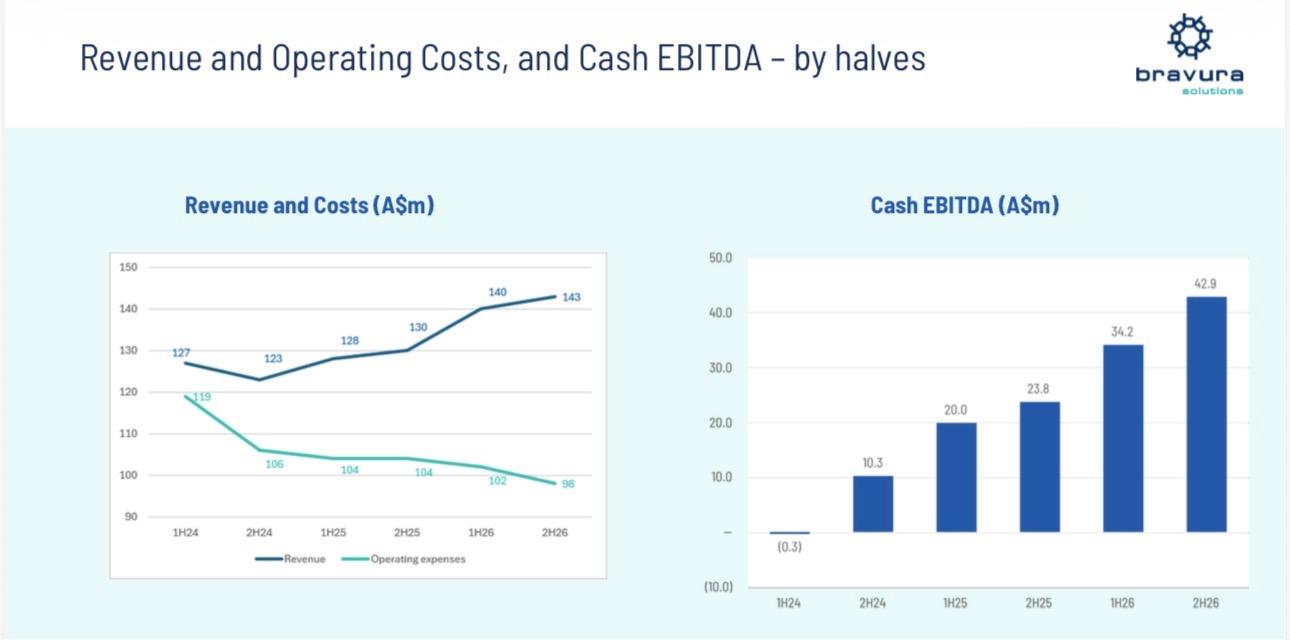
Bravura Solutions (ASX: BVS) has reported a FY26 result that landed in line with its early July guidance at the Cash EBITDA level while beating expectations on underlying net profit after tax (UNPAT), aided by favourable interest and foreign exchange outcomes. The performance underscores the company’s progress in stabilising and growing its core software businesses, and management has reinforced confidence in its cash generation trajectory by declaring total dividends of 25.23 cents per share. This significantly exceeds consensus estimates of 14.2 cents.
Capital returns signal confidence in the cash flows
The board’s decision to return substantial capital to shareholders via dividends, alongside an announced on-market buyback of up to $50 million, signals strong belief in the sustainability of cash flows. Bravura has also expanded its debt facilities to a combined $100 million, providing additional flexibility that could support both the buyback and potential future M&A activity.
The FY27 guide is constructive, and this management team has form
Looking ahead, the FY27 outlook is constructive. Management has guided for revenue of $280 million to $300 million and Cash EBITDA of $84 million to $94 million, assuming an AUD:GBP exchange rate of 1.90, compared with 1.98 in FY26. At the midpoint, this implies Cash EBITDA growth of approximately 6.6% against consensus of $83.5 million. Current spot rates around 1.91 suggest the FX assumption is realistic. Consensus revenue sits near $289 million to $290 million, placing the guided range sensibly around market expectations. Bravura has a track record of positively surprising on forward guidance; the original FY26 Cash EBITDA target of more than $50 million ultimately translated into $77.1 million delivered, a 74% outperformance.
The operating momentum is real
Operationally, the result reflected healthy underlying momentum. Organic revenue rose 9.6%, with recurring revenue up 6.9%. Roughly two-thirds of growth came from pricing, supplemented by contract renewals, project work and new modules. The company achieved a 30% Cash EBITDA margin in the second half and continued to reduce administrative costs through efficiency initiatives, including smaller office footprints and greater automation, without compromising service quality.
Clients are coming back, and new markets are opening
Client developments provided further encouragement. One of the three clients involved in the November 2022 churn event, representing an estimated $5 million in annualised revenue, has re-signed for a minimum of two years. All three key extensions or renewals are for terms of two to five years. Despite the headwind from a client that rolled off on 1 January, the business still grew its customer base.
Bravura has also secured an anchor annuities client in the UK, opening a new market adjacent to its existing workplace expansion. In Australia, growth continues to be driven by digital advice solutions. Management noted that the majority of licence fees are already locked in for FY27, providing good visibility.
The regulator is quietly working in Bravura’s favour
The broader UK regulatory environment appears supportive. Following a major outage at a firm that had outsourced platform administration, the regulator has signalled a preference for insourcing. This dynamic is viewed as positive for a pure software provider such as Bravura, which has previously experienced churn when clients moved to fully outsourced solutions.
Management highlighted the benefits of realigning the organisation around core businesses so that P&L ownership sits closer to the customer. The UK team is actively supporting expansion into workplace and annuities markets while delivering new features and innovation. Delivery capacity is being closely managed, with resources to be added if required. Project revenue is expected to track client growth, and ongoing repricing benefits should continue to flow through.
Second-half revenue trajectory is seen as a solid base for “more of the same” in FY27, with both Australian and UK operations showing positive momentum. The new annuities client is described as meaningful relative to typical registry or digital advice contracts.
Overall, the combination of an inline-to-slightly better result, a generous dividend and buyback, expanded funding capacity, client retention and expansion wins, and a constructive FY27 guide leaves little to challenge the view that the market should receive this update favourably. Bravura continues to demonstrate improving operational discipline and confidence in its medium-term cash generation profile.
Bravura has now returned 56 cents in capital and dividends over the last 3 years and the stock has re-rated 10x since we initiated a position in 2023. This highlights how a savvy board and management team with an aligned shareholder base can turn around an underperforming business into a growing and highly cash generative operation. We believe the key catalyst going forward is FY27 guidance being met or exceeded and potential M&A. We believe the stock is worth $4.00+.
Risks
No thesis is complete without the counterpoints, and there are several worth holding in view.
The first is that FY27 revenue guidance of $280 million to $300 million sits close to where FY26 revenue landed. At the midpoint, revenue growth is modest, which means the guided Cash EBITDA improvement is largely margin led rather than volume led. Margin expansion driven by cost discipline and repricing is real, but it is finite in a way that new revenue is not.
That leads to the second risk. Roughly two-thirds of organic growth came from pricing. Pricing-led growth works while clients accept it and while switching costs remain high. It becomes harder each year, and it can strain relationships in a market where the buyer base is small and well informed.
Third, client concentration remains the structural feature of this business. The November 2022 churn event demonstrated how quickly revenue can leave, and a client rolled off on 1 January this year. The re-signing of a former client is a genuine win, but the same mechanism that delivered it can operate in reverse.
Fourth, the FX assumption. Guidance assumes AUD:GBP of 1.90 against 1.98 in FY26, with spot around 1.91. That is a reasonable assumption today, but a materially weaker pound would pressure the guided range without anything changing operationally.
Fifth, the capital return programme is generous. Dividends of 25.23 cents per share plus a buyback of up to $50 million, funded alongside expanded debt facilities of $100 million, is a confident allocation of cash. If M&A follows, execution risk enters a story that has so far been about doing less, better.
Finally, valuation and expectations. A stock that has re-rated 10x since 2023 is no longer a turnaround being ignored by the market. Much of the operational improvement is now understood and priced. The upside from here depends on management delivering the FY27 guide, which management has historically done, but the margin for disappointment is narrower than it was three years ago.
TAMIM Takeaway
Bravura delivered a FY26 result that was in line at the Cash EBITDA level and better than expected on UNPAT, paired with a dividend well ahead of consensus, a $50 million buyback and expanded debt capacity. The FY27 guide points to further Cash EBITDA growth, and this is a management team with a track record of setting targets it goes on to beat.
The broader lesson sits underneath the numbers. Bravura is what happens when an aligned board, a disciplined management team and a supportive register take an underperforming software business and rebuild it around cash generation rather than growth for its own sake. Costs came out, focus narrowed to the core, clients were retained and in one case won back, and the cash began to flow. The market took several years to believe it.
For long term investors, the useful questions from here are narrower than they were. The turnaround has largely happened. What matters now is whether FY27 guidance is met or exceeded, whether the new annuities and workplace markets convert into durable recurring revenue, and whether any acquisition activity is done at sensible prices. Those are execution questions rather than survival questions, which is itself a marker of how far this business has travelled.
Disclaimer: Bravura Solutions (ASX: BVS) is held in TAMIM portfolios as at the date of article publication. Holdings can change substantially at any time.
This week’s reading list steps away from markets and looks instead at some of the ideas shaping how we work, build, consume and think. We explore why the traditional route into a career may no longer be the most effective one, how entire ecosystems of manufacturing knowledge can disappear, and what medieval ideas about diet reveal about the way accepted wisdom develops. There is also a fascinating look inside an unusual corporate structure that connects a baseball television network with life insurance assets. Different subjects, but with a common thread: the systems around us are often more complicated, and more fragile, than they first appear.
How to Enter Side Doors A thoughtful field guide to finding opportunities that never make it onto job boards. It looks at cold emails, relationships, visible proof of work and the importance of making it easy for the right people to understand what you can do. Particularly relevant in a world where traditional recruitment channels are increasingly crowded with similar looking applications.
Why Sony Can’t Bring Back Its Classic Walkman Models Why can’t Sony simply start making its most iconic Walkmans again? A former Sony engineer explains that the problem is not nostalgia or demand, but the disappearance of suppliers, specialist components, manufacturing equipment and decades of accumulated engineering knowledge. A great piece on how industrial capability can quietly disappear once an ecosystem is dismantled.
Fish Bad, Sugar Good… And Other Medieval Ideas About Food Medieval nutrition advice could sound very strange today. Fish was considered dangerous, sugar could be healthy and the correct preparation of food was thought capable of altering its effect on the body. Beyond the entertaining details, it is an interesting reminder that every generation develops its own apparently authoritative ideas about health, some of which future generations may find equally peculiar.
The Cash Machine A baseball team’s television network, two life insurers and hundreds of millions of dollars of debt would appear to have little in common. This piece follows the connections between them and shows how legal labels and corporate structures can make economically related assets look completely unrelated. It is part finance, part corporate detective story, and a good example of why understanding how something is structured can matter as much as understanding what it owns.
There is a particular species of investor who is convinced that the hard part is seeing the future. Get the thesis right, the reasoning goes, and the returns arrive as a matter of arithmetic. It is a flattering idea, because it locates the difficulty in the one place the ambitious investor is confident of his own superiority: insight.
The last week of July offered an expensive correction to that view.
Leopold Aschenbrenner, formerly of OpenAI, author of a 165 page essay in 2024 that argued more capable artificial intelligence would drive enormous demand for semiconductors, memory, data centres and power, was correct. Broadly, structurally, and in a way that has made a great many people a great deal of money, he was correct. Chips did run hot. Memory did tighten. Power did become the bottleneck. The trade worked.
His fund still lost roughly three quarters of its assets in a matter of days.
Situational Awareness, launched in late 2024 with reported seed capital of $225 million, grew to something in the order of $45 billion at its peak. It reportedly returned 439 per cent net in the first half of 2026 and more than 1,000 per cent since inception. Then the semiconductor complex pulled back, the margin calls arrived, and the prime brokers did what prime brokers do. The entire leveraged public equity book, including positions in names such as SK Hynix and CoreWeave, was sold to Citadel at a discount. Assets fell to around $10 billion. Reported leverage was in the region of four times.
Being right, it turns out, is roughly half the job. The other half is being solvent on the day you are proved right.
What the market is focused on
The commentary since has largely divided into two camps, both of them slightly beside the point.
The first camp reads the collapse as a verdict on artificial intelligence. The bubble has popped, the emperor is unclothed, and the sensible investor should now retreat to tinned goods and dividend stocks. This is the same reflex that declared the internet finished in 2001, shortly before it ate the global economy.
The second camp reads it as a story about a 25 year old with no risk management scar tissue, which is closer to true but still too comfortable. It permits everyone else to feel professionally superior and change nothing.
Neither camp is looking at the mechanism. And the mechanism is where the lesson lives.
What actually happened
Situational Awareness ran what had become the most crowded expression of the AI trade: long the hardware, short the software. Long the physical bottleneck, the chips and memory and infrastructure that AI demand cannot proceed without. Short the application layer companies whose economics AI might quietly dismantle.
It is, as a thesis, defensible. Arguably it is right. We have written before about the point at which every digital revolution discovers concrete, copper, steel and lead times.
The problem is not the direction. The problem is that a correct trade held at four times leverage is not the same instrument as a correct trade held unlevered. It is a different asset with a different risk profile and a different failure mode. Unlevered, a 30 per cent drawdown in semiconductors is an uncomfortable quarter and an opportunity to add. Levered four times, the same move is an existential event, and the decision about whether you survive it is taken by someone else, at a time of their choosing, at a price you do not negotiate.
That is the part worth sitting with. In a forced liquidation, the investor stops being an investor. Judgement, conviction, time horizon, the entire apparatus of thinking that justifies an active fee, all of it becomes irrelevant. A risk officer at a bank presses a button. The counterparties on the other side, in this case Citadel and reportedly Millennium, buy the assets at discounts of 20 to 50 per cent and book the difference.
This is not a market failure. It is the market working precisely as designed, transferring assets from the person who could no longer hold them to the person who could.
The second act is more interesting than the collapse
Here is where it becomes genuinely instructive.
Despite losing most of its assets, the fund is reported to be up something like 80 per cent for the year. The reason is that roughly a quarter of the portfolio sat in private holdings, dominated by a large stake in Anthropic, which has reportedly been marked up around 620 per cent. That single private mark is said to have offset the catastrophic public equity losses.
Read that again slowly.
The publicly listed portion of the portfolio was marked every second of every trading day, and those marks triggered the margin calls that destroyed the fund. The private portion is marked when a financing round happens, which is to say, when someone chooses to mark it.
One book was liquidated by its own transparency. The other book was rescued, on paper, by its opacity.
We do not say this to imply anything improper. Private valuation practice is what it is, and a large funding round is a real transaction with real capital behind it. But an investor looking at a headline return of 80 per cent and an investor looking at a forced fire sale of the entire public book are looking at the same fund. Only one of those pictures involved a price anyone was compelled to accept.
There is a broader point here that extends well beyond one fund. A great deal of capital has migrated in recent years toward assets that are marked infrequently, and a portion of that migration has been sold on the basis of lower volatility. Lower observed volatility is not the same thing as lower risk. It is often the same risk with the reporting turned down.
Why this matters beyond one blow-up
The AI infrastructure trade is not discredited by this episode. The demand for power, memory, cooling, transmission and land has not changed because one leveraged fund was liquidated. If anything, the businesses at the physical end of the chain remain the least speculative way to hold the theme, because their revenue arrives under contract and their assets exist in the ground rather than in a forecast.
What the episode does tell us is that the trade had become crowded enough, and levered enough, that a moderate pullback in semiconductors could produce a violent unwind. Crowding is not visible in a company’s accounts. It is visible in how the market behaves on a bad day. Late July was a bad day, and the behaviour was informative.
For long term investors, the useful reframing is this. The question is rarely whether a theme is real. Most of the popular themes are real. The question is what price is being paid, what structure is being used to hold it, and whether the holder can survive the interval between being right and being proved right. That interval is where most capital is lost, and it is almost never shortened by conviction.
Australian investors are not immune to this simply because the ASX has no meaningful AI hardware exposure of its own. Superannuation funds, global equity allocations and passive index holdings carry the exposure regardless. The transmission is indirect, but it is present.
Risks and counterpoints
Several things could make this analysis look foolish.
The pullback may already be over. Semiconductor names have recovered from sharper falls than this within a quarter, and a fund being liquidated is frequently a sign that the selling is finished rather than beginning. Forced sellers mark lows more often than they mark tops.
The reported figures deserve scepticism. Peak assets have been reported variously at $45 billion and around $20 billion, leverage at four times and at 400 per cent, and the Anthropic mark up at 620 per cent. These are sourced from anonymous briefings and unaudited estimates. The direction of the story is not in dispute. The decimal places very much are.
There is also a risk in drawing too tidy a moral. Plenty of leveraged funds have been correct and survived. The counterfactual in which semiconductors rose 15 per cent in July instead of falling produces a fund manager on magazine covers rather than in obituaries, and the underlying decisions would have been identical. Survivorship shapes which lessons get taught.
Finally, treating this as a signal to reduce AI exposure generally is its own error. A leverage accident is a leverage accident. It is not an earnings downgrade.
TAMIM Takeaway
A fund built on a correct thesis about artificial intelligence lost most of its assets in days, not because the thesis failed but because four times leverage removed the option to wait. The public book was liquidated by its own daily marks. The private book was cushioned, at least on paper, by marks that only move when someone chooses to move them.
For long term investors, three things are worth carrying away. First, the difficulty in investing is rarely identifying the trend. It is holding the position through the part where you look wrong. Second, leverage does not amplify returns so much as it transfers the decision about when you sell to a stranger. Third, an asset that is not marked often is not thereby less risky, it is merely quieter.
The AI infrastructure theme remains intact. Power, grid, cooling and memory are still bottlenecks with contracted revenue behind them. What changed last week was not the theme. It was a reminder that surviving long enough to collect on a good idea is the whole game, and that the market charges its highest fees to those who forget it.
Large cap investing is rarely about finding the most exciting story in the market. More often, it is about understanding what is already priced in, what is being underestimated, and whether the business can keep compounding through the noise.
August is the month when that question stops being theoretical.
More than 250 ASX listed companies will report FY26 results between 3 and 31 August. The market enters the season carrying a set of expectations that have been quietly lowered, a pile of short positions that have quietly grown, and a Reserve Bank decision landing in the middle of it on 11 August. That combination tends to produce sharp moves in both directions, often on results that are, in absolute terms, perfectly unremarkable.
For long term investors, the useful preparation is not to guess which companies will beat. It is to understand why the reactions this August may be larger than the results deserve.
Where the market is starting from
FY26 was not a strong year for Australian equities. The S&P/ASX 200 returned around 6.1 per cent for the financial year, below its longer run average of roughly 9.6 per cent. Underneath that headline, the dispersion was considerable. Resources delivered their strongest year since 2006. Technology, healthcare and consumer facing businesses had a materially harder time.
This is what analysts have taken to calling a multi speed economy, and the description is fair. The ASX 200 is expected to post its first profit growth in four years, but that growth leans heavily on the mining sector. Strip resources out, and cumulative industrial earnings are forecast to rise by around 2.6 per cent, which trails underlying inflation of about 3.6 per cent.
In other words, the average industrial company is expected to go backwards in real terms while reporting a nominal increase. That distinction matters, and it is the sort of thing that gets lost in a headline profit number.
The rate backdrop is doing real work
The RBA has raised the cash rate three times in 2026, in February, March and May, taking it from 3.60 per cent to 4.35 per cent. It held in June. The June quarter CPI released on 30 July came in softer than expected, at 3.8 per cent headline and 3.6 per cent trimmed mean, and all four major banks now expect a hold when the Board announces on 11 August alongside its quarterly Statement on Monetary Policy.
Two points follow from that.
First, no forecaster of consequence is calling a cut. The debate is between holding at 4.35 per cent and one further increase later in the year. Companies reporting this month are describing a full year lived under a tightening cycle, and the pressure on household budgets shows up in their revenue lines whether or not the RBA moves again.
Second, the August meeting sits in the middle of the reporting calendar rather than at its edges. Results released before 11 August will be read again after it. Guidance issued on the assumption of stable rates will be reassessed within days. This is a season where the sequencing of information matters more than usual.
Why the reactions may be outsized
Several structural factors are converging.
Earnings forecasts have gone stale. Confession season has already reset a number of consensus figures downward, which means the numbers the market is pricing off are, in places, revised expectations rather than the forecasts brokers held entering FY26. A company can beat a lowered bar and still be delivering a poor result. Investors should check what the bar was, not only whether it was cleared.
Short interest has climbed sharply. ASX short interest is reported to have risen more than 60 per cent over the past six months. Crowded shorts do not make a stock cheap, but they do change the mechanics of a positive surprise. Domestic cyclical valuations are depressed in many cases, and a modestly better than feared outlook statement can produce a violent move upward that has more to do with positioning than with fundamentals.
The composition of the market has changed. Momentum strategies and multi manager platforms now account for a larger share of trading around results than they did a decade ago. Those participants are not weighing five year earnings power on the morning of a result. They are reacting to the delta.
And there is a newer factor: automated analysis of earnings releases is now fast enough and widespread enough that guidance language gets parsed within seconds of release. A single hedged word in an outlook statement can move a share price before a human has finished reading the first page. This is worth understanding rather than lamenting. It creates dislocations, and dislocations are where patient capital earns its keep.
What to actually watch in the results
For a long term investor, four things carry more information than the headline profit number.
Margins, not revenue. Energy and labour costs have worsened since the February half year results. Many businesses have protected headline revenue through price increases while volumes softened. The margin line is where you see whether pricing power is genuine or whether the customer is simply not yet gone.
Cash conversion. Reported profit is an opinion. Cash is closer to a fact. A widening gap between the two, particularly through inventory or receivables, is the most reliable early signal of a business under strain.
Dividend guidance. Legislated capital gains tax changes are driving a structural rotation from growth toward yield, which raises the stakes on payout decisions. Commonwealth Bank reports on 12 August with a consensus NPAT around $10.9 billion and a dividend per share consensus near 500 cents, making it the single largest earnings event of the month and a reference point for income focused investors across the market.
The FY27 outlook, and how confidently it is held. Some forecasts point to stronger earnings growth in FY27. A result that meets FY26 expectations can still be sold hard if the accompanying outlook looks softer on revenue, margins or cash flow. The market is paying for the next twelve months, not the last twelve.
Risks and counterpoints
The pessimism could itself be the mistake. When expectations are broadly low and short interest is elevated, the balance of surprise tends to skew positive. A season everyone expects to be poor frequently is not.
The resources contribution is not a guarantee. The earnings growth the index is relying on depends on commodity prices holding, and commodity assumptions embedded in forecasts can unwind quickly. Investors relying on the aggregate profit growth number should understand how sensitive it is to a small number of large producers.
Inflation may not be finished. The soft June quarter print removed the case for an August increase, but a portion of economists still expect at least one more rise in 2026. A hawkish tone in the Statement on Monetary Policy, even without a move, would reset the discount rate applied to every result released this month.
And it should be said plainly that reporting season is a poor environment for making decisions. Volatility around results is high, information is incomplete on the day, and the temptation to act quickly is strongest exactly when the evidence is thinnest.
What long term investors should do
Very little in the first week, in most cases.
The practical approach is to treat August as a data gathering exercise rather than a trading window. Read the results of businesses you already own or already understand, and read them for durability rather than for the beat or miss. Note which management teams describe cost pressure precisely and which describe it vaguely. Note who is protecting margin through genuine pricing power and who is protecting it through deferred investment that will need to be made eventually.
Where a quality business is sold hard on a soft outlook, the question is whether the softness is cyclical or structural. That is a question that can be answered carefully over a few weeks. It rarely needs to be answered within an hour of the announcement.
The opportunity in a nervous, low expectation season usually sits with the investor who is willing to be slower than the market.
TAMIM Takeaway
The August reporting season arrives with the ASX 200 expecting its first profit growth in four years, driven largely by resources, while industrial earnings outside mining are forecast to grow around 2.6 per cent, below inflation. Expectations have been lowered, short interest has risen sharply, and the RBA decision on 11 August lands in the middle of the calendar.
What the market may be missing is that lowered expectations cut both ways. A season everyone dreads often produces upside surprises simply because the bar has been set low and positioning is defensive.
For long term investors, the lesson is not to trade the season. It is to use it. Reporting season is the one month each year when Australian companies are compelled to show their margins, their cash conversion and their honest assessment of the year ahead. That information is worth more than the share price reaction to it.
The mindset to bring is patience. Read the results carefully, note the businesses that are managing costs and capital well under genuine pressure, and let the market’s short term nervousness create the entry points rather than dictate the decisions.
Disclaimer:Commonwealth Bank (ASX: CBA) is held in TAMIM portfolios as at the date of article publication. Holdings can change substantially at any time.