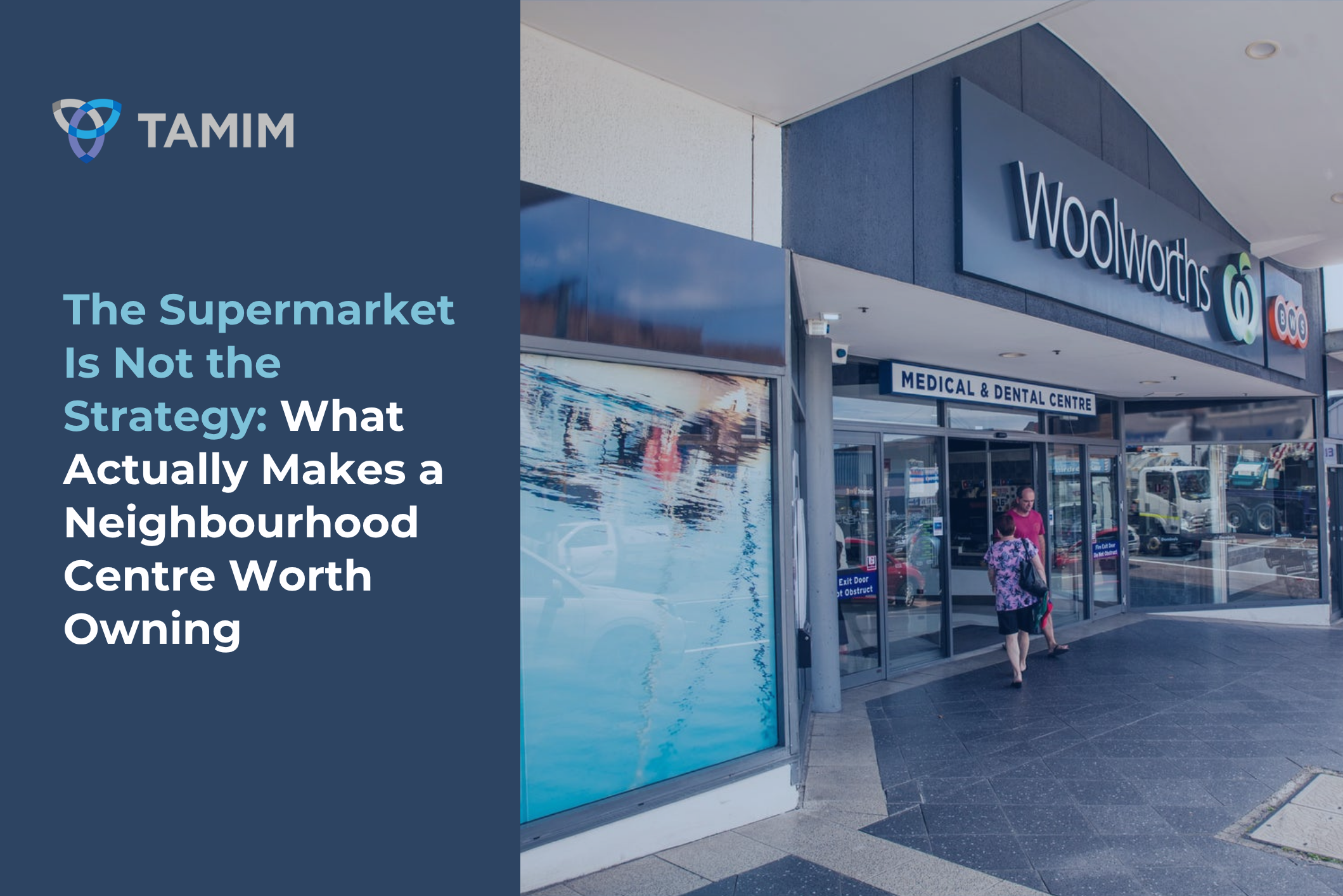
There is a comfortable assumption in Australian property investing that goes something like this. Put a full line supermarket at the front of a centre, sign a long lease, and the income takes care of itself. Groceries are non discretionary, people shop weekly, and the rest is detail.
The first part of that is true. The conclusion does not follow.
A supermarket anchor tells you what kind of income you are buying. It does not tell you whether that income is well positioned, whether the centre is the one shoppers will actually choose, or whether someone can build a competing offer down the road next year. Those are separate questions, and they are the ones that determine returns over a decade of ownership.
This matters right now, because the neighbourhood end of retail property has been performing well and the explanation usually offered for it is only half right.
The sector is leading, but not for the reason most people give
Dexus has just published its Australian Real Asset Review for the September quarter, and the headline number is striking. Retail has been the best performing sector in the MSCI Australian Wholesale Index since June 2024, with unlisted retail funds returning 10.8 per cent in the year to June 2026.
The usual explanation is scarcity. Nothing is being built, so what exists becomes more valuable. That argument deserves closer inspection, because it is true of one part of the market and not the other.
For large regional centres it holds. Construction costs have risen by roughly a third over five years, no new regional centres are planned in Australia, and what is happening instead is refurbishment and extension of what already stands. If you own a dominant regional mall, genuine new competition is unlikely to appear.
For neighbourhood centres it does not hold, and investors should be clear eyed about this. Dexus notes that new supply has largely consisted of smaller formats, with neighbourhood centres representing a significant share of completions in 2026 so far. Small format retail still gets built. A supermarket operator that sees a growing residential pocket will happily open a new store two kilometres from an existing one, because their catchment maths is about convenience and drive times, not about protecting somebody’s asset value.
So the honest position is this. If you are buying a neighbourhood centre, you are not buying protection from new supply. You are buying an income stream whose durability depends on things you have to assess directly.
What actually protects the income
Start with the nature of the income itself, because this part is genuinely strong.
A centre anchored by a supermarket, a pharmacy, a medical practice and the everyday services around them is not selling discretionary retail. It is selling the weekly shop, the prescription, the appointment and the haircut. Those categories carry on when households feel poor, which is exactly when discretionary retail suffers.
The current data makes the point. Dexus reports total retail spending grew 5.8 per cent over the year while consumer sentiment fell 13 per cent. Households are anxious, and yet grocery spending still grew 4.2 per cent, because people do not stop eating when confidence dips. They trade down within the supermarket rather than abandon it. That behaviour is the foundation of the whole asset class.
There is also less digital threat here than the headlines suggest. Online retail is growing faster than in store, but the categories moving online are overwhelmingly discretionary. You cannot get a filling, collect a script or pick up dinner on the way home through a screen. Proximity is the product.
That is the income. Now the harder part.
Position has to be earned, not assumed
If new competition can arrive, then the question that matters is whether shoppers will keep choosing your centre when it does. That comes down to a handful of unglamorous physical and commercial realities.
Location within the town centre, not merely within the suburb. A centre sitting on the main road with multiple street frontages captures passing trade that a centre tucked into a side street never will.
Access and parking. This sounds trivial until you watch how people actually behave. Convenience retail is a decision made in seconds. Undercover parking, easy entry and exit and generous bay ratios are not amenities, they are the reason someone turns in rather than driving on.
Depth of the non discretionary mix. An anchor plus a pharmacy plus a medical practice plus services generates multiple independent reasons to visit. A centre where the supermarket is the only real draw is a centre with a single point of failure.
Lease structure. Fixed annual rent reviews across the bulk of the rent roll deliver contracted income growth regardless of what the market does. A long anchor lease with options provides the base. The specialty tenancies around it need active management, and their expiry profile deserves genuine scrutiny.
Management capability. When a competitor opens nearby, the response is operational. Re-leasing, re-mixing, presentation, community engagement. Passive ownership does not answer a new entrant. Active ownership can.
None of these are exciting. All of them are the difference between a centre that keeps trading through a competitive shift and one that slowly bleeds foot traffic.
The pricing tells you something
If you want evidence that the market takes this income seriously, look at what buyers have been doing with their money in a difficult rate environment.
The cash rate sits at 4.35 per cent after the Reserve Bank held in June, following three increases earlier this year. Ten year bond yields are close to 5 per cent, and the major banks are split between another rise and a long pause, with most not expecting a cut before 2027.
Against that backdrop, retail capitalisation rates held firm through the quarter. The value of these assets did not fall away even though the safe alternative return was elevated. That is defensive behaviour, and it is more informative than any forecast.
Two further observations from the same report. Within retail, neighbourhood centres now trade at tighter yields than regional centres, which is investors paying up specifically for grocery anchored, defensive income. And direct property valuations have remained far less volatile than listed markets, with unlisted property returning around 9.7 per cent over the year in a steady line while listed property trusts swung 13.7 per cent in a single quarter. For an investor who wants income they can plan around, that difference in behaviour is the point rather than a technicality.
Transaction volumes are thinner, down about 20 per cent, so this is not a market where everything is clearing easily. The deals that are happening are landing on the assets with the most reliable income.
How a long term investor should think about it
The useful question is not whether rates will fall. It is whether the income can be relied upon through the cycle, and whether this particular asset is the one the catchment will keep choosing.
That reframing matters because it changes what you examine. A scarcity thesis invites you to buy the category. An income and position thesis forces you to assess the specific asset, its frontage, its parking, its tenant mix, its lease expiry profile, its catchment, and the capability of whoever manages it. The second approach is harder work. It is also the one that survives contact with reality, including the reality of a competitor opening nearby.
For long term investors, the practical conclusion is that supermarket anchored retail can be a genuinely defensive holding, and that the defensiveness comes from the income and the position rather than from an absence of competition. Anyone selling the category on scarcity alone is selling an argument that does not apply evenly across formats.
The risks, stated plainly
Lease expiry is the first. A long anchor lease can distract from a much shorter weighted average lease expiry across the specialty tenants, where income churns and vacancy can open up. Clusters of expiries falling in the same year are worth identifying before purchase rather than after.
Vacant space and value add components carry leasing and development risk. Where a centre has empty tenancies or an undeveloped pad earmarked for future income, that income is a forecast rather than a contract. It depends on securing a tenant and sometimes on planning approval, and neither is assured.
Illiquidity is a real constraint. Direct, unlisted property does not offer the daily exit of a listed trust. Capital can be committed for years, which matters particularly for retirees and self managed super funds who may need access to it.
The consumer can weaken further. Sentiment is already down 13 per cent, and while grocery spending is resilient, even non discretionary demand softens at the margin if unemployment rises. Discretionary specialty tenants feel that first.
And rates cut both ways. Higher for longer supports the case for reliable income, but it also caps the prospect of capital growth from falling yields and keeps borrowing costs high for any geared structure. Treat any property argument that quietly depends on rate cuts with suspicion, because that assumption has not been rewarded this year.
Tamim Takeaway
Supermarket anchored retail has been the best performing corner of Australian property, and the reason is worth getting right. It is not that these centres cannot be replicated, because at the neighbourhood end they demonstrably can. New small format supply is still being delivered, and a competing store can open nearby.
What actually does the work is the quality of the income and the strength of the position. Groceries, pharmacy, medical and everyday services keep trading when households tighten up, as this year’s data shows plainly. And the centres that hold their catchment are the ones with the right location, the right access, a deep non discretionary tenant mix and an owner willing to manage them actively.
For long term investors, the lesson is to stop buying the category and start assessing the asset. Ask what is being built nearby. Ask when the specialty leases expire. Ask whether the parking works. Those questions are less satisfying than a broad thesis about scarcity, and they are considerably more useful, because they are the ones that determine whether the income is still there in ten years.
This week’s reading list highlights the key forces shaping markets as investors balance improving economic data with a rapidly evolving global landscape. Cooling inflation, resilient business conditions, and the start of earnings season have helped support market sentiment, while energy prices, central bank decisions, and geopolitical developments continue to influence the outlook. In Australia, steady business activity reflects the economy’s underlying resilience despite ongoing uncertainty. Longer-term themes, including the transition to new energy sources, also remain firmly in focus as governments and businesses invest in future growth. Together, these articles provide valuable perspectives on the macroeconomic trends, market dynamics, and structural changes that are likely to influence investment decisions in the months ahead.
Large cap investing is rarely about finding the most exciting story in the market. More often it is about working out what is already priced in, what is being underestimated, and whether the business can keep compounding through the noise. Every so often the market hands you a case where those three questions pull in different directions. Australia’s largest gold miner is one of them right now.
Consider the setup. Gold has just been through one of the most remarkable runs in its history. The metal peaked above 5,500 US dollars an ounce in late January 2026, having traded near 2,700 dollars only eighteen months earlier. Even after a substantial correction, it was changing hands around 4,100 dollars an ounce this week, still far above where it sat a year ago. For a gold producer with costs largely fixed in Australian dollars, that is close to the best operating environment the sector has ever seen.
And yet Northern Star Resources (ASX: NST) shares have gone from a high near 32 dollars in early March to around 19 to 20 dollars in recent sessions. The stock has underperformed the broader market by a wide margin over six months, even while it remains up over a year. The commodity cooperated. The company, by its own admission, did not fully capture it.
That gap is worth understanding, because it is where the investment question actually sits.
What happened to the production
The plainest version of the story is a guidance miss.
Northern Star entered the 2026 financial year guiding to 1.7 to 1.8 million ounces of gold sold at an all in sustaining cost of 2,300 to 2,700 Australian dollars an ounce. On 13 March 2026 it revised that materially lower, to above 1.5 million ounces. The company confirmed on 2 July that it sold a preliminary 433,000 ounces in the June quarter, taking full year sales to 1,543,000 ounces, in line with the reset target.
So the year finished inside the revised guidance and well short of the original ambition. The Kalgoorlie production centre sold 844,000 ounces for the year, with 468,000 of those from KCGM. Yandal contributed 434,000 ounces and Pogo in Alaska 265,000.
Hitting a lowered bar is not the same as hitting the bar. The market understood the difference. Shares did rise on the July update, because the result removed lingering uncertainty about whether the reset number would be met, but that is a low form of good news. It confirms delivery against a promise that had already been downgraded.
For a producer of this scale in a gold market this strong, the reasonable expectation was that volumes would be the easy part. They were not.
The activist, and what it changed
The second development is governance, and it arrived quickly.
In early June, US activist investor Elliott Investment Management disclosed a stake worth more than one billion Australian dollars, around four per cent of the company. Elliott called for board renewal, a strategic review and improved disclosure, criticising operational execution, project delivery, capital project issues and what it considered inadequate disclosure relative to global peers.
The board responded with a leadership reset. On 2 July, Northern Star announced Suresh Vadnagra as incoming managing director and chief executive, effective 5 October 2026. Vadnagra currently heads Glencore’s nickel and zinc industrial assets, a portfolio of more than 25 operations across several continents, and was previously chief technical and projects officer at Newcrest. Stuart Tonkin steps down during the first quarter of FY27 after 13 years in the role. Chief financial officer Ryan Gurner becomes deputy chief executive immediately and will serve as interim chief executive in the gap. Separately, chairman Michael Chaney retires at the November annual meeting, with director Michael Ashforth succeeding him.
Two observations follow, and they point in opposite directions.
The first is that the appointment is well matched to the diagnosis. The criticism was about project delivery and operational execution. The board hired a technical and projects operator rather than a deal maker or a financier. That is a coherent response to the actual problem.
The second is that Elliott did not declare victory. It responded that a change of chief executive does not remove the need for broader change. Investors should read that as a campaign continuing, not concluding.
The business underneath
Set the noise aside and look at what is actually owned here.
Northern Star operates three production centres: Kalgoorlie and Yandal in Western Australia, and Pogo in Alaska. The asset base has been assembled through a long sequence of acquisitions and disposals over more than a decade, which is both the source of its scale and, arguably, the source of some of its integration complexity. It carries roughly a decade of reserves.
The balance sheet is genuinely strong. At 30 June 2026 the company held 1,255 million dollars in unaudited cash and bullion, up from 1,183 million at the end of March, with no corporate bank debt. That is a producer generating cash and holding it conservatively.
Capital management has been active rather than passive. Northern Star bought 129 million dollars of its own shares during the June quarter as part of an on market buy back of up to 500 million dollars. It has historically paid two franked dividends a year, totalling around 55 cents last year, which places the trailing yield near 2.7 per cent. For a cyclical producer that is a reasonable, if unspectacular, income contribution.
The single most important operational item is the KCGM mill expansion. After a three year construction period the project remains on schedule, with commissioning targeted for early FY27, and consolidation of the Gidji facility into the new Fimiston mill also tracking. This is the swing factor for the next two years. It is the project that determines whether the Kalgoorlie centre can lift volumes meaningfully, and it is also the project whose delivery record has attracted the most criticism.
What the market appears to be pricing
At around 19 to 20 dollars, the company carries a market capitalisation in the region of 27 to 28 billion dollars. Analyst consensus sits at a buy recommendation with a target price near 27 dollars, and consensus earnings per share for the coming financial year of roughly 1.20 dollars. On those numbers the shares trade on a mid teens earnings multiple, close to where the trailing multiple sits.
Note what that implies. The stock is priced neither for disaster nor for the mill expansion working perfectly. It is trading roughly 15 per cent below its 200 day moving average and far below both the March high and the analyst consensus target. A cooling gold price has driven fair value reductions across the sector generally, so this is not a Northern Star specific de-rating alone. But the underperformance against the broader market over six months suggests company specific scepticism sitting on top of the commodity move.
One possible interpretation is that the market is applying an execution discount. It has watched a guidance downgrade, an activist campaign and a chief executive transition inside five months, and it is declining to pay for a recovery it has not yet seen. That is not an unreasonable position for the market to take. The question for an investor is whether the discount is larger than the remaining problem.
There is also a takeover dimension that should be acknowledged without being overstated. Commentary has noted activist pressure directed at the possibility of a sale to a larger player, and the incoming chief executive’s sign on share grant contains a provision converting it to cash if a takeover occurs before the rights are granted. That is a standard protective clause rather than evidence of a live process, and no investor should build a thesis on it. It is context, not a catalyst.
Risks and counterpoints
The gold price is the dominant variable, and its sensitivity deserves to be spelled out rather than assumed. A producer selling roughly 1.5 million ounces a year sees revenue move by around 1.5 billion Australian dollars for every 1,000 dollar move in the realised Australian dollar gold price, before tax and before any change in costs. Most of that flows to the bottom line, because mining costs do not fall when the metal does. That is operating leverage, and it works in both directions. Gold is already roughly a quarter below its January peak. A further decline would compress earnings faster than most investors expect, and the currency matters too, since a stronger Australian dollar reduces the local price received.
The macro backdrop is not obviously supportive from here. Markets are currently pricing the possibility of further US rate increases into 2027. Rising real yields have historically been a headwind for gold, since the metal pays no income. An investor buying a gold producer today on the assumption that the metal simply resumes its climb is making a macro bet, and should be honest with themselves that they are doing so.
Execution risk has not gone away with a new appointment. The mill expansion still has to be commissioned and ramped up, and ramp ups are where mining plans most often disappoint. A new chief executive who arrives in October will need time, and there is an interim leadership period before he does. Thirteen years of institutional habit does not change on an announcement date.
Cost performance is currently an information gap. All in sustaining costs for the June quarter were still being finalised at the time of the July update and will be reported with the quarterly. Volumes tell only half the story. If costs came in at the upper end of the range, or above it, the margin picture is weaker than the ounces suggest.
The activist campaign may not deliver. Elliott has made its position clear, but activist campaigns frequently produce governance change without producing operational change, and a strategic review is not the same as a strategic outcome. Investors should not underwrite a re-rating on the assumption that pressure automatically converts into value.
Finally, there is portfolio complexity. A business built through many acquisitions across two countries, now also progressing the Hemi development, carries more moving parts than a single asset producer. That is a source of resilience and a source of things that can go wrong at once.
Investor implications
For long term investors, the practical question is not whether gold goes up from here. It is whether a large, well capitalised producer trading at a visible discount to consensus, with a fixable operational problem and a credible attempt underway to fix it, is being priced fairly for the risk that the fix takes longer than hoped.
Reasonable people will answer that differently, and the answer depends heavily on the view an investor already holds about gold itself. What should not be in dispute is the framework. Judge this on cost control and delivery of the mill expansion, not on the gold price, because the gold price is the part nobody controls and everybody is already watching.
One timing note matters here. Northern Star reports its June quarter results on 29 July 2026, which will bring all in sustaining costs for the year and, importantly, FY27 guidance. That guidance number will say more about the company’s confidence in its own operations than any announcement made so far this year. Anyone forming a view would be sensible to wait for it.
TAMIM Takeaway
Australia’s largest gold miner had an extraordinary commodity backdrop and did not fully convert it. Production guidance was cut in March and the year finished within the reduced target rather than the original one. An activist investor arrived with a billion dollar stake, and the board responded with a new chief executive, a new chairman and a technically credentialled leadership reset.
What the market may be missing is that the balance sheet never broke. Over 1.2 billion dollars in cash and bullion, no corporate bank debt, an active buy back and a franked dividend describe a business with a delivery problem, not a solvency problem. Those are very different conditions, and they are usually priced differently. Whether the discount now on offer is sufficient depends on execution over the next two years, particularly the mill expansion ramp up.
For long term investors, the lesson is broader than one stock. When a commodity cycle is generous, it flatters everybody, and the differences between operators are hard to see. When the commodity cools, those differences become the whole story. That is when quality of execution, discipline on costs and strength of balance sheet actually determine returns. The sensible approach is not to chase the metal or to time the cycle, but to ask which businesses will still be standing comfortably if the metal does nothing at all for two years.
This week’s reading list explores how markets are balancing improving economic conditions with ongoing uncertainty. Easing inflation, shifting interest rate expectations, and the start of earnings season have helped support investor sentiment, even as geopolitical developments and central bank decisions continue to influence market direction. Across global and Australian markets, resilience remains evident, with equities responding positively to improving fundamentals and renewed confidence in key sectors. At the same time, policymakers are adapting to the rapid pace of technological change while navigating the broader implications for productivity and economic growth. Together, these articles highlight the importance of looking beyond short-term market movements to understand the structural forces shaping investment opportunities. This week’s selection offers timely insights into the evolving relationship between monetary policy, market sentiment, and long-term growth.
There is a curious sameness to the equity conversation this year. Roughly every second idea that crosses the desk is a variation on the same theme: chips, models, hyperscaler capital expenditure, the coming compute supercycle, and the breathless assumption that everything else in the market is now a rounding error. Some of this is fair. A great deal of capital is being spent, and some of it will earn a return. But an investor who only owns the story everyone agrees on is not really diversified. He is simply concentrated in the consensus.
So this week I want to spend time on two businesses that have nothing to do with artificial intelligence, sit in unglamorous corners of the world, and have quietly done the one thing the market claims to value most: they have kept compounding. One runs the plumbing through which capital changes hands. The other makes the machines that bend and cut metal. Neither will ever headline a technology conference. Both are worth understanding.
What actually matters here
The point of this piece is not that these two are cheap. They are not, particularly. The point is that quality, capital discipline and a genuine structural tailwind can carry a business a long way without a single mention of a graphics processing unit. When the fashionable trade is this crowded, the useful question is not “what else might go up as much as AI”, but “what can I own that behaves differently, earns real cash, and is run by people who respect their own balance sheet”.
Both names below pass that test. Both also come with the honest caveat that the market has already noticed, so the entry point demands more thought than it would have two years ago.
Singapore Exchange: the toll booth on Asian capital
Singapore Exchange (SGX: S68) is the closest thing a listed market gives you to a regulated toll booth. It is the only integrated securities and derivatives exchange in Singapore, and it earns money at almost every stage of the journey a trade takes: listing, trading, clearing, settlement, depository, market data and index services. When activity rises, SGX clips the ticket more often. When it falls, the depository, data and connectivity revenue keeps arriving regardless. That is a good kind of business to own.
The recent numbers make the case better than any narrative. In the first half of financial year 2026, the six months to 31 December 2025, SGX reported net profit after tax of S$342.7 million, with adjusted net profit up 11.6 per cent to S$357.1 million and adjusted earnings per share of 33.4 cents. Net revenue, excluding treasury income, grew about 10 per cent. Securities daily average traded value rose 19.5 per cent to S$1.5 billion, a five-year high, and total securities traded value climbed more than 20 per cent. Perhaps most telling after two thin years, SGX recorded 15 new listings against 5 in the prior period, raising roughly S$3 billion. The listings drought appears to be ending.
This followed a full year to June 2025 that was itself the strongest since the exchange listed in 2000, with record net revenue of S$1.30 billion, up 11.7 per cent, and adjusted profit of S$610 million.
Two things give the business its character. The first is the currencies and commodities franchise, and within it the over the counter foreign exchange platform, now among the top three exchange-backed venues of its kind globally. Fixed income, currencies and commodities net revenue rose about 12.5 per cent in the half. In a world of currency volatility and shifting trade flows, a neutral venue that helps global institutions manage risk is a structurally advantaged place to sit. The second is capital discipline. SGX has committed to a progressive dividend, raising the quarterly payout by 0.25 cents every quarter through to the end of financial year 2028, and lifted the latest interim dividend by 22 per cent. Management continues to guide to organic revenue growth of 6 to 8 per cent, excluding treasury income, over the medium term.
There is also a growth option that costs shareholders very little to hold. SGX is building a Global Listing Board with Nasdaq to bridge the United States and Singapore markets, has introduced Singapore Depository Receipts over Indonesian underlyings, and has added cryptocurrency perpetual futures. None of these needs to work for the base case to hold. If one or two do, they are upside.
Amada: the machines behind the machines
If SGX is the plumbing of capital, Amada (6113 JP) is the plumbing of manufacturing itself. The Japanese company is one of the world’s leading makers of metalworking machinery: laser cutting machines, press brakes, turret punch presses, band saws and the software and automation that increasingly ties them together. If a factory somewhere is bending, cutting or shaping sheet metal into an electrical enclosure, an automotive part or the steel frame of a building, there is a fair chance an Amada machine is doing the work. Its revenue is spread sensibly across the developed manufacturing world, with Japan around 35 per cent, the United States around 25 per cent and Europe around 20 per cent.
The structural driver is one of the least glamorous and most reliable trends in global industry: there are not enough skilled workers to bend metal by hand anymore, and there never will be again. Ageing workforces and chronic labour shortages in developed economies push manufacturers towards automation whether they like it or not. Amada does not just sell a machine; it increasingly sells an integrated cell, with laser cutting paired to automated loading, storage towers and robotic handling. That is a stickier, higher-value proposition than a standalone tool, and it lands squarely in the reshoring conversation that trade policy keeps reinforcing.
The most recent full year, to March 2026, showed the cyclicality plainly. Revenue rose about 10 per cent to ¥437.4 billion, but net income fell 5.7 per cent to ¥30.6 billion and the net margin slipped to 7.0 per cent from 8.2 per cent as costs rose faster than price. This is a capital goods business, and capital goods businesses breathe in and out with the industrial cycle. What separates the good ones is what they do with the cash in between. Here Amada is behaving exactly as a shareholder would hope. It has been buying back stock and, importantly, cancelling the shares rather than parking them, with a programme to repurchase about 18 million shares, roughly 5.6 per cent of capital, for around ¥20 billion. This is the practical face of the Japanese governance reform that has drawn so much attention: a company deliberately shrinking its share count to lift returns on equity, alongside a steady dividend.
The valuation, said plainly
This is where a little discipline is required, because neither of these is a bargain hiding in plain sight.
SGX has re-rated strongly over the past eighteen months and now trades at close to record levels, on a price to earnings multiple in the mid twenties, with a forward dividend yield approaching 3 per cent once the progressive payout steps up. That is a full, though not absurd, multiple for a dominant exchange with pricing power and a rising payout. Amada, having roughly doubled from its lows over the past year, trades on around 30 times earnings with a yield near 2 per cent, which is a demanding multiple for a cyclical machine tool maker in a soft-margin year.
So the honest framing is this. You are not being handed either of these at a distressed price. You are being offered two high-quality, structurally supported businesses, with genuine capital discipline, at prices that already reflect a good deal of that quality. For a long-term investor, the question is whether the durability and the compounding justify paying up, and whether they earn their place precisely because they do not move with the same crowd that owns everything else.
Risks
For SGX, the obvious risk is that trading volumes are cyclical. The strong first half rode a wave of market activity and a listings recovery, and both can fade. Treasury income is sensitive to the level of interest rates, so a sharp fall in rates would take some earnings with it. The valuation leaves little room for a disappointment, and the newer ventures in crypto and cross-border listings carry execution and regulatory risk even if they are small today.
For Amada, the risks are those of any capital goods business. Demand is tied to industrial investment cycles, which are slowing in parts of Europe and China. Margins are under pressure from costs, as the latest year showed. The yen adds a layer of currency translation risk for offshore earnings. And at roughly 30 times earnings in a year of falling profit, the shares are priced for a recovery that the cycle has not yet delivered. Buybacks support the equity, but they do not repeal the cycle.
TAMM Takeaway
The AI trade may well continue to work. That is not the argument here. The argument is that a sensible global portfolio should own more than one idea, and that the businesses which quietly keep the world’s capital and the world’s factories moving are worth a place alongside the fashionable names, not instead of them.
Singapore Exchange is a dominant toll booth on Asian capital flows, with a recovering listings pipeline, a growing foreign exchange franchise and a progressive dividend. Amada is a global leader in the machines that automation and labour shortages make increasingly essential, run by a management team that is cancelling its own shares to lift returns. Neither is cheap, and both should be judged on quality and durability rather than on the hope of a bounce. That, plus a reasonable and rising cash return, tends to do more for long-term wealth than chasing the next variant of the trade everyone already owns.
The unfashionable virtue in this market is not contrarianism for its own sake. It is simply owning good businesses that behave differently, and paying attention to the price.
Disclaimer: Singapore Exchange Limited (SGX: S68) and Amada Co., Ltd. (6113 JP) are held in TAMIM portfolios as at the date of article publication. Holdings can change substantially at any time.