This week’s TAMIM Reading List unpacks the fine line between financial wisdom and deception. Learn how to protect your parents from scammers and why so many investors fall for financial traps. As crypto stirs controversy, Cliff Asness takes aim at the idea of a “Crypto Fort Knox,” while the president faces pressure over a bitcoin bailout. In a world where everything seems to be on sale, are discounts even real? We also explore radical ideas on how the mind emerges from matter, the lessons from 150 years of market crashes, and why government spending plays a crucial role in GDP. Dive in for insights on finance, philosophy, and survival in uncertain times.
The ASX continues to be a hub for fintech innovation, with digital payments playing a crucial role in reshaping financial transactions and business operations. As businesses transition toward cashless transactions, demand for seamless, efficient payment solutions continues to rise. Tyro Payments (ASX: TYR) has positioned itself at the forefront of this transformation, providing tailored solutions for small and medium-sized enterprises (SMEs). With a focus on technology-driven growth and financial discipline, the company seems well-placed to capitalise on the evolving payments landscape.
Strong Financial Performance
Tyro Payments (ASX: TYR) has solidified its position as a leading fintech player, reshaping payment solutions for small and medium-sized enterprises (SMEs) through technological innovation, strategic market expansion, and disciplined financial execution.
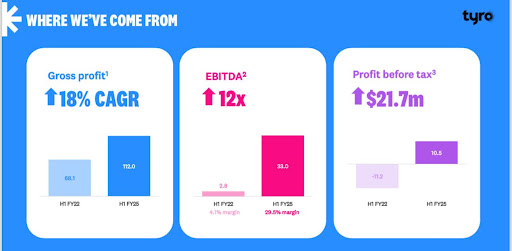
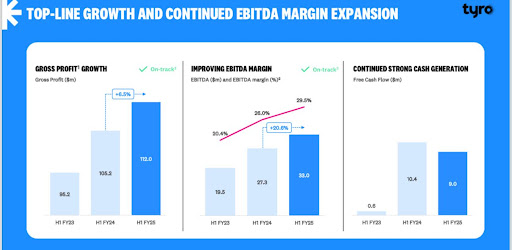
Tyro’s financial turnaround has been remarkable. The first half of FY25 marked its most profitable period to date, underscoring the company’s focus on operational efficiency and strategic growth. Since its IPO, Tyro has achieved an 18% compound annual growth in gross profit, rising from $68 million to $112 million, alongside 12x EBITDA growth, reaching $33 million. The company has also transitioned from an $11 million loss to a $10.5 million profit. These results highlight a well-executed strategy centered on disciplined cost management and targeted expansion into high-growth sectors.
(Source: Tyro Payments Investor Presentation)
Beyond these financial metrics, Tyro’s disciplined approach to cost control and margin improvement demonstrates a sustainable growth trajectory. The company has successfully optimised transaction processing costs, renegotiated key supplier agreements, and enhanced merchant retention, further strengthening its bottom line. This ability to drive profitable growth, even in a highly competitive market, reinforces Tyro’s position as a leading payments provider for SMEs.
Healthcare Payments as a Growth Engine
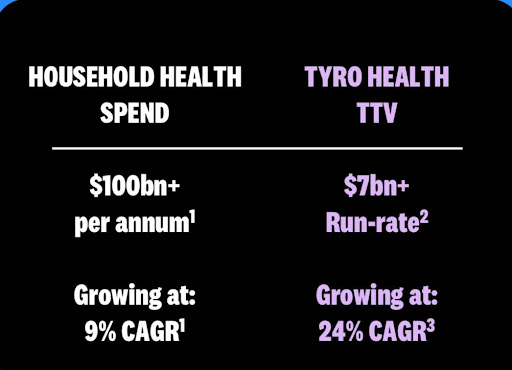
The healthcare sector is a key growth engine for Tyro. With Australia’s healthcare payments market expected to reach $100 billion annually, Tyro processes $7 billion, capturing a 7% market share. The company has outpaced industry growth with a 24% compound annual growth rate in healthcare transactions. Tyro’s edge lies in its omni-channel capabilities, seamlessly integrating online and in-person payment solutions. The company’s proprietary technology connects with over 120 payment providers, including private health insurers and Medicare.
(Source: Tyro Payments Investor Presentation)
In key healthcare segments, Tyro has established a strong presence, holding a 30% market share in general practitioners, 2% in allied health, and 1% in dental. These figures highlight a significant growth opportunity, particularly in underpenetrated sectors such as allied health and dental. Given the ongoing digital transformation in healthcare, Tyro’s ability to offer seamless payment solutions tailored to industry needs positions it for further expansion.
Additionally, as healthcare providers increasingly adopt integrated payment and billing systems, Tyro’s technology enables a frictionless experience for both practitioners and patients. By leveraging its deep integration capabilities, Tyro can continue to capture market share in this highly resilient and growing industry.
Expansion into High-Growth Verticals
Tyro is entering a new, high-potential vertical with a total addressable market of $5-10 billion. In collaboration with a market leader holding over 50% market share, the company aims to automate manual processes and enhance merchant value. This initiative is expected to generate $2-3 billion in transaction value over three years, with a gross profit potential of approximately $39 million and a target market penetration of 30-40%.
The decision to expand into this sector aligns with Tyro’s broader strategy of targeting industries where payments are still largely fragmented or inefficient. By providing a streamlined, automated solution, Tyro not only enhances the merchant experience but also unlocks significant long-term revenue potential.
Another key advantage of this vertical expansion is the opportunity for cross-selling. Tyro can leverage its existing merchant base to introduce new products and services, such as embedded finance solutions and working capital lending. This not only deepens customer relationships but also increases transaction volumes and recurring revenue streams.
Banking Services Growth Strategy
Tyro’s banking division is another significant growth opportunity. Currently contributing 7% of gross profit, the company aims to increase this to 20% through its partnership with Constantinople, an Australian fintech platform. The banking expansion strategy includes transaction accounts, cash flow lending solutions, term deposits, and the potential to settle $44 billion in processed payments through Tyro bank accounts.
Banking services represent a natural extension of Tyro’s core business. By integrating financial products with its payment solutions, Tyro can enhance merchant stickiness and generate higher-margin revenue streams. The company’s strong merchant relationships provide a unique advantage in cross-selling banking services, positioning it as a trusted financial partner for SMEs.
Moreover, as traditional banks continue to scale back their SME offerings, Tyro’s ability to provide fast, tailored financial solutions will become increasingly valuable. Whether through cash flow lending, deposit accounts, or transaction banking, Tyro has a significant opportunity to disrupt the SME banking landscape.
Competitive Advantage Through Technology
Tyro’s proprietary switch infrastructure gives it a cost advantage over outsourced solutions, enabling more efficient transaction processing. Unlike many competitors that rely on third-party processors, Tyro controls its entire payments stack, allowing for greater flexibility, cost efficiency, and improved service delivery. The company prioritises industry-specific payment solutions over generic offerings, ensuring a differentiated market position.
Additionally, Tyro’s focus on automation and AI-driven analytics further strengthens its competitive advantage. By leveraging data insights, Tyro can help merchants optimise their payment operations, reduce fraud risks, and improve transaction approval rates. These capabilities not only enhance the merchant experience but also contribute to higher customer retention and long-term profitability.
Financial Strength and Acquisition Strategy
With $155 million in cash and a robust balance sheet, Tyro is exploring capital management strategies, including potential share buybacks, subject to APRA approval. The company is also evaluating strategic acquisitions to enhance its technological infrastructure and market reach. One compelling opportunity is the acquisition of Smartpay (SMP). By processing SMP transactions on its in-house switch instead of through Cuscal, Tyro could unlock significant cost synergies, potentially adding $40 million in EBITDA.
(Source: Tyro Payments Investor Presentation)
The acquisition of Smartpay (ASX: SMP) would not only be accretive from a financial standpoint but also strategically beneficial. It would allow Tyro to consolidate market share, expand into new customer segments, and further strengthen its industry position. Additionally, by bringing Smartpay’s transaction volume onto its in-house platform, Tyro can drive additional cost efficiencies and revenue synergies.
Future Outlook
CEO, John David has outlined a clear roadmap focused on further penetration in the healthcare sector, expansion into new industry verticals, leveraging macroeconomic recovery in hospitality and retail, and advancing banking services to drive long-term revenue growth. With a combination of organic growth initiatives and potential strategic acquisitions, Tyro is well-positioned to capitalise on evolving market dynamics.
Looking ahead, the broader payments landscape continues to shift towards integrated solutions that offer greater convenience, security, and efficiency. Tyro’s ability to stay ahead of these trends by developing industry-specific payment and financial solutions will be critical in maintaining its growth trajectory. By continuously investing in innovation and merchant-centric offerings, Tyro can reinforce its position as a leader in the fintech space.
TAMIM Takeaway
The evolving payments landscape presents substantial opportunities for companies that offer tailored, technology-driven solutions. Tyro’s strategic focus on solving specific merchant challenges positions it well for sustained growth and potential market leadership. Trading at 5.3x EBITDA, Tyro appears significantly undervalued, with considerable upside potential. Given its previous takeover bids at $1.50+ per share in 2022, it remains an attractive acquisition target. From an investment standpoint, Tyro’s strong financial performance, technological advantage, and market expansion strategies suggest significant potential for long-term value creation.
Over the past fortnight, we’ve seen continued market skepticism toward the banking sector. With global recession fears, some dubbing it a potential “Trumpcession”, we’ve witnessed a correction in bank share prices. Westpac is on track to hit Morgan Stanley’s bearish target of $29.20, while CBA has pulled back 5.5% in just one week. However, rather than focusing on short-term market moves, savvy investors should be looking at the long-term prospects of Australia’s major banks.
Now, with CBA and Westpac covered, let’s turn our attention to Australia and New Zealand Banking Group (ASX: ANZ) and National Australia Bank (ASX: NAB).
ANZ: Diversified Strength, but Margin Pressures Ahead
ANZ’s biggest strength has always been its diversified operations, with a strong presence outside of traditional retail banking. The latest results reaffirmed this positioning:
Institutional banking saw impressive 13% loan growth, with corporate finance rising 6% in just the last quarter
Customer deposits increased 2% overall, with Suncorp’s newly acquired banking business growing at 5%.
The weaker Australian dollar provided a foreign exchange tailwind for the business.
However, ANZ’s growing pains have also surfaced:
Credit quality is worsening, with gross impaired assets rising to $1.90 billion, the highest level since 2021.
New Zealand operations saw home loan arrears spike by 75 basis points, in contrast to a slight improvement in Australia.
Net Interest Margins (NIMs) are under pressure, currently at 1.5% with expectations of further downside.
The bank’s CET1 capital ratio (a measure of financial strength) came in at 11.5%, slightly below market expectations. However, given the Suncorp acquisition and ongoing share buybacks, this was anticipated.
Final Verdict on ANZ
Strengths: Diversified operations, strong institutional banking, stable deposit growth. Weaknesses: NIM pressure, deteriorating loan quality in New Zealand.
NAB: A Turnaround Story Facing Headwinds
When we last covered NAB, it was positioned as a turnaround story, a bank attempting to navigate cost pressures and a high SME (small business) exposure. That story remains largely the same, but with additional hurdles.
For Q1, NAB reported:
Cash earnings of $1.74 billion, missing consensus estimates.
Net profit of $1.7 billion, down 2% from the previous quarter despite a 3% revenue increase.
Credit impairments rose to 1.43%, the highest level in two years, primarily from business lending stress.
While NAB’s SME focus has traditionally been an advantage, it’s now proving to be a double-edged sword. The bank is more vulnerable to:
Heightened deposit competition, leading to funding cost increases.
Higher impairments, as small businesses struggle with rising interest costs.
On the cost side, NAB is trying to rein in expenses:
The bank is targeting $400 million in productivity savings for FY25.
NAB expects operating expense growth to slow as efficiency measures kick in.
However, the market remains unconvinced. Shares fell 7% on results day, reflecting concerns about the balance sheet and the lack of a clear turnaround catalyst.
With all four major banks now reporting, here’s what we know:
CBA remains the most profitable and well-run, but trades at a steep premium. Investors should consider valuation risks before buying.
Westpac has struggled, but the market reaction may be overly harsh. A higher-risk proposition with potential long-term upside if execution improves.
ANZ offers a more balanced approach, benefiting from institutional strength and Suncorp’s integration. However, margin pressure is a risk.
NAB continues to face structural challenges, with higher impairments and funding costs weighing on sentiment.
Ultimately, CBA remains the best-managed bank but is priced accordingly. ANZ presents a reasonable alternative, while Westpac and NAB have more execution risks.
At TAMIM, we focus on businesses that are not only well-managed but also trading at attractive valuations. With interest rates shifting and macro uncertainties ahead, investors should remain selective when considering Australian bank stocks in 2025.
Disclaimer: Commonwealth Bank (ASX: CBA), NAB (ASX: NAB) and ANZ Bank (ASX: ANZ) are held in TAMIM Portfolios as at date of article publication. Holdings can change substantially at any given time.
The February 2025 earnings season has placed Coles (ASX: COL) and Woolworths (ASX: WOW) under the microscope, with both supermarket giants facing an evolving retail landscape. While Coles demonstrated strong execution and market share gains, Woolworths encountered cost pressures and operational disruptions that impacted profitability. However, despite their contrasting short-term results, both companies present compelling investment opportunities, each offering distinct risks and rewards for investors.
Coles: Strong Execution and Market Gains
Coles (ASX: COL) delivered a net profit after tax of A$576 million, maintaining stability in an economic environment where cost-of-living pressures have influenced consumer spending habits. The company’s supermarkets division achieved a 4.3% revenue increase, reflecting its ability to retain customers through value-driven promotions, digital transformation, and supply chain resilience. The decision to declare a 37 cents per share dividend, the highest in over five years, reinforces its commitment to shareholder returns.
Leveraging Supply Chain Strength and Market Share Gains
Coles successfully capitalised on Woolworths’ supply chain disruptions, which were impacted by industrial action, capturing an estimated $120 million in incremental sales. This underscores Coles’ ability to execute efficiently under pressure, reinforcing its reliability to Australian consumers. By strengthening its distribution networks and investing in automation, Coles has positioned itself as a more dependable option for both suppliers and customers during periods of market instability.
Digital Expansion Driving Future Growth
One of the key drivers of Coles’ ongoing growth has been its investment in digital retailing. The company reported a 22.6% rise in eCommerce sales, with a 55% increase in Coles App monthly active users. Innovations such as windowless Rapid Delivery and the full transition to automated customer fulfillment centers have streamlined its online order execution. As consumer demand for convenience continues to grow, Coles’ investment in digital and logistics infrastructure ensures it remains competitive in the fast-evolving grocery sector.
Margin Expansion and Cost Management Initiatives
Coles achieved an 88-basis-point increase in underlying gross margins, driven by operational efficiencies and AI-driven inventory management. The company’s ability to optimise stock availability and reduce markdown losses has strengthened profitability. However, cost pressures remain a risk, particularly as wage inflation and supply chain investments continue to weigh on operating expenses. The key challenge for Coles will be balancing its investments in long-term growth while maintaining short-term profitability.
Woolworths (ASX: WOW), despite reporting a 21% decline in net profit to $739 million, remains a dominant force in Australian retail with strong foundations for future growth. While the company faced short-term pressures from rising operational costs and supply chain disruptions, its leadership in digital innovation, eCommerce expansion, and customer engagement position it well for a rebound. Grocery sales grew by 2.7%, and its continued investment in convenience, loyalty programs, and supply chain improvements signal a commitment to long-term profitability. The company’s ability to navigate industry headwinds while maintaining its dominant market position highlights the resilience of its business model. With a $400 million cost-cutting initiative underway and ongoing enhancements to its supply chain efficiency, Woolworths is well-positioned to regain profitability as market conditions stabilise.
eCommerce and Digital Innovation as a Competitive Advantage
Woolworths continues to lead the industry in online sales, with eCommerce revenue reaching $4.7 billion, an 18.3% increase year-over-year. Its integration of MILKRUN and expanded on-demand delivery capabilities have positioned Woolworths at the forefront of digital grocery retailing. With 31% of online orders now being delivered within two hours, Woolworths is setting the industry standard for convenience, an area where Coles is still catching up. However, digital expansion comes at a cost, and Woolworths must ensure its online operations contribute positively to overall profitability.
Supply Chain Disruptions and Cost Challenges
One of the biggest setbacks for Woolworths this earnings season was the impact of industrial action, which resulted in $240 million in lost revenue and a $95 million EBIT hit. While these disruptions are temporary, they have exposed vulnerabilities in Woolworths’ supply chain resilience. Rising costs, including higher wages, increased logistics expenses, and elevated stock losses, have further pressured margins. In response, Woolworths has initiated a $400 million cost-cutting program aimed at streamlining operations and improving efficiency, though the full benefits may take time to materialise.
Changing Consumer Behavior and Competitive Pressures
Woolworths is also contending with a shift in consumer behavior. With household budgets tightening, more customers are cross-shopping between multiple supermarkets, leading to increased price sensitivity. This has forced Woolworths to invest heavily in discounting and promotional strategies, which have, in turn, compressed profit margins. While the company has taken steps to improve its value proposition, balancing competitive pricing with sustainable profitability remains a key challenge.
Investment Outlook: Two Different Paths to Growth
While Coles and Woolworths faced contrasting earnings results this season, both companies offer distinct investment opportunities. Coles currently appears stronger in execution, market share gains, and cost discipline, making it an attractive choice for investors seeking short-term stability. Woolworths, despite its earnings decline, retains strong long-term fundamentals, particularly in digital retailing, customer loyalty, and long-term growth strategies. If its cost-saving measures and operational improvements take effect, the company could regain profitability momentum.
For investors, the choice between Coles and Woolworths ultimately depends on individual risk tolerance and investment horizons. Coles offers a steadier trajectory with strong near-term execution, while Woolworths presents a potential turnaround opportunity for those willing to wait for operational improvements to take hold. A balanced portfolio approach could include both, capitalising on Coles’ resilience and Woolworths’ long-term upside.
A Quick Look at Other Retailers in the Sector
Beyond Coles and Woolworths, the February 2025 earnings season also provided insight into other key players in the retail sector. Harvey Norman (ASX: HVN) delivered a 39.7% profit increase, benefiting from AI-driven demand in consumer electronics, though its international expansion efforts faced setbacks. Super Retail Group (ASX: SUL), which owns brands such as Supercheap Auto, Rebel, and BCF, reported a 10% decline in profit due to rising operational costs and margin pressures. Wesfarmers (ASX: WES), despite shutting down its struggling online marketplace Catch, maintained stable performance, underscoring its ability to allocate capital effectively across its retail portfolio.
While the grocery sector remains a defensive investment, opportunities exist in discretionary retail, particularly for companies that are successfully leveraging digital transformation and cost efficiencies. At TAMIM, we continue to assess businesses based on their ability to generate sustainable cash flow, maintain competitive advantages, and navigate changing economic conditions. Coles and Woolworths both demonstrate resilience, with Coles currently positioned as the stronger performer in the short term, while Woolworths retains long-term upside potential through its leadership in digital innovation. For investors, the key decision lies in whether they prioritise immediate stability or are willing to back a longer-term recovery story.
The TAMIM Takeaway
Coles has reinforced its position as a stable, well-executed market leader, leveraging supply chain efficiency, digital expansion, and cost discipline to drive consistent growth. Woolworths, despite short-term challenges, remains a dominant force with strong eCommerce leadership and long-term recovery potential. For investors, Coles offers immediate stability, while Woolworths presents an opportunity for future upside. A balanced approach may provide the best exposure to Australia’s resilient supermarket sector. Execution, adaptability, and pricing power will remain the key differentiators for success in the evolving retail landscape.
Disclaimer: Coles Group Ltd (ASX: COL), Woolworths Group Ltd (ASX: WOW) and Wesfarmers (ASX: WES) are held in TAMIM Portfolios as at date of article publication. Holdings can change substantially at any given time.
This week’s TAMIM Reading List unpacks the shifting landscapes of health, technology, and geopolitics. Denmark’s Ozempic and Wegovy boom is reshaping everything from diets to infrastructure, while Microsoft’s quantum computing breakthrough could redefine what’s possible. As voters’ perceptions of the economy challenge the data, we explore whether the West has lost the war it once thought was won. Palmer Luckey emerges as a modern industrialist, and the accuracy of time itself is up for debate. Meanwhile, Gen Z’s reluctance to leave home raises social questions, air travel safety is under scrutiny, and Germany faces deepening economic dilemmas. Finally, take a moment to appreciate the breathtaking winners of the 2025 World Nature Photography Awards.







 Coles (ASX: COL) delivered a net profit after tax of A$576 million, maintaining stability in an economic environment where cost-of-living pressures have influenced consumer spending habits. The company’s supermarkets division achieved a 4.3% revenue increase, reflecting its ability to retain customers through value-driven promotions, digital transformation, and supply chain resilience. The decision to declare a 37 cents per share dividend, the highest in over five years, reinforces its commitment to shareholder returns.
 Woolworths (ASX: WOW), despite reporting a 21% decline in net profit to $739 million, remains a dominant force in Australian retail with strong foundations for future growth. While the company faced short-term pressures from rising operational costs and supply chain disruptions, its leadership in digital innovation, eCommerce expansion, and customer engagement position it well for a rebound. Grocery sales grew by 2.7%, and its continued investment in convenience, loyalty programs, and supply chain improvements signal a commitment to long-term profitability. The company’s ability to navigate industry headwinds while maintaining its dominant market position highlights the resilience of its business model. With a $400 million cost-cutting initiative underway and ongoing enhancements to its supply chain efficiency, Woolworths is well-positioned to regain profitability as market conditions stabilise.