Iress Ltd has emerged as a formidable technology provider in the wealth management and trading sectors, strategically positioning itself for significant growth through disciplined transformation and innovative AI-driven initiatives.
Company Overview
Headquartered in Australia, Iress is a market leader in wealth and trading technology, serving 2,000 clients with over 60,000 end users across Australia, the United Kingdom, Canada, and South Africa. The company has successfully completed a comprehensive transformation program, streamlining its business and focusing on its core competencies in wealth and trading technologies.
Financial Performance Highlights
The first half of 2025 demonstrated the company’s robust performance and strategic direction. Key financial metrics include:
– Revenue increase of 6.8% on a continuing business basis
– Adjusted EBITDA of $60.2 million, up 8.7%
– Margin expansion to 24.1%
– Interim dividend of 11 cents per share (50% franked)
The company’s financial discipline is evident in its impressive metrics, with adjusted EBITDA nearly doubling since the first half of 2023 and earnings per share tripling over the same period.
Strategic Focus and Market Position
Iress has deliberately narrowed its focus to two primary sectors: wealth management and trading technology. The company boasts market leadership in Australia and the UK, with remarkably stable client relationships. Over 90% of its top 20 clients have been with the company for more than a decade, and the business maintains an exceptionally low churn rate of below 2%.
The recurring revenue model is particularly strong, with over 94% of revenues being recurring, providing a consistent and reliable income stream that supports ongoing investment and innovation.
AI and Technology Initiatives
A significant portion of Iress’s current strategy revolves around leveraging artificial intelligence and data capabilities. The company has recently appointed a head of AI with extensive experience from AWS and Commonwealth Bank of Australia, signalling a serious commitment to technological innovation.
Key AI and technology initiatives include:
– Development of AI-driven wealth solutions for unadvised markets
– Launch of Iris Data Insights and Funds Flow product
– Continued development of retirement income solutions
– Building advanced data and AI platforms
The company sees substantial opportunities in the unadvised market, with approximately 12 million unadvised individuals in Australia and 25 million in the UK. Iress believes its trusted brand, deep industry expertise, and extensive data assets position it uniquely to capitalise on this market.
Potential Takeover Speculation
Management confirmed recent speculation about potential private equity interest, with Blackstone and Thoma Bravo showing interest at acquiring the company.
The company’s streamlined structure, strong financial performance, and innovative technology portfolio make it an attractive potential acquisition target and hence we believe a deal is likely.
Growth Strategy and Outlook
Iress has outlined an ambitious yet disciplined growth strategy focused on:
– Investing in existing wealth and trading businesses
– Developing new revenue streams through data and AI technologies
– Maintaining a strong balance sheet with low leverage
– Implementing a stranded cost program to generate $12-16 million in corporate cost savings
The company expects revenue growth to accelerate from 2-3% to 4-5% in the current year, with EBITDA margins improving to the mid-20s. Management projects a potential revenue growth trajectory of 6-8% over the coming years and Ebitda margins of 28%.
Trading Technology Advancements
In the trading sector, Iress has made significant strides, including the successful implementation of the ASX single open project. This achievement aligns the Australian market with international standards and provides a foundation for future technological enhancements.
The company is developing a new cloud-native Execution Management System (EMS) that will improve connectivity, interoperability, and client functionality across its trading platforms.
TAMIM Takeaway
Iress Ltd stands at an exciting inflection point. With a clear strategic vision, strong financial performance, and a commitment to technological innovation, the company is well-positioned to capitalise on growing opportunities in wealth management and trading technologies.
The combination of a robust core business, significant AI initiatives, and a disciplined approach to growth makes Iress an intriguing player in the financial technology landscape. Investors and industry observers will be watching closely as the company continues to execute its strategic plan.
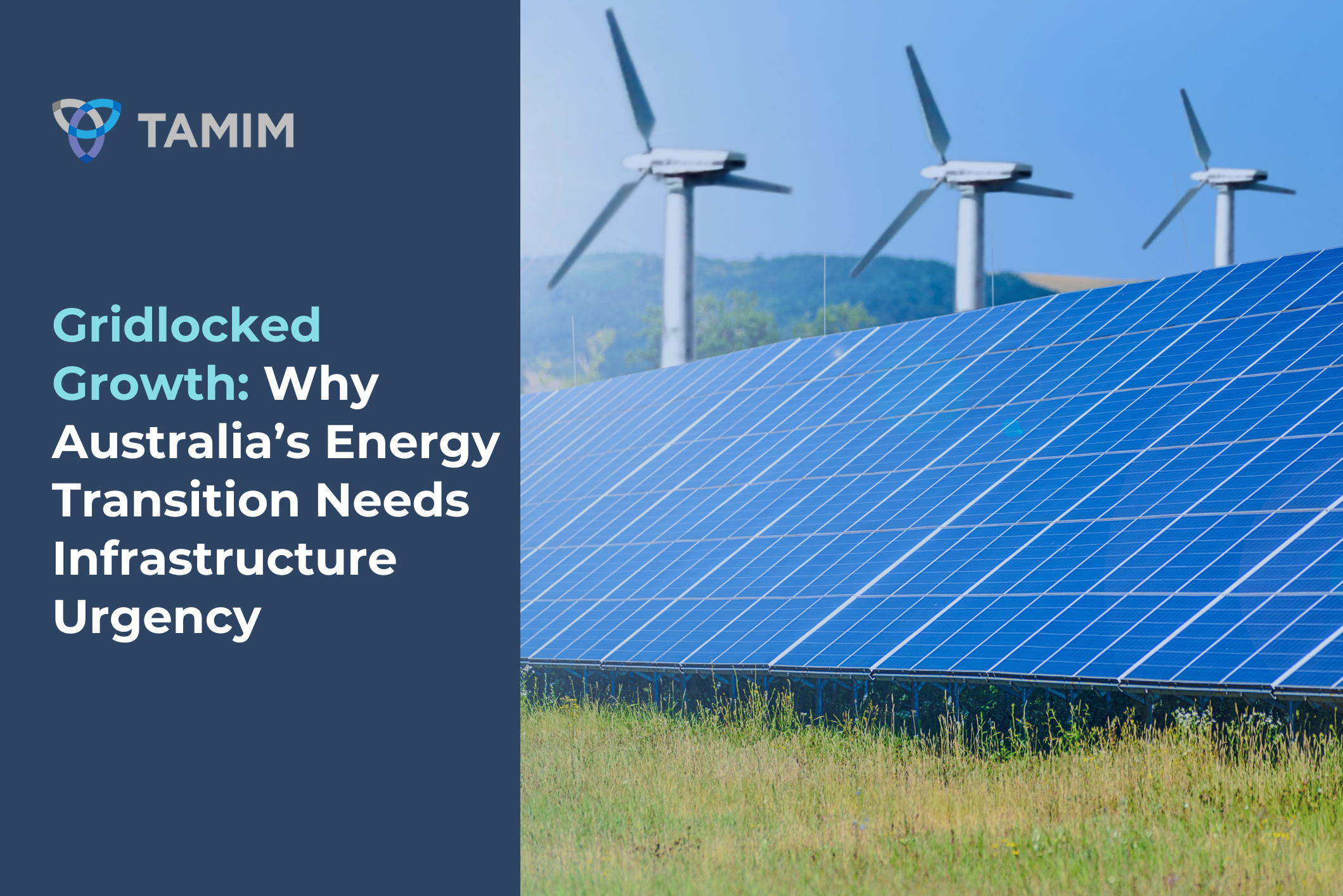
Australia is at a critical crossroads in its energy journey. On one side lies the global imperative to decarbonise, driven by climate goals and investor pressure. On the other, the need to ensure energy reliability and affordability for households and businesses. And now, layered atop this energy trilemma, is a digital revolution demanding ever more electricity, especially from hyperscale data centres powering AI and cloud infrastructure.
Yet, despite this complex backdrop, Australia is lagging in the one thing that binds it all together: energy infrastructure. Political indecision, policy fragmentation, and a failure to move quickly on transmission, storage, and firming capacity threaten to derail the transition. At TAMIM, we believe this creates a paradoxical investment opportunity. As governments struggle to deliver, private capital can step in where policy fails.
AGL, The Canary in the Decarbonisation Coal Mine
The recent results from AGL Energy (ASX: AGL) offered a sobering view of what happens when ambition outpaces capability. Despite its best efforts to reposition as a renewable energy champion, AGL’s underlying profit dropped 25% to $576 million. Its legacy coal assets remain critical to grid reliability, but they are ageing and costly. Meanwhile, renewable rollout and firming capacity have lagged.
Even with Grok Ventures’ activist pressure and a refreshed board committed to climate targets, AGL is struggling to execute. Its slow and costly pivot highlights the challenge of being a first mover without adequate infrastructure and regulatory support. The company faces the dual burden of maintaining outdated baseload assets while investing in new ones, a capital-intensive balancing act.
For investors, the lesson is clear: the transition cannot be achieved through good intentions alone. Infrastructure must lead ambition, not lag behind it.
Gas Paralysis
Victoria’s recent decision to delay or potentially cancel a critical gas import terminal is another example of infrastructure inertia. As coal retires and renewables ramp up, gas remains essential for peaking and firming power. Yet, instead of supporting this bridge fuel, political risk has led to a vacuum in new investment.
This decision puts added pressure on the east coast gas market, already tight and exposed to global LNG price shocks. It also increases the risk of blackouts during periods of low renewable output. The result? More expensive energy and declining reliability.
This is precisely where infrastructure investors should be paying attention. Players like APA Group, Origin Energy, Santos, and Jemena are positioned to benefit from gas infrastructure buildouts, especially if governments ultimately recognise the need for practical, not ideological, energy solutions.
Power-Hungry AI: Data Centres Are the New Aluminium Smelters
Australia’s energy story isn’t just about decarbonisation; it’s increasingly about digitisation. As AI adoption accelerates, data centres are becoming energy giants. According to recent estimates, data centre power consumption could triple by 2030.
Yet the grid was not designed for this. In places like Western Sydney and Inner Melbourne, where data centre clustering is occurring, the grid is already straining. Major US and Asian tech companies seeking to build in Australia are finding connection times delayed, capacity constrained, and project viability threatened.
This opens up massive opportunity. Companies involved in grid augmentation, storage, and long-duration firming, from listed infrastructure players to global renewables specialists, will be key to enabling this growth. Investors must also look globally for solutions. Japan’s restart of idle nuclear capacity, including Hokkaido Electric and Kansai Electric, offers a case study in how baseload capacity is being reborn.
The Opportunity, Invest Where Governments Are Dragging Their Feet
With government-led projects stalling or bogged down in red tape, listed infrastructure is increasingly where the action is. Investors can tap into companies building the digital backbone (Quanta Services), enabling energy redundancy (Engie, A2A), or developing critical gas, transmission, and storage capacity.
Global capital is flowing into the space. Private equity, sovereign wealth funds, and listed infrastructure vehicles are now hunting for scalable, cash-yielding projects in politically stable jurisdictions. Australia should be a prime target, if only the permitting and approval systems would catch up.
Locally, players like Transgrid, AusNet, and APA Group remain core watchlist names. Internationally, Quanta, Sempra, NextEra, and Japan’s nuclear operators warrant close attention. The shift from 100% renewable narratives to balanced, diversified energy mixes is finally gaining traction, with real implications for asset values.
The TAMIM Takeaway
When governments hesitate and policy drags, private capital steps in to solve the real-world bottlenecks. Whether it’s power to homes or energy for AI workloads, the global trend is clear: infrastructure, particularly energy, is not keeping pace with demand. In Australia, the challenge is especially acute, and for investors, that’s a glaring opportunity.
We continue to look for companies, locally and globally, that are solving infrastructure problems others are still debating. This includes grid operators, gas transporters, storage innovators, and even overlooked Japanese nuclear assets. As the energy transition becomes more complex and capital-intensive, we want to be positioned where investment meets necessity.
Investing in infrastructure isn’t just about bricks and wires. It’s about underwriting resilience, relevance, and return.
This week’s TAMIM Reading List is all about inflection points, moments when the ground shifts beneath our feet both literally and metaphorically. The AI industry faces its most significant legal challenge yet, with a record-setting copyright class action. At the same time, data centers and EV policy are reshaping the conversation around energy and infrastructure. A new road user charge for electric vehicles looms, while a teenage pilot prepares for a record-breaking global journey. Venus Williams proves age is just a number as she returns to the US Open at 45. Alan Joyce steps back into public view, and an earthquake in Victoria reminds us that change can strike without warning. From legal disruption to sporting defiance, this week’s stories explore ambition, innovation, and resilience.
Imagine you’re offered two investments: one is a company with strong financials and a clear market advantage, but a mediocre leadership team; the other is a company with average metrics but led by visionary operators who’ve repeatedly shown they can turn lemons into lemonade. Which would you choose?
At TAMIM, we’ve long championed the importance of backing not just businesses, but the people who run them. And two recent stories, one from the bleeding edge of AI, and the other from the world of venture capital and early-stage investing, bring this idea into sharper focus than ever.
Welcome to the Skill Stack Era: a time when adaptability, learning speed, and multi-domain competence in individuals are just as important as traditional business fundamentals. This isn’t just a theory, it’s becoming a necessity in a world changing faster than ever before.
Sam Altman and the Rise of the Infinite Learner
Sam Altman, CEO of OpenAI and one of Silicon Valley’s most recognisable names, recently made a pointed comment: the best way to remain employable in the AI age is to be extremely ambitious and adaptable. Those who can learn quickly, work hard, and navigate uncertainty will thrive, even as AI changes entire industries overnight.
Altman’s point isn’t just about employment, it’s about leadership and value creation. The kind of people who will win in the AI era are not just coders or engineers; they’re polymaths, entrepreneurs, and operators who can combine technical knowledge with business acumen, who iterate fast, and who aren’t afraid of pivoting. They stack skills like chess pieces.
From an investment standpoint, Altman is indirectly reinforcing a profound truth: back the jockey, not just the horse. OpenAI’s success isn’t solely a function of its models, it’s the result of Altman’s vision, network, talent-scouting, and leadership.
The lesson here? When evaluating businesses in a fast-changing world, assess the leadership stack. Are they domain experts? Can they hire well? Are they emotionally intelligent? Do they understand tech, product, finance, and strategy?
Enter Ramtin Naimi: The Unconventional Capital Allocator
On the other side of the spectrum is Ramtin Naimi, a little-known but increasingly influential early-stage investor whose fund, Abstract Ventures, has delivered spectacular results.
His background is fascinating, not from a traditional finance or VC pedigree, but from poker. He parlayed his instincts in reading people, understanding risk, and thinking probabilistically into a strategy of identifying founders with grit, resilience, and range.
Naimi’s approach focuses on backing people over ideas. He has famously written cheques to pre-product, pre-revenue founders, often based on little more than conviction in their ability to adapt, hustle, and execute.
He refers to it as backing “outliers”, people who don’t fit neatly into a resume box, but who exude that rare mix of intelligence, street smarts, and fire. Unsurprisingly, Abstract Ventures has backed companies like Figma, Ramp, Rippling, and Mercury, names that are now shaping the future of work and fintech.
The parallel to Altman’s thesis is striking. Whether building AI models or venture portfolios, the common denominator is people who build, those who can operate at the intersection of disciplines.
Investing in Human Capital: The TAMIM Perspective
So what does all this mean for us at TAMIM and for our investors?
It means we dig deeper into the leadership layer of every company we invest in. We’re asking:
Is this founder or CEO a learner, or a legacy operator?
Have they built and scaled before?
Do they attract talent?
Do they adapt fast, or cling to yesterday’s playbook?
We’ve found that the best performing companies in our portfolios often had something in common: highly capable, underestimated leaders with broad skill stacks.
Why Skill Stacking Is Now a Moat
In the past, companies built moats around products or IP. But in many industries, that edge erodes quickly. What lasts longer? Teams that can learn faster than competitors.
Skill stacking, combining multiple competencies into one individual or team, has emerged as a modern form of defensibility. Think of it as the difference between a chess grandmaster who only plays one opening vs. one who can pivot in real time.
In investing, that means finding founders who:
Know enough product to lead engineering sprints
Know enough sales to land anchor clients
Understand capital markets to raise efficiently
Can coach and build culture
It’s no longer about finding “the smartest” founder. It’s about finding the most versatile.
Investors Must Shift the Lens
In an era of noise, where AI models are released weekly, rates move unpredictably, and geopolitical shifts abound, what’s the signal?
People.
Investors can no longer afford to just read balance sheets. We need to read people:
Listen to how they talk about the future.
Track who they hire.
Follow how they pivot when challenged.
This soft data often precedes hard financial outcomes.
What to Look for in a Skill Stack Founder
Here’s a mental checklist we use:
Curiosity: Do they ask more questions than they answer?
Range: Can they talk product and people in the same breath?
Decisiveness: Can they make calls under uncertainty?
Adaptability: How have they responded to change historically?
Resilience: Are they still here after setbacks?
In a world full of hype, these traits are often the truest indicators of durable alpha.
Tamim Takeaway: From Products to People
Sam Altman and Ramtin Naimi represent two sides of the same coin, builders and backers who understand that in times of change, the only real edge is human.
At TAMIM, we’re doubling down on this insight. We’re looking past the noise, past the market fads, and finding companies where the leadership is the edge. Because at the end of the day, great people build great companies. And those are the companies worth owning.
We’re living through a once-in-a-generation reset. The world is increasingly volatile. Institutions are mistrusted. Alliances are shifting. Supply chains are being redrawn. And in the background, something far more permanent is taking place: the rebuilding of the physical and digital scaffolding of the global economy.
As investors, our job is to follow the money, but more importantly, to follow the cement trucks, the fibre-laying crews, the nuclear engineers, and the quietly compounding returns of long-duration assets that underpin the next chapter of global commerce. In this article, we lay out the case for global infrastructure investing as the ultimate antidote to today’s uncertainty, and highlight why we believe the companies literally rebuilding trust are where smart capital will want to be.
The Fractured Trust Economy
What happens when people stop trusting systems? They withdraw. From the media, from government, from tech platforms, from central banks. And eventually, from markets. We see signs of this everywhere: falling voter turnout, declining institutional confidence, fragmented online communities, “reshoring” of supply chains, and yes, even capital outflows from once-loved global funds.
But trust isn’t just philosophical. It’s physical.
When institutions break, people turn to what they can see and touch. In investment terms, that’s infrastructure. Whether it’s energy grids that actually deliver, ports that function despite geopolitical tension, or data centres built in stable jurisdictions to house critical information, the pendulum has swung from abstract valuations to concrete value.
The Return of Real Assets
We’ve argued before that we are entering an era where real assets will reassert their place in portfolios. Inflation fears, geopolitical de-risking, climate-driven spending, and now AI’s insatiable demand for power and connectivity are pushing capital toward infrastructure plays that offer three things: visibility, durability, and alignment.
Let’s unpack that.
Visibility: Infrastructure projects often come with long-term contracted revenues or regulated pricing. This is music to our ears as long-duration investors.
Durability: You can’t “disrupt” a port. You don’t just uninstall a data centre. These assets may be slow to build but are even slower to decay. They anchor portfolios.
Alignment: Infrastructure isn’t just about returns, it’s also about economic direction. When governments commit to AI buildouts, net zero targets, and regional defence resilience, they signal where long-term capital will compound. We listen.
Concrete: Rebuilding the Physical World
Across the world, the hard-hat economy is booming. In the United States, the CHIPS Act and Inflation Reduction Act are pushing hundreds of billions into reshoring and electrification. Europe, after years of underinvestment, is scrambling to secure energy autonomy and rebuild transit. Japan has quietly restarted its nuclear ambitions. Even Australia is seeing a pipeline of transmission, hydrogen, and logistics infrastructure proposals.
Take ports. Companies like CK Hutchison (HKEX: 1), which we hold in our Global High Conviction portfolio, operate 53 ports across 24 countries. They’re a microcosm of global trade. When we see China negotiating to include COSCO in a consortium with US financial backers for the Panama Canal, it confirms our thesis: the global economy may be fracturing politically, but it’s doubling down on shared hard infrastructure.
The same applies to clean energy transmission, intermodal transport hubs, and water management. As old systems creak under population pressures and environmental stress, new investment is not just an opportunity, it’s a necessity.
Code: Infrastructure is Digital Too
Infrastructure isn’t just steel and concrete anymore. Code is infrastructure too. The digitisation of everything, payments, supply chains, health systems, communications, has made data the new oil and power the new battlefield.
This is where our recent investments in Japanese power utilities come in. Companies like Hokkaido Electric (TSE: 9509) and Kansai Electric (TSE: 9503) own dormant nuclear plants, unloved assets that are suddenly valuable again as AI’s power demand surges. The market is waking up to the fact that you can’t have AI-scale compute without AI-scale electricity, and the fastest way to meet that demand isn’t building new solar farms, it’s restarting and upgrading what already exists.
Digital infrastructure is more than semiconductors. It’s the grid, the pipes, the redundancy. And just as 19th century empires were built on railways and canals, today’s empires will be built on data centres, energy corridors, and secure cloud networks.
Cables: The New Silk Roads
Let’s not forget the glue that connects it all: subsea cables, satellites, 5G towers, and terrestrial fibre.
When Sam Altman talks about needing hundreds of new data centres globally to support artificial general intelligence, it’s not just a Silicon Valley flex, it’s a capital call to the world’s infrastructure builders. We’re watching governments, telecoms, and private equity scramble to fund new “digital trade routes” between Asia, the US, and Europe.
For Australian investors, this opens up multiple angles. Yes, we can own the data centre operators and the contractors, but we can also own the utilities that feed them.
The Trust Dividend
There’s a reason why infrastructure has historically been considered “boring but brilliant.” It compounds quietly, throws off cash, and in times of volatility, becomes more valuable, not less.
We believe infrastructure will provide the “trust dividend” of the next decade. In a world where people trust less, they will pay more for assets that don’t move, don’t lie, and don’t default. That’s why infrastructure, particularly listed infrastructure, remains central to how we think about building wealth for the long term.
What We’re Doing
At TAMIM, we continue to tilt our global portfolios toward these enduring themes:
Japanese power utilities with restart optionality
Listed infrastructure giants like CK Hutchison, with flexible capital and strategic positioning
High-conviction plays on data centre buildouts and global digital infrastructure
Real-asset-backed businesses that benefit from geopolitical capital shifts
We are positioning not for the next quarter, but the next cycle. And this cycle, we believe, will be built, literally and metaphorically, on infrastructure that restores trust in the systems that move the world.
TAMIM Takeaway
Markets move fast. But infrastructure moves slow, and sometimes, that’s exactly the point. In a world craving certainty, physical and digital infrastructure provide durability, resilience, and cash flow visibility. That’s where we’re looking. Because when others chase momentum, we chase foundations.
Disclaimer: CK Hutchison (HKEX: 1), Hokkaido Electric (TSE: 9509) and Kansai Electric (TSE: 9503) are held in TAMIM Portfolios as at date of article publication. Holdings can change substantially at any given time.