This week’s TAMIM Reading List explores the tension between nostalgia, disruption, and control. Windsurf’s collapse is sending shockwaves through the start-up world, while governments attempt to regulate teen social media use. Time itself comes under scrutiny in a philosophical deep-dive, as does the truth behind Christian Horner’s dramatic sacking. We track the global ripple effects of a major earthquake and tsunami, reflecting on our vulnerability to sudden shocks. Meanwhile, Happy Gilmore 2 banks on familiarity but fails to deliver fresh substance, underscoring how even safe bets can fall flat. Whether seismic or subtle, each story this week captures moments when systems shift and certainty slips.
As the global energy puzzle grows more complex, investors are confronting a critical inflection point: the economic cost of the energy transition is rising, public patience is thinning, and traditional industrial titans are bearing the brunt of an increasingly politicised global order. The disconnect between energy ambition and energy reality is becoming clearer by the day, and for equity markets, it’s sparking a subtle but significant reshuffle.
Rio Tinto: A Canary in the Energy-Industrial Coal Mine
This week, Rio Tinto (ASX: RIO) posted its weakest earnings in five years and slashed its dividend. The headline culprit: weaker iron ore and aluminium prices. But dig deeper, and a broader story emerges, one that reflects the mounting costs and complexity of operating in an energy-constrained, regulation-heavy environment.
Rio’s aluminium division in particular highlights the stress. Aluminium smelting is one of the most energy-intensive industrial processes in the world. In a region like Australia, where coal-fired power is retiring and renewable generation is still scaling, maintaining stable and affordable energy has become a challenge, both financially and politically. What was once considered a straightforward industrial operation is now dependent on grid pricing, firming capacity, emissions policy, and community sentiment.
Meanwhile, capital intensity is rising across the board. Rio is pouring billions into decarbonisation, modernisation, and ESG compliance, all (arguably) necessary in the long run, but dilutive in the short term. Investors have rewarded other sectors with higher multiples in 2024/25, yet companies like Rio are being punished for their transitional growing pains.
This earnings result is more than just a cyclical dip; it is a reflection of how industrial economics are changing in real time.
Australia’s Transition Tension: Public Support on the Line
The broader context for Rio’s challenges is Australia’s energy transition narrative, which is itself under pressure. AGL, Origin, and other major energy players have raised concerns that the public’s support for decarbonisation is at risk due to steep electricity bills and declining grid reliability. These companies have quietly begun urging the government to be honest about the trade-offs: yes, the future is renewable, but the path there is neither straight nor cheap.
This week’s reporting season has crystallised that risk. Energy-intensive sectors are not just dealing with the carbon transition, they’re caught in a squeeze between regulatory uncertainty, infrastructure bottlenecks, and rising political expectations.
Tariffs and Trade Tensions: America’s Energy-Centric Reordering
Across the Pacific, a parallel dynamic is unfolding. Donald Trump’s latest remarks point to a second-term agenda loaded with protectionism: a blanket 10% tariff on all imports and 50% tariffs on key strategic products, including copper and EVs. These moves are not empty rhetoric, they’re part of a broader repositioning of US industrial and energy policy.
Even under Biden, the message is clear: the US wants to rebuild industrial capacity, rewire supply chains, and shore up energy independence. Tariffs and incentives are the new tools of choice. But this has implications far beyond America. Australia, as a major exporter of copper, lithium, and iron ore, will have to navigate a more fragmented and politically charged trade environment.
For a company like Rio Tinto, this environment cuts both ways. While near-term trade tensions are a headwind, the long-term value of its strategic resources, particularly copper, only increases as Western economies try to de-risk their supply chains from China.
Investing in the Age of Energy Realism
The dream of an effortless energy transition is running into the hard facts of engineering, economics, and electoral politics. For investors, this means a more selective approach is required.
We are focusing on three key themes:
Industrial resilience: Companies like Rio are being tested, but they are also building the infrastructure for tomorrow’s economy. The revaluation of heavy industry is not just about ESG, it’s about geopolitical relevance.
Cross-sectional volatility: Earnings dispersion is increasing. Some companies, like Nike and Centene this week, are blaming tariffs for weaker guidance. Others are adapting faster. This is fertile ground for active stock-picking.
The price of energy reliability: As power costs and security become central to policymaking, firms positioned to provide, store, or efficiently use energy will outperform. Conversely, energy-intensive sectors without pricing power face a tougher road.
TAMIM Takeaway
Rio’s result this week wasn’t just about falling commodity prices. It was a glimpse into the mounting pressures facing industrial businesses in a decarbonising world. The energy transition isn’t a straight line, it’s a jagged path filled with geopolitical flashpoints, infrastructure gaps, and rising costs.
Yet for investors, these pressures create opportunities. The repricing of industrials is already underway, and the companies that adapt, those that control their energy inputs, reshape their operations, or benefit from reshoring, will be the long-term winners.
In a world where the definition of energy security is expanding and the politics of trade are turning sharper, it pays to stay informed, nimble, and selectively contrarian.
There are moments in markets where the noise becomes so loud, it drowns out common sense. Tariffs, geopolitics, inflation, central banks, and a US Congress with a taste for budgetary excess. And yet, despite all the reasons to panic, a certain type of company is quietly thriving. Welcome to the age of “Trust in Rust”: the reindustrialisation of the global economy and the surprising strength of companies that build, move, power, and fix things.
At TAMIM, we’ve been positioning for this shift for some time. But recent developments, from the passage of the Big Beautiful Bill (BBB) in the US to signs of supply chain nationalism in China and Europe, suggest that the tailwinds are growing stronger. This isn’t a speculative tech play. It’s the resurgence of hard assets, infrastructure, and industrial muscle.
The Macro Shift: From Build Back Better to Big Beautiful Business
In Washington, the BBB may be an awkward acronym, but it signals a return to old-school capital spending. The new bill echoes aspects of the 2017 Tax Cuts and Jobs Act, which delivered some Laffer curve benefits to the US economy before being eclipsed by the more pork-laden Build Back Better. This time, the goal is clear: nudge private investment while reducing the burden of state-driven inefficiency.
Across the Atlantic, Europe struggles under the weight of debt and slow growth, expanding the definition of “defence spending” to include wind turbines and climate initiatives. Japan, meanwhile, quietly restarts its nuclear power fleet while inflation finally stirs.
In Australia, recent news from Woodside’s renewed control of the Bass Strait gas field echoes the theme, a recommitment to energy security and critical infrastructure. While our main investment lens is global, we’re always watching for domestic parallels that reinforce the thesis.
In short, the paradigm is shifting. Governments are realising that growth, resilience, and sovereignty require more than services and software. They require steel, ports, power grids, and real industrial capacity.
The Stocks We Trust
Here are three companies in our Global High Conviction (GHC) portfolio that embody this industrial renaissance.
CK Hutchison Holdings Ltd. (HKEX: 1)
CK Hutchison is not your typical infrastructure play. With 53 ports across 24 countries, telecommunications, logistics, and retail assets, it’s a listed infrastructure powerhouse with optionality built in. Earlier this year, we sold our holding when China blocked BlackRock’s bid for a stake in the Panama Canal, a signal that geopolitical risk was rising.
But now we’re back in. Why? Because the stock has corrected to around 10x P/E, and signs of a US-China thaw are emerging. COSCO, China’s state-owned shipping firm, has been invited to join a revised consortium for the Panama Canal asset, indicating that both sides want to de-escalate.
The potential windfall for CK Hutchison from the canal deal is estimated at $19 billion, a figure that nearly equals its entire market cap. That kind of optionality is rare. And because it’s listed, we can increase or reduce exposure as needed, unlike an unlisted infrastructure fund.
Santen Pharmaceutical Co., Ltd. (TSE: 4536)
Santen Pharma may not immediately scream “industrial,” but it fits our thesis perfectly. In a world of increasingly fraught US pharmaceutical regulation, we looked to Japan. Santen focuses on eye care, a niche but growing segment driven by ageing populations and rising diabetes rates across Asia.
It has 70+ products, a presence in 60 countries, and 50 million global users. Its R&D spend exceeds 10% of revenue, signalling a commitment to innovation. Competitors like Novartis and Bausch + Lomb may have scale, but Santen has geographic positioning and a clean runway.
More importantly, this is a company that makes things, ophthalmic drugs and devices, at scale and profitably. It’s a play on health infrastructure, demographic trends, and a non-Western path to global pharmaceutical leadership.
The Australian Angle: Woodside (WDS.AX)
While this is a global thesis, we’d be remiss not to mention what’s happening at home. In the last two days, Woodside Energy has resumed full operational control of its Bass Strait gas assets, part of a larger national trend to reassert energy independence. Woodside Energy (ASX: WDS) remains one of Australia’s key players in the global energy transition conversation. As the world grapples with the dual mandate of reducing emissions while maintaining energy security, companies like Woodside stand to benefit from a more pragmatic, diversified approach to energy. The company offers exposure to LNG, a critical bridge fuel in the shift from coal to renewables, especially in fast-developing economies across Asia. With robust free cash flow generation, a disciplined capital allocation strategy, and high-return project options in the Gulf of Mexico and Senegal, Woodside provides investors with both income and growth. Recent developments such as the Scarborough gas project are evidence of the company’s ability to execute large-scale, long-life projects that align with energy security and transition goals. While the stock has been under pressure due to lower spot LNG pricing and sentiment around fossil fuels, we believe that such pressures are transient. In a world where energy diversification and reliability are being reprioritised—especially in the wake of supply shocks—Woodside offers a resilient, cash-generative business with strategic assets and optionality in both conventional and transitional energy markets.
TAMIM Takeaway
The world is rediscovering that economic resilience isn’t built in the cloud alone. It’s built with ports, power plants, factories, and physical infrastructure. While speculative tech grabs headlines, the real gains may come from the so-called “boring” sectors.
We’re doubling down on this global pivot to making, building, and fixing. Whether it’s a Japanese nuclear restart, a Hong Kong logistics conglomerate, or a US-based digital disruptor getting its cost base right, the opportunity set is broad and increasingly compelling.
Disclaimer: CK Hutchison Holdings Ltd. (HKEX: 1), Santen Pharmaceutical Co., Ltd. (TSE: 4536) and Woodside (WDS.AX) are held in TAMIM Portfolios as at date of article publication. Holdings can change substantially at any given time.
In the rapidly evolving world of medical cannabis, one Australian company is quietly positioning itself as a potential industry leader. Bioxyne (BXN.ASX), a relatively young public company, is rewriting the playbook for medical cannabis manufacturing through a combination of strategic vision by its Founder and CEO, Sam Watson, regulatory expertise, and operational efficiency.
Founded through a reverse takeover in May 2023, Bioxyne represents a transformation from a dormant shell company to a sophisticated medical cannabis and psychedelics manufacturing powerhouse. The company’s journey began when its current CEO identified an opportunity to consolidate a struggling public entity with his existing medical cannabis business, Breathe Life Sciences. From our discussions with Sam, he came across as a young but highly motivated founder with ambitious growth aspirations – exactly what we are looking for in our portfolio companies.
The company’s breakthrough came in February 2024 when it secured a comprehensive GMP (Good Manufacturing Practice) manufacturing license in Australia – a critical milestone that set it apart from competitors. Unlike most cannabis manufacturers who focused on limited product lines, Bioxyne obtained certification to produce an unprecedented range of products, including flower, oils, gummies, MDMA, and psilocybin.
Manufacturing Excellence as a Competitive Advantage
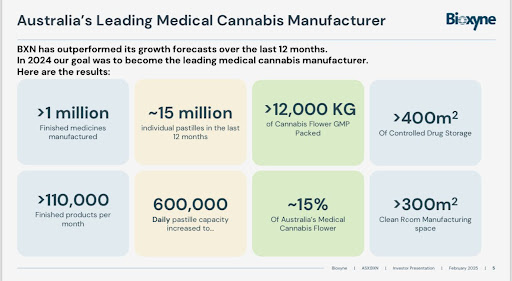
Bioxyne’s core strength lies in its manufacturing capabilities. We like to think of the company as the “Foxconn” to the industry. With fully automated production lines capable of processing up to 6,000 kilos of product monthly, the company offers something rare in the medical cannabis industry: scale, efficiency, and versatility. Their current market share stands at approximately 10-15% of the Australian flower packing market (estimated TAM $250 million in a $1 billion sales market), with revenues approaching $30 million annually in FY25. They currently service over 100+ customers with each one generating in excess of $250k p.a.
Source: Bioxyne Shareholder Presentation
The company’s business model is elegantly simple. They primarily operate as a contract manufacturer for medical cannabis companies, charging per-unit fees for their sophisticated manufacturing services. This approach allows them to generate consistent revenue while minimizing the risks associated with brand development and direct patient sales. We think of BXN as a “Picks and Shovels” play to the sector, akin to Foxconn in China being the manufacturer for Apple products.
Strategic Global Expansion
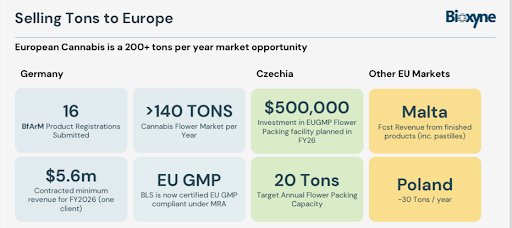
Bioxyne isn’t content with dominating the Australian market. The company has set its sights on international expansion, with particularly promising developments in Germany and the United Kingdom. In Germany, they’ve already secured a $5.6 million initial agreement to export cannabis flower products, tapping into a market that has recently seen significant deregulation and growth.
Source: Bioxyne Shareholder Presentation
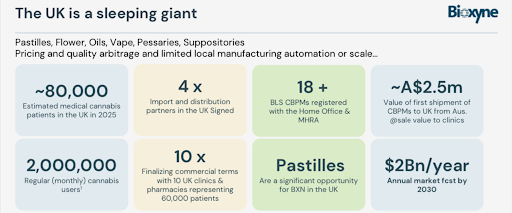
The UK presents another exciting frontier. Bioxyne is currently onboarding with nine of the top ten clinics and pharmacy businesses, positioning itself as a preferred manufacturing partner. Their ability to provide 12-18 months of product stability – compared to the typical 90-day limit for locally manufactured products – gives them a significant competitive edge. A recent $2.5 million contract win signals the start of an expanding opportunity.
Source: Bioxyne Shareholder Presentation
Financial Potential and Growth Trajectory
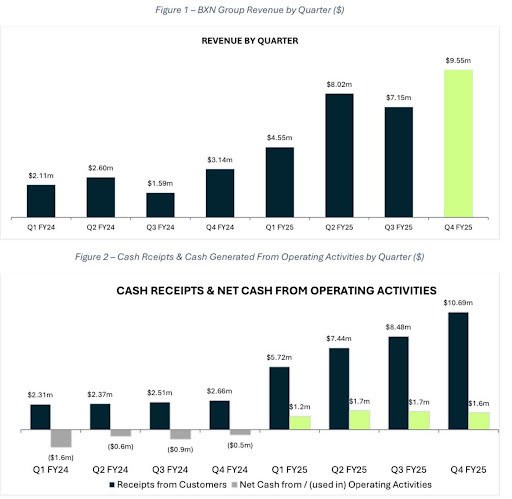
The company’s financial projections are compelling. FY25 sales of $29.3 million were achieved following 3 upgrades during the year. With a current run rate of around $45 million as a base case for FY26 and gross margins near 50%, we estimate FY25 Ebitda of $8.5 million growing to over $14 million in FY26. We also estimate free cashflow generation of $8-$10 million next 12 months. Bioxyne is aspiring to potential revenue of $100 million within two to three years if their current execution in Europe bears fruit. Their cost structure remains lean, with a monthly operational expense of just $500-600k, suggesting robust profitability and margin expansion ahead. Blue sky potential in FY27 is $30 million Ebitda if all the “Weeds” align (pardon the Dad jokes).
Source: Bioxyne Shareholder Presentation
Source: Bioxyne ASX Release
The leadership team, led by a CEO who owns 29% of the company, appears committed to strategic, measured growth. Rather than pursuing rapid, potentially dilutive expansion, they’re focused on strategic acquisitions and market consolidation. The company ticks what we look for from a founder led business. We do expect M&A in Europe to consolidate BXN market position and enable pricing power in future as they grow.
Beyond Cannabis: Exploring Psychedelics
Perhaps most intriguingly, Bioxyne is positioning itself at the forefront of the emerging psychedelics market. They’ve already signed their first commercial contract for MDMA capsules used in PTSD treatment, seeing significant potential in this nascent therapeutic space.
Challenges and Opportunities
The medical cannabis sector remains volatile, with historical investor skepticism due to previous market failures. Bioxyne must continue to differentiate itself by emphasising its unique regulatory advantages, manufacturing expertise, and clear strategic vision. Apart from regulatory risks, the market is growing fast, with Germany legalising in 2024 and already running over $1B in sales and eclipsing Australia.
A Unique Investment Proposition
What sets Bioxyne apart is its approach to medical cannabis manufacturing. Like Foxconn in electronics, they’re building a business model centered on becoming the go-to manufacturing partner in a complex, regulated industry.
Their competitive advantages are multifaceted:
– Comprehensive regulatory licenses
– Advanced manufacturing infrastructure
– Highly skilled operational team
– Ability to manufacture multiple product types
– Efficient, scalable production processes
Looking Ahead
As the medical cannabis and psychedelics markets continue to mature, Bioxyne appears well-positioned to capitalise on growing demand. Their strategy of focusing on manufacturing excellence, rather than direct consumer sales, provides a more stable and potentially more profitable approach to this emerging industry unlike many peers who are yet to turn profitable.
With projected revenues approaching $100 million in 2-3 years, a lean cost structure, and expanding international footprint, Bioxyne represents an intriguing opportunity for investors seeking exposure to the specialty pharmaceutical and medical cannabis sector.
The TAMIM Takeaway
BXN ticks all the boxes we look for in a company:
⁃ Industry leader
⁃ Founder led and alignment with shareholders
⁃ High growth and profitable
⁃ Strong cashed up balance sheet and Free cashflow generation.
⁃ Track record of under promising and over delivering.
⁃ Significant room for growth in a large TAM
⁃ Under the radar with no institutional ownership or broker research – yet!
⁃ Large discount to our 8 cents valuation next year and potentially 15 cents if they can achieve $100 million of sales.
This week’s TAMIM Reading List dives into industries, policies, and ideas undergoing transformation. GLP-1 drugs are challenging the life insurance industry’s traditional models, while off-premises dining has evolved from a temporary trend into an essential pillar for restaurants and consumers. We take a closer look at the origins of the Baby Boom and the powerful demographic and cultural forces it unleashed. On the geopolitical stage, we examine whether the U.S. is truly prepared for the next major conflict. Education and research also come into focus with a deep dive into the origins of the modern research university. Finally, clean energy advocates are racing to take advantage of tax credits before they disappear, underscoring the shifting dynamics of policy and innovation.




 CK Hutchison is not your typical infrastructure play. With 53 ports across 24 countries, telecommunications, logistics, and retail assets, it’s a listed infrastructure powerhouse with optionality built in. Earlier this year, we sold our holding when China blocked BlackRock’s bid for a stake in the Panama Canal, a signal that geopolitical risk was rising.
 Santen Pharma may not immediately scream “industrial,” but it fits our thesis perfectly. In a world of increasingly fraught US pharmaceutical regulation, we looked to Japan. Santen focuses on eye care, a niche but growing segment driven by ageing populations and rising diabetes rates across Asia.
 While this is a global thesis, we’d be remiss not to mention what’s happening at home. In the last two days, Woodside Energy has resumed full operational control of its Bass Strait gas assets, part of a larger national trend to reassert energy independence.