Most investors like to think they’re making decisions based on hard numbers. They pore over charts, debate valuations, and argue about whether the economy is heading for a soft or hard landing. But the truth is, the most important determinant of long-term investment outcomes isn’t always what happens in markets. It’s what happens inside the investor.
The ability to take risk and the willingness to take risk are often lumped together. They shouldn’t be. Understanding the difference between the two, and managing that relationship well, can be the difference between building wealth steadily and watching opportunities slip away in a fog of uncertainty.
Ability vs Willingness to Take Risk
Your ability to take risk is an objective concept. It’s determined by financial capacity, the strength of the balance sheet, liquidity, investment horizon, and stability of capital. A sovereign wealth fund can endure volatility that would sink a family office. A retiree has different parameters from a 30-year-old entrepreneur.
Willingness, on the other hand, is a psychological concept. It’s about how much risk an investor is comfortable with, emotionally and institutionally. It’s about what keeps them up at night.
A mismatch between ability and willingness is one of the most common and under-discussed sources of poor investment performance. A portfolio that could afford to be bold but plays it defensively often sacrifices returns unnecessarily. A portfolio that wants to be bold but lacks the balance sheet to back it up is even worse, that’s how permanent capital is lost.
Four Investor Archetypes
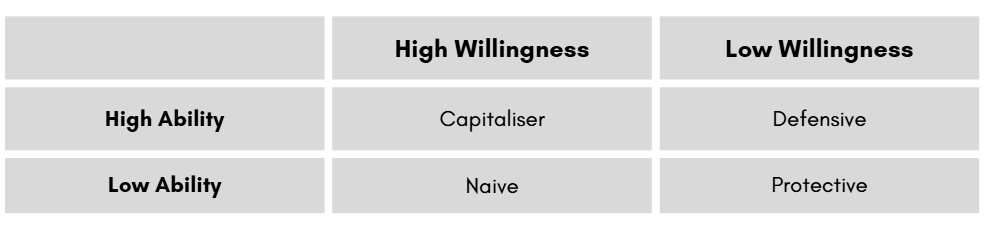
A useful way to visualise this is a simple two-by-two framework:
Capitaliser: These investors have both the means and the stomach to take on risk intelligently. Think well-funded, long-term investors who can handle periods of drawdown without blinking. This is the ideal position to be in, if the risk is taken with discipline.
Defensive: Financially strong but cautious. These investors accept lower return potential to sleep well at night. In bull markets they may lag, but they tend to preserve capital better in downturns.
Naive: The most dangerous quadrant. High willingness to take risk with little capacity to absorb losses. This is how speculative manias end badly.
Protective: Low ability and low willingness. These investors prioritise capital preservation and often underperform, but their conservatism reflects their circumstances.
The point isn’t that one quadrant is “right.” It’s that misalignment is costly. A defensive investor with high ability can afford to take more risk than they do. A naive investor is one shock away from disaster.
Why This Matters More Than Forecasting
Too many investment processes start with macro forecasts: where rates are heading, what earnings will do, which sectors are hot. But none of that matters if the investor can’t stick with the strategy when volatility arrives.
In reality, markets spend a lot of time doing one thing very well, making people uncomfortable. Prices rise too quickly for the cautious and fall too sharply for the bold. Without clarity on risk willingness, discomfort turns into reactive decision-making. Investors sell near the lows, buy near the highs, and call it “bad luck.”
The most successful investors and institutions share one trait: their investment strategy is calibrated to their real tolerance for risk, not the one they wish they had.
The Real Cost of Playing It Too Safe
There’s a certain romance to being cautious. The idea of “protecting capital at all costs” sounds responsible. And for some, it is. But excessive caution for those who can afford more risk can lead to something just as dangerous as loss: opportunity cost.
A portfolio sitting heavily in cash or ultra-defensive assets may protect against short-term volatility, but over the long run it quietly erodes purchasing power and wealth. In an environment of moderate inflation and rising productivity, staying on the sidelines can be an expensive habit.
There’s nothing wrong with being defensive, if that’s where your willingness lies. But it should be a conscious, strategic choice, not the accidental outcome of fear.
Volatility Is Not the Real Risk
Many investors treat volatility as the enemy. Sharp drawdowns feel painful, and traditional finance loves to package risk into neat measures like standard deviation or Sharpe ratios. But volatility is not the same as risk.
The real risk is permanent capital loss, the kind that comes from forced selling, liquidity mismatches, or overleveraged positions that can’t survive a shock. Volatility, on the other hand, is often just noise. A temporary mark-to-market movement means nothing if the underlying business or asset remains sound and the investor has the staying power to ride through the storm.
Ironically, some of the most conservative investors suffer the most from volatility precisely because they treat every fluctuation as a signal to act. Those with longer time horizons, better liquidity, and clear risk willingness can afford to sit still.
Externalities: When Volatility Becomes Dangerous
Volatility becomes dangerous not because of the asset itself, but because of the environment around the investor.
A fund that prices daily and faces redemptions cannot ride out a storm the way a sovereign wealth fund can.
A retiree relying on portfolio income to fund living expenses experiences volatility differently than a 25-year-old.
A board with political or career constraints may feel forced to “do something” when markets turn down.
These externalities mean that two investors can own the exact same asset and experience completely different levels of risk. Recognising this is critical to aligning strategy with reality.
Liquidity, Leverage, and Flexibility
When discussing risk willingness, liquidity and leverage are key levers.
Liquidity: Some illiquidity can be beneficial, it can anchor investors to a longer-term view. But too much can be dangerous if cash flow needs are underestimated.
Leverage: Modest, well-structured leverage can enhance returns for strong balance sheets. But it must be paired with realistic assumptions about market shocks and refinancing risk.
Risk willingness isn’t just about attitude. It has to be operationalised into portfolio structure.
Performance Isn’t About Beating Peers
A surprisingly common but flawed goal in investing is “beating peers.” It makes for good marketing but bad strategy. For pension funds, family offices, or long-term investors, the real objective is simple: meet obligations and grow capital prudently.
Beating a benchmark while failing to meet your funding needs is meaningless. Conversely, lagging a peer group but hitting your funding targets is a success. The scoreboard matters less than the scoreboard most people don’t see, the internal one that measures whether your capital is doing its job.
Rethinking Performance Measurement
Short-term performance is often a terrible guide to investment skill. A good year may just mean a market tailwind. A bad year may reflect prudent caution. The only meaningful way to assess a strategy is across a full market cycle, through good times and bad.
A portfolio that keeps up in bull markets but falls less in bear markets compounds more effectively over time than one that chases every rally but crumbles when volatility bites. The willingness to stay the course through a full cycle, rather than demand instant validation, is what separates disciplined investors from tourists.
Practical Investor Reflection: Which Quadrant Are You In?
Before making your next allocation decision, pause and ask yourself three deceptively simple questions:
What is my financial ability to bear risk? Consider time horizon, liquidity, obligations, leverage capacity, and funding stability.
What is my true willingness to bear risk? Think beyond slogans. How much drawdown could you genuinely endure without panic or forced selling?
Are these two aligned? If not, how should the strategy adjust? More diversification? Different liquidity mix? Less exposure to high beta assets?
This exercise sounds simple. But most investors don’t do it honestly. They anchor to market narratives instead of their own reality. The result is predictable: strategies they can’t stick to.
The Psychology of Comfort vs Opportunity
Markets punish indecision. When willingness is lower than ability, investors often build portfolios they can’t commit to emotionally. They start defensively, get jealous of rising markets, chase risk late, then retreat at the first sign of volatility.
This is not an investing strategy. It’s a behavioural trap.
On the flip side, investors with clear, aligned willingness and ability move deliberately. They know when to be bold, when to be patient, and when to do nothing. Their portfolios reflect strategy, not sentiment.
Case Study Logic (No Names Needed)
Consider two hypothetical investors with the same $100 million in capital.
Investor A is well funded, long horizon, but extremely cautious. They sit heavily in cash and low-yield bonds. Over 10 years, their real purchasing power erodes. They sleep well but sacrifice upside.
Investor B also has high capacity but is reckless, taking outsized bets on illiquid assets with leverage. When the cycle turns, liquidity vanishes, and losses crystallise.
Investor C aligns willingness and ability. They take measured risk, manage liquidity prudently, and stick with their process through cycles. Their results compound quietly over time.
Investor C wins not because they’re smarter, but because they’re honest about who they are.
The Power of Strategic Alignment
In the end, markets don’t reward courage or caution in isolation. They reward consistency. Investors who build strategies they can live with through the entire market cycle tend to outperform those constantly at war with their own risk appetite.
If your ability is high but willingness is low, it may be worth questioning what’s holding you back. If willingness is high but ability is low, the portfolio needs to be restructured before reality does it for you.
This alignment is not static. As circumstances change, liquidity, goals, age, obligations, so too should risk willingness. A disciplined process revisits these questions regularly.
TAMIM Takeaway
Markets don’t reward the bold or the cautious. They reward those who know themselves.
Understanding your willingness to take risk is not an academic exercise. It is the foundation of a resilient investment strategy. Forecasting, valuation models, and macro narratives matter, but they all sit on top of this psychological and structural bedrock.
The investors who thrive are not those who avoid risk but those who own their relationship with it.
Few companies are more deeply embedded in the Australian economy than Woolworths. It sits at the heart of everyday spending, riding the same tailwinds and headwinds that shape the national mood. When households tighten their belts, Woolworths feels it in the aisles. When economic optimism rises, it benefits quickly. After a challenging FY25, the supermarket giant has now released its Q1 FY26 sales results, and the story is one of quiet stabilisation. Not a roaring comeback, not a structural reinvention, but a methodical retail turnaround built on price, simplicity and execution.
That might not sound thrilling, but for long-term investors, this is exactly the kind of story that creates enduring value.
A Reset Year
Let us rewind to FY25. Woolworths reported group sales of $69.1 billion, a modest 1.7 percent increase. Group EBIT before significant items fell almost 15 percent, and net profit before significant items dropped 19 percent year on year. The drivers were clear. Wage inflation, price investment to protect market share, margin pressure in Australian Food and underperformance at BIG W all weighed on the bottom line. The company spent the year defending its position and setting the stage for a reset.
At the time, management outlined three strategic priorities. First, get it right for customers. That meant sharper value, more consistent availability and stronger convenience propositions. Second, simplify the way the business works, with a $400 million above-store cost-out target by the end of calendar 2025 and major investments in automated distribution. Third, unlock the full potential of the group through portfolio rationalisation and operational focus. The sale of MyDeal and integration of Healthylife into core operations were part of that plan.
In short, FY25 was less about results and more about building a platform to deliver them later. That kind of year rarely excites investors. But it often sets up the stories that do.
Early Signs of Traction
Q1 FY26 is the first real test of whether Woolworths’ plan is working. The 14-week period to 5 October 2025 showed group sales up 2.7 percent year on year to $18.5 billion. Australian Food, the engine room of the business, was up 2.1 percent overall and 3.8 percent excluding tobacco. Group eCommerce sales grew 13.2 percent, with On Demand orders increasing 39 percent. New Zealand Food continued its turnaround, with sales up 3.2 percent in local currency. Even BIG W, which dragged results in FY25, delivered modest sales growth of 1.0 percent.
Perhaps more telling than the raw numbers were the signals from customers. Woolworths’ Voice of Customer Net Promoter Score rose 3 points on the prior year and 4 points on the previous quarter. Value for Money VOC rose 5 points year on year. Prices excluding tobacco fell for the seventh consecutive quarter. These are not glamorous metrics. But they are the sort that tend to precede sustained volume improvements and, in time, margin recovery.
Average weekly traffic on Woolworths’ digital platforms grew to 29.3 million. More than 750 products now sit in the Lower Shelf Price program, which is growing units at double-digit rates. The company is delivering on its promise to make Woolworths feel more affordable again, not by flashy promotions but through persistent price resetting and strategic offers through Everyday Rewards.
This is the foundation of a retail turnaround. It does not happen overnight. It builds quarter after quarter.
Australian Food: Stabilising the Core
Australian Food is the beating heart of the Woolworths investment case. It generated $51.5 billion in sales in FY25 and remains the group’s primary earnings driver. FY25 saw margins squeezed as Woolworths fought to maintain price competitiveness while managing labour cost pressures. Q1 FY26 hints at the early stages of stabilisation.
Excluding tobacco, sales grew 3.8 percent, a notable improvement on FY25 trends. Comparable sales grew 1.6 percent, supported by increased items per basket and improving availability. Fresh food categories led the way, particularly Chilled, Meat and Fruit, while Long Life categories remained soft but stable. Tobacco remains a significant drag, declining over 50 percent year on year.
Importantly, price deflation is no longer creating panic. Fruit and vegetables moved into deflation due to higher supply of berries and avocados. Long Life categories saw modest deflation. For investors, this matters because it reflects an environment in which Woolworths is controlling the deflation rather than being whipsawed by it. It is using lower prices as a deliberate competitive lever, supported by its scale, distribution advantages and digital engagement.
Ecommerce penetration rose to 16.2 percent. The company’s On Demand delivery and MILKRUN offerings continue to expand rapidly. This is one of the clearest competitive advantages Woolworths holds over traditional retail peers and smaller independents. It is a moat that is expensive to build and difficult to replicate.
New Zealand Food: A Quiet Turnaround
New Zealand Food was one of the brighter spots in FY25, and that momentum has carried into Q1 FY26. Total sales grew 3.2 percent in local currency. VOC NPS improved by six points year on year, with meaningful gains in both store controllable metrics and online experience. Ecommerce penetration rose to 16.8 percent.
The rebrand to Woolworths New Zealand is progressing ahead of schedule. Everyday Rewards membership in New Zealand increased by around 250,000 members over the past year, with engagement improving significantly. This is a market that was once a drag on group results but is now beginning to pull its weight.
For long-term investors, the significance is subtle but important. A stabilised and growing New Zealand operation provides earnings diversification and reduces the reliance on the core Australian supermarket business to carry the entire group.
BIG W: From Problem Child to Possible Contributor
In FY25, BIG W posted an EBIT loss of $63 million. The business was squeezed by clearance activity, soft discretionary spending and operational complexity. In Q1 FY26, BIG W sales grew 1.0 percent, and gross transaction value rose 5.7 percent, supported by stronger performance in Clothing and Toys. Ecommerce penetration grew from 12.5 to 17.3 percent. BIG W Market, which is now integrated into the broader platform strategy, saw sales surge 148 percent.
This is not a turnaround story completed. It is a turnaround story beginning. Management is transitioning BIG W to an independent technology platform in FY26, aiming to drive better efficiency and flexibility. If the business can sustain mid-single digit GTV growth and gradually expand margin through mix and efficiency, it can shift from being a drag on group earnings to a contributor.
In a market where investors are fixated on Woolworths’ core supermarkets, this is an underappreciated lever.
B2B: The Quiet Performer
While less visible, the Australian B2B segment continues to perform solidly. Q1 FY26 sales increased 6.2 percent, driven by PFD Food Services and Export Meat. Export Meat sales surged over 30 percent due to strong international beef markets. B2B Supply Chain revenue excluding tobacco grew modestly, supported by the expansion of Primary Connect’s customer base.
This segment provides incremental earnings resilience and diversification. It is not a growth rocket, but in retail, stability has value.
Why This Matters for Investors
The Q1 results are not fireworks. They are not meant to be. Woolworths is not trying to reinvent itself as a high-growth retailer. Instead, it is aiming to execute better. After several years of cost pressure and consumer strain, that might be the smarter strategy.
There are three key investment implications.
First, stabilising the core. Australian Food remains the profit engine. As price investments mature and inflation stabilises, Woolworths can capture more operating leverage from its fixed cost base. Volume recovery tends to lag customer sentiment improvements, and early signs suggest that lag is now narrowing.
Second, digital scale matters. Ecommerce growth of 13.2 percent is not just a sales figure. It reflects a structural advantage built through years of investment. Competitors can offer promotions. They cannot replicate nationwide delivery and pickup infrastructure overnight. This creates a durable moat.
Third, portfolio simplification is starting to work. Closing MyDeal, integrating Healthylife and repositioning BIG W and Petstock are reducing noise and focusing capital where it counts. Investors often underestimate how powerful simplification can be in improving group returns.
The Next Test: Christmas Trading
Q2 is always the critical quarter for Woolworths. It covers the Christmas trading period, when consumers spend more freely and retailers battle for share of wallet. Management has already indicated that Woolworths Food Retail sales in Q2 to date are up 5 percent excluding tobacco. This is encouraging. It suggests that the pricing and value investments are translating into stronger momentum heading into the festive season.
This quarter will not only set the tone for FY26 earnings but also determine whether the market begins to re-rate Woolworths from a defensive stalwart back to a business with modest growth and improving margins.
Valuation and Market Positioning
Woolworths currently trades on a multiple consistent with its reputation as a defensive blue-chip. The market has largely priced in modest growth and stable earnings, not a material reacceleration. If the company delivers on its guidance of mid-to-high single digit EBIT growth in FY26, this expectation may prove too low.
Unlike some of the fast-growing but operationally volatile retail names, Woolworths has a strong balance sheet, deep operational infrastructure and structural digital advantages. This creates a classic setup. If management executes, there is scope for both earnings growth and multiple expansion over time. If not, the business still offers stable cash flows and a sustainable dividend.
For investors seeking optionality without excessive risk, this is an attractive mix.
The TAMIM Takeaway
Woolworths is not trying to be flashy, it is quietly rebuilding. The company is focusing on price and value perception to reconnect with its customers, using its digital scale to strengthen its competitive position and simplify its portfolio to sharpen execution. These steps are beginning to show tangible results in customer sentiment, sales momentum and operational clarity. The Q1 FY26 update is an early proof point that Woolworths is on the right path, but the more telling moment will come through the key Christmas trading period in Q2. If the current trajectory holds, FY26 could represent a meaningful inflection point, shifting the business from playing defence to delivering disciplined growth. In a high-rate, slower-growth environment, this kind of measured, fundamentals-driven turnaround is exactly the type of story that markets tend to reward.
Disclaimer: Woolworths Group Ltd (ASX: WOW) is held in TAMIM’s Equity Income IMA’s as at date of article publication. Holdings can change substantially at any given time.
This week’s TAMIM Reading List explores global tension, technological shifts, and the power of storytelling. Japan’s convenience stores are turning to offshore-controlled robots, while Australia’s submarine program promises to reshape the nation’s industrial base. In the US, debt levels are set to surpass even Italy and Greece, and the country’s EV policy reversal could play straight into China’s hands. Locally, WiseTech finds itself under regulatory scrutiny, and Brisbane students face exam chaos after being taught the wrong syllabus. Finally, we unpack how the structure of a story can directly shape the way we remember it, scientifically speaking.
This week’s TAMIM Reading List explores fragility, friction and trust at a global scale. America faces the possibility of population decline for the first time, while confidence in the judicial system reaches a historic low. A looming tariff war escalates tensions between China and the U.S., and Ukraine’s energy standoff with Russia triggers deeper economic pain. In science and tech, AI-designed proteins raise critical biosecurity concerns, while the collapse of TV’s “Golden Age” signals a shift in cultural appetite. We also dive into the legal battle over fat substitutes in protein bars, a story that blends biotech, branding and big business.
After nearly two years of debate, the government has unveiled a revised version of the superannuation tax reform, softening some of its most controversial elements. The good news for trustees: unrealised gains will no longer be taxed. The bad news: the measure still raises the effective tax burden for high-balance accounts and introduces new tiers, thresholds, and reporting complexity.
This is the most significant rewrite of superannuation taxation in more than a decade. Below, we unpack what has changed, how the new model works, and what it means for SMSF trustees navigating the new landscape.
The Policy in Context
The original proposal from early 2023 sought to double the tax rate on earnings linked to super balances above $3 million, with the key controversy being the inclusion of unrealised gains. Industry groups warned that taxing paper profits would penalise long-term investors, particularly SMSFs holding property or private assets. In response to sustained pressure from trustees, accountants, and superannuation bodies, the government has now modified the design to focus solely on realised earnings.
The revised policy takes effect from 1 July 2026, giving investors more time to prepare for a more predictable, though still progressive, tax structure.
The New Tax Structure Explained
The reworked framework now operates on a tiered system of taxation based on an individual’s Total Superannuation Balance (TSB) across all funds.
Tier
Balance Range
Tax Rate on Earnings
Tier 1
Up to $3 million
15 % (current rate)
Tier 2
$3 million – $10 million
30 %
Tier 3
Above $10 million
40 %
The rates apply only to the portion of earnings attributable to the balance above each threshold.
Importantly, these thresholds will be indexed to inflation, addressing one of the largest long-term concerns from earlier drafts. Indexation ensures that rising asset values and CPI growth will not gradually drag middle-tier retirees into higher-tax territory.
Unrealised Gains No Longer Included
Under the original model, the ATO would have taxed annual changes in asset valuations regardless of whether assets were sold. That feature has been removed entirely.
Tax will now apply only to realised earnings, including:
Dividends and distributions
Interest income
Rental income
Realised capital gains from the sale of assets
This change dramatically simplifies compliance and eliminates the cash-flow risk of having to pay tax on paper gains. SMSF trustees holding property or unlisted shares will no longer face the possibility of being taxed on notional growth.
It also restores one of the key principles of the super system, that long-term investing should not be penalised by short-term fluctuations in asset prices.
The $3 Million Threshold and Indexation
The $3 million threshold remains the cornerstone of the reform, but unlike the earlier draft, it will now rise annually with CPI. This means that over time, fewer Australians will drift into the higher-tax category simply due to inflation and compounding returns. Treasury expects that fewer than 100,000 individuals will be affected at launch, representing roughly 0.5 per cent of all super members.
For trustees approaching the threshold, the challenge will be to forecast whether future growth could push their balances into Tier 2. Proactive planning will become critical for anyone currently sitting in the $2.5 – $3 million range.
Treatment of Defined Benefit Schemes
The new draft retains special rules for defined benefit schemes, which primarily affect senior public-sector employees and politicians. These funds will use a formula that converts the projected lifetime pension entitlement into an equivalent account-based value for the purpose of determining which tier applies. Critics argue that these conversion factors may still underestimate the true value of such entitlements, effectively giving some defined-benefit members preferential treatment.
For SMSF trustees, however, the calculation is straightforward: their reported balances and earnings will be based on market valuations and actual realised income.
Implementation Timeline
1 July 2026: The new regime commences.
FY 2026-27: The first year in which higher tax rates apply.
FY 2027-28: The first assessment notices will be issued by the ATO based on lodged returns.
This extended timeline gives trustees and advisers nearly two financial years to adjust portfolios, rebalance liquidity, and update valuation processes.
Compliance and ATO Administration
The ATO will continue to calculate total balances using each fund’s annual return. For SMSFs, this means accurate reporting and valuation practices remain essential. Although unrealised gains are excluded, trustees must still ensure that:
Realised gains are reported correctly with substantiating documentation.
Withdrawals, contributions, and pension payments are accurately recorded.
Member balances are reconciled across all funds and accounts to avoid double counting.
The ATO will then issue an annual liability notice for those falling into Tier 2 or 3, much like Division 293 tax assessments today.
Liquidity and Portfolio Strategy
The removal of unrealised gains from the tax calculation reduces the liquidity pressure that many feared, but the higher rate on large balances still demands careful planning. Trustees should:
Maintain sufficient liquidity to meet tax obligations from realised income and sales.
Consider balancing high-yielding assets with long-term growth holdings.
Model future cash-flows under different asset-realisation scenarios.
Funds heavily weighted toward property or private equity should ensure that rental income or distributions can cover any additional tax rather than relying on asset sales.
How the Changes Affect Investment Behaviour
The shift to a three-tier system could influence how large SMSFs allocate capital.
Growth vs. Income: Some may shift from high-growth equities to income-producing assets to manage volatility and realised gains.
Diversification: Trustees may spread wealth across family members or structures to stay within lower thresholds.
Non-super vehicles: There may be renewed interest in discretionary trusts or investment companies as supplementary vehicles for wealth accumulation beyond super.
While diversification can help manage tax exposure, it must be weighed against CGT consequences, contribution caps, and the loss of super’s broader concessions.
Revenue Impact and Political Framing
Treasurer Jim Chalmers has described the final plan as a balanced, fair, and fiscally responsible measure, estimating it will raise around $2 billion a year once fully implemented. By scrapping the unrealised-gains component and introducing indexation, the government has neutralised the harshest criticisms from industry groups while still achieving its revenue goals.
Nevertheless, the measure reopens a philosophical debate about the purpose of superannuation, is it primarily a retirement-income system or a wealth-storage mechanism? For trustees, the answer shapes how they think about risk, yield, and intergenerational planning.
Key Implications for SMSF Trustees
Simplified Administration Excluding unrealised gains means valuations can revert to normal end-of-year standards rather than mark-to-market revaluations each June. Compliance workload and audit costs should fall relative to earlier expectations.
Liquidity Management Still Vital Although the most severe cash-flow risks are gone, trustees must ensure that the fund generates enough income to pay higher tax on realised earnings.
Estate-Planning Considerations For multi-member SMSFs, higher tax rates may influence when and how benefits are withdrawn. Balances approaching the Tier 2 threshold might be partially rolled into spouse funds to optimise household-level taxation.
Review of Contribution Strategies Future contributions that push balances above $3 million may yield diminishing tax benefits. Advisers are now modelling whether to cap super balances intentionally and redirect additional savings into alternative vehicles.
Communication and Reporting Discipline As the new rules bed in, trustees will need clear records of realised gains, distributions, and member transactions to avoid disputes with the ATO over taxable earnings attribution.
What Has Stayed the Same
Not all aspects of the system are changing.
The 15 % tax rate still applies to all earnings below the threshold.
Earnings in retirement (pension phase) remain tax-free up to the Transfer Balance Cap (currently $1.9 million per member, indexed).
Franking credits and deductions continue to operate as before.
The fundamental mechanics of super taxation remain intact; what differs is the additional layer of progressivity at the top end.
Remaining Grey Areas
Several technical questions remain under Treasury consultation, including:
How capital losses will offset gains across tiers.
Whether refunds of excess franking credits will be proportionally reduced for Tier 2 members.
How transitional arrangements will apply to asset sales straddling June 2026.
Trustees should expect detailed guidance from the ATO in early 2026 once consultation feedback is finalised.
Strategic Considerations Before 2026
With two years to plan, SMSF trustees should now:
Assess total balances across all funds and members.
Model exposure to the new tiers under realistic growth assumptions.
Review contribution strategies to avoid breaching the indexed thresholds.
Revisit asset-allocation for liquidity and yield sufficiency.
Engage advisers early to optimise structuring and estate-planning outcomes.
Early modelling can identify whether it is worth realising gains before the new tax year or deferring income to benefit from the lower tier in 2026.
The Bigger Pict!ure
By moving away from taxing unrealised gains, the government has restored confidence in the principle that superannuation should reward patient capital. However, the broader signal is clear: large balances are now a political target. The conversation has shifted from whether to tax super more heavily to how to do it efficiently.
SMSF trustees, particularly those with balances above $5 million, should view this as the start of a structural change rather than a one-off policy tweak.
The TAMIM Takeaway
The updated super tax reforms strike a more measured tone. By excluding unrealised gains, introducing tiered rates, and indexing thresholds, the government has avoided the most distortionary outcomes of its earlier proposal.
Yet, higher tax rates on large balances will still reshape behaviour within the SMSF sector. Liquidity management, contribution timing, and portfolio diversification are becoming just as important as asset selection.
For long-term investors, this reinforces an enduring truth: tax policy may shift, but discipline, prudence, and strategic planning remain the keys to compounding wealth effectively within super.