The global economy is standing on a precarious sandpile, one built from years of excess leverage, underpriced risk, and political complacency. With each new grain, be it a policy misstep, a rate shock, or a geopolitical surprise, we move closer to triggering a cascade.
Recent headlines, such as the US-China tariff pause, offer a reprieve from escalating tensions. However, this is not a signal that volatility is subsiding. Quite the opposite: the system is becoming more brittle, and the dislocations more frequent. As articulated in a recent macroeconomic outlook, the global economy is facing multiple simultaneous stressors, any of which could tip the pile.
At Tamim, we believe this era of continuous volatility is fertile ground for decisive investors. Over the next 3 and a half years (of the Trump Presidency), we expect repeated waves of fear and relief, repricing and recovery. This is not the time to be meak. It is a time for boldness, tempered by clarity, strategy, and deep research.
The Global Sandpile: Layer Upon Layer of Instability
John Mauldin recently described the world economy as a complex system where seemingly small changes can spark outsize consequences. The analogy of the sandpile is powerful: we have built global systems: financial, trade and monetary that appear stable until, suddenly, they aren’t.
Multiple stress points are developing:
Offshore US Dollar Liquidity: Eurodollar markets are increasingly strained as US fiscal dominance and Fed tightening crowd out foreign borrowers.
Trade Fractures: Despite this week’s tariff pause, the broader trend of deglobalisation and supply chain realignment continues.
Commercial Real Estate (CRE): Particularly in the US, CRE debt is rolling over into a higher-rate world.
Municipal and Sovereign Debt: Global public finances are deteriorating, with the US now running $2 trillion deficits in peacetime, a fiscal position that may become unsustainable under even mild stress.
This is not fear mongering. It is simply the reality of a system in which each fault line interacts with others in unpredictable ways.
Repricing and the Mirage of Stability
Markets are conditioned to expect reversion to the mean. But in systems under stress, the mean itself is shifting. What was once considered “normal” may no longer be relevant.
For example:
Yields are rising not from strength, but from disorder. A steepening US yield curve typically precedes recovery, but here it reflects a flight from duration amid inflation, fiscal fear, and geopolitical uncertainty.
Monetary policy has limited power to backstop growth. The Fed and other central banks are constrained by inflation risks, even as consumer and business confidence wavers.
Liquidity can vanish quickly. The velocity of money, once a quiet footnote, is now a flashing red light, warning of systemic slowing that can cascade quickly.
What this means for investors is simple: stability is not the baseline. Volatility is.
Volatility as a Feature, Not a Bug
Periods of economic tension often birth innovation and reallocation. This was true in the 1970s, the early 2000s, and again post-GFC. What we’re entering now is not dissimilar, a world where:
Mispriced assets are common.
Policy overreach and correction alternate.
Narratives change monthly.
Mauldin’s core message: the coming cycle will be jagged, non-linear, and filled with opportunities for those who can stay nimble and long-term focused.
At Tamim, we view volatility as the mechanism by which capital is transferred from the reactive to the prepared. Our role is to be in the latter camp.
Thematic Conviction Amid Disorder
We are applying this lens across our thematic portfolios. Where others see noise, we see:
Technology Repricing: AI, automation, and cloud computing continue to accelerate. Ýet valuations have reset, especially outside the mega-cap bracket. We are positioning into profitable, under-the-radar names where the market is yet to catch on.
Energy Transition: Australia’s shift towards a decarbonised economy is not optional. It’s inevitable. We continue to focus on the enablers, grid software, smart metering, storage infrastructure. Companies like Gentrack and Southern Cross Electrical remain well-placed.
Commercial Property Repricing: As Mauldin notes, CRE globally is repricing, particularly in office and retail. Yet repricing creates opportunity. We’re focusing on suburban, ESG-aligned office spaces with value-add potential.
Capital Rotation from Passive to Active: Benchmark-hugging may have worked in the liquidity-flooded 2010s. It won’t work now. We are already seeing capital flow to active managers who can navigate dislocation, not merely absorb it.
Macro Watch: US-China, Inflation, and the Political Cycle
The temporary truce in US-China tariffs is not the end of trade tension, it is a tactical delay. It reflects political strategy, not economic cooperation. As the US election cycle ramps up, expect more such blinks.
However, these pauses offer windows of clarity and pricing dislocations. Investors who can interpret these episodes not as direction, but as opportunity, will thrive.
The Fed, the RBA, and others are walking a tightrope. But history suggests the balance will tip. When it does, capital will flood into underloved sectors, likely triggering explosive rebounds.
Be positioned before that happens, not after.
TAMIM Takeaway: Opportunity Favours the Prepared and the Brave
In the next three years, we will likely see:
More market corrections
More major geopolitical or financial shocks
Shifting policy settings as governments grapple with fiscal pressures
Major moves in interest rates, both up and down
None of this should frighten disciplined investors. If anything, it should excite them. Such dislocations are where long-term returns are built.
Actionable insights for investors:
Don’t wait for the all-clear, invest on fundamentals, not headlines.
Keep powder dry, but don’t stay on the sidelines for too long.
Focus on companies with strong cash flows, scalable business models, and structural tailwinds.
Stay light on leverage, high on agility.
Use volatility as an entry point, not an exit excuse.
The next decade will be shaped by those who step into complexity with clear strategy and strong hands. This is the time to think boldly, act patiently, and embrace the dislocation as the birthplace of value.
This week’s TAMIM Reading List explores how we think, how we age, and how we shape the world around us. We begin with a debate at the heart of neuroscience: what is consciousness, and where does it come from? From there, we spotlight the surprising brain-boosting effects of gardening, nature’s antidote to cognitive decline. On the cultural front, Nicolas Cage’s wildest roles reveal a surprisingly coherent artistic vision. In economics, rising tariffs are quietly creeping toward the US consumer, while a $200B philanthropic bet raises bold questions about legacy and risk. We examine Sinofuturism’s techno-cultural lens on Asia’s future, and ask if a single line of code might just fix Google. Across science, art, policy, and platforms, this week is about futures being reshaped.
This week’s TAMIM Reading List captures a world in flux, where technology, money, ethics, and identity intersect in surprising ways. Google is quietly shifting its role from search engine to answer gatekeeper, while North Korea is reportedly gaming AI job interviews to infiltrate tech firms. As AI accelerates, thought leaders warn that protecting human creativity may soon be as important as protecting natural resources. In the U.S., a stark split in consumer behaviour emerges between the wealthy and the rest. Meanwhile, Elon Musk’s political transformation adds fuel to an already polarised moment. For balance, we finish with dogs, pills, and Aaron Judge’s improbable year.
Introduction: Investing in the Utilities of Tomorrow
In the final instalment of our Small Cap Energy Transition Playbook, we explore a vital but often overlooked enabler of the global shift to clean energy: software for utilities. Following our reviews of Southern Cross Electrical (infrastructure) and Energy One (trading platforms), we now turn to Gentrack (ASX/NZX: GTK), a small cap leader in billing and customer engagement software, positioned at the heart of energy sector digitisation.
As the global push toward decarbonisation accelerates, the transformation of utility IT systems has become critical. “Smart grid software,” “utility billing platforms”, and “digital transformation in energy” are more than just buzzwords, they reflect a generational shift in how power is delivered, priced, and managed. Gentrack offers investors exposure to the software spine of that transition.
Thematic Fit: From Ageing Systems to Agile Software
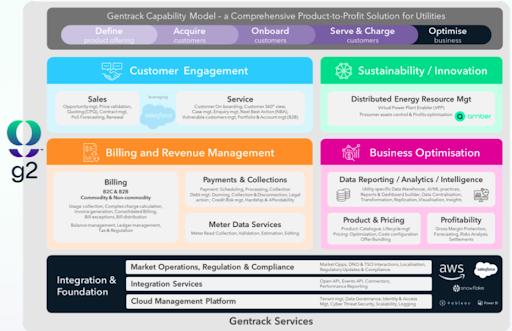
Gentrack is one of a handful of global software firms providing cloud-based billing and engagement solutions tailored to energy and water utilities. Why now? Because the industry is experiencing a once in a generation churn event: legacy platforms, often built over 30 years ago, are no longer equipped to handle the complexity of distributed energy, dynamic pricing, or customer centric services.
A key catalyst: SAP, the market incumbent, is retiring its on-premise billing stack by 2027. Utilities globally must transition to SAP HANA or choose alternative providers. This has created a spike in RFPs and tenders, with many utilities re-evaluating their vendor mix. Gentrack’s next-gen product, g2.0, has emerged as a modern, scalable alternative.
Source: Company
GTK’s g2.0 is built for modularity, fast deployment, and integration with renewable systems, smart meters, and digital apps. It enables utilities to future-proof their billing, improve customer experience, and embrace regulatory changes with speed.
Financial Profile: Profitable Growth with Recurring Revenue
Consensus forecast for Gentrack is forecasting NZ$240 million in revenue and NZ$42 million in EBIT for FY25 (September year-end), underscoring its earnings momentum. Ahead of 1H25 results (due 19 May 2025), analysts expect:
Revenue of NZ$110–$118 million (+8–15% YoY)
Recurring revenue rising to NZ$76 million (from NZ$65 million)
Cash EBITDA of NZ$20 million (before SBC)
Importantly, Gentrack’s revenue is largely subscription-based, giving it high earnings visibility and strong operating leverage. Even as it invests in R&D and international expansion, margins remain healthy.
Growth Signals: Pipeline Maturing, Team Expanding
Gentrack’s hiring spree tells its own story. With 46 open roles and a 5% headcount increase over six months, GTK is clearly preparing for delivery. Recent job ads in Bulgaria suggest work has begun on a significant project with the country’s largest retailer with over 4 million meter points. GTK recently won UK contracts with Utility Warehouse and Ecotricity (UK), and already counts AC Energy (Philippines), and Neom (Saudi Arabia) as recent customers.
Management has also reported a surge in RFPs, spurred by its strengthened reputation and the SAP transition tailwind. Trusted consulting firms like EY and Deloitte are increasingly recommending GTK, creating new inbound opportunities.
The company has guided to >15% revenue CAGR and 15–20% EBITDA margins over the medium term—despite fully expensing all R&D costs.
Balance Sheet and Strategic Optionality
With NZ$70 million net cash, Gentrack has dry powder for opportunistic acquisitions that could complement its product suite or geographic footprint. Management has hinted at bolt-ons, but the focus remains on disciplined growth.
GTK’s clean balance sheet, proven management, and expanding pipeline give it the optionality to grow both organically and via acquisition.
Catalyst Watch: May Results Key to Re-Rating
GTK has a track record of outperforming post-earnings:
Last four reporting periods saw rallies of 10–29%
Market responds favourably to contract wins and pipeline updates
May’s 1H25 results will be pivotal. Investors should watch for:
New contracts (Bulgaria confirmation, other EU wins)
FY25 guidance upgrades
Strength in recurring revenue
Margin expansion as scale increases
Given GTK’s high operating leverage and expanding addressable market, we believe the stock is worth $25.00 on a 2-year view.
Tamim Takeaway: Betting on the Backbone of Energy Digitisation
Gentrack is not just a billing software provider, it is a mission-critical enabler of the modern utility. As energy providers shift from centralised generation to distributed, digitised, and customer centric models, platforms like g2.0 are indispensable.
For Tamim, GTK fits squarely within our investment framework: a founder-aligned, profitable small-cap with structural tailwinds, high recurring revenue, and global growth prospects. As with Southern Cross and Energy One, GTK provides exposure to the picks and shovels of the net-zero transition, without betting on binary outcomes.
Actionable insights for investors:
GTK is a prime candidate for investors seeking digital infrastructure exposure in the utilities sector.
Monitor May’s 1H25 results for evidence of revenue acceleration and contract conversion.
Long-term structural tailwinds (SAP sunset, regulatory reform, decentralised energy) make this a multi-year compounder.
With strong cash flow and no debt, GTK offers growth with downside protection.
Gentrack isn’t flashy, but it’s foundational. And in energy, that’s where the real value lies.
Disclaimer: Gentrack (ASX/NZX: GTK) is held in TAMIM Portfolios as at date of article publication. Holdings can change substantially at any given time.
The Australian CBD office sector finds itself at a crossroad. Amid rising interest rates, shifting tenant behaviours, and growing operational costs, market sentiment has soured. Yet, beneath the headlines of falling values and surging incentives, there are pockets of resilience and opportunity, particularly for active managers with local insights and hands-on strategies.
Rather than declaring a broad-based structural decline, we believe the current environment calls for a nuanced approach. Yes, there are real challenges, especially in oversupplied or policy-unfriendly regions. But there are also meaningful opportunities for long-term investors willing to engage actively with their assets.
Supply, Demand, and the Flight to Quality
Let’s start with the macro picture. CBD vacancy rates nationally have pushed higher, with Melbourne currently over 18% and Sydney at 13.3%. Substantial new supply in recent years has coincided with evolving work-from-home patterns and cost-conscious tenant behaviour, resulting in a tenant’s market across many grades.
However, this trend is not uniform. Premium-grade assets in core locations continue to attract tenants seeking high ESG ratings, modern infrastructure, and attractive amenities. The “flight to quality” is real, and while incentives remain elevated, net effective rents in top-tier assets are beginning to stabilise.
In cities like Brisbane and Adelaide, leasing volumes remain robust, with net absorption in 2024 surpassing 10-year averages. Perth is experiencing improved leasing outcomes due to lack of new supply, and the Canberra market remains supported by government tenancy.
Operational Headwinds: Incentives and Fit-out Costs
One area where pressure is building across the board is in incentive structures. Landlords are offering generous inducements, often above 35%, to secure long-term tenants. These incentives, combined with rising fitout and compliance costs, are squeezing net returns.
This is particularly acute in older, secondary-grade buildings requiring capital upgrades to meet ESG or tenant expectations. For assets lacking a clear repositioning strategy, value erosion is real and continuing.
That said, modern, well-located assets with proactive management teams are weathering the storm better. Incentives may remain high in nominal terms, but they are increasingly being deployed strategically, to accelerate leasing, secure renewals, or support tenant co-investment.
Government Policy: A Double-Edged Sword
Governments, especially in Victoria, have introduced land tax increases, foreign ownership levies, and council rate escalations that are beginning to bite. These policy settings are deterring offshore capital and undermining feasibility for new projects.
The system for land valuation, often opaque and seemingly disconnected from market dynamics, is amplifying the challenge. In many cases, assessed land values have climbed despite falling rents and capital values.
On the flip side, several state and local governments are actively supporting CBD revitalisation initiatives, including transport infrastructure, residential conversion incentives, and planning reform. These initiatives could pave the way for medium-term demand uplift and value recovery in well-positioned precincts.
Valuations: Realignment Underway
Across the market, asset values have already reset significantly. Valuation write-downs of 10–25% are common, particularly in B-grade and fringe assets. Yet, this correction is creating new entry points for investors willing to navigate complexity.
Importantly, yields in some markets are beginning to stabilise. Buyers with longer investment horizons, especially those with build teams and refurbishment capability, are starting to re-enter the market. These investors recognise the value in acquiring well-located assets at a discount to replacement cost, with the ability to reposition for the next cycle.
Tamim’s Perspective: Active Over Passive, Strategy Over Sentiment
At Tamim, our approach to office property is pragmatic and selective. We’re not blindly bullish but nor are we writing off the sector. Our experience managing office assets underscores the importance of:
Local knowledge: Understanding tenant demand and council planning priorities
Hands-on management: Working closely with leasing agents, tenants, and build partners
Capex discipline: Prioritising spend where it drives returns or de-risks leasing
Valuation rigour: Challenging assumptions around land values and return on investment
We see value in certain metro and fringe CBD locations, especially those well-connected by transport, benefiting from infrastructure upgrades or migration tailwinds.
TAMIM Takeaway: Repricing Reveals, It Doesn’t Destroy
Yes, Australia’s CBD office sector is under pressure. But it is not homogenous, nor is it structurally broken. The challenges, supply, incentives, and policy, are significant but not insurmountable.
Actionable insights for investors:
Focus on location, tenant profile, and building quality—not just rental yield.
Be cautious in Victoria, where policy settings remain highly unfriendly.
Look for assets trading at material discounts to replacement cost with repositioning upside.
Avoid passive strategies, success in this cycle requires operational skill and real estate IQ.
Assess land valuations critically and be ready to challenge assessments through review.
This is a market for investors who build, manage, and engage, not those who buy and hope. For the right assets, managed the right way, this repricing phase may ultimately prove to be an opportunity, not a crisis.