As the world rushes headlong into the age of artificial intelligence, electrification, and digital dependency, much of the investor focus remains fixed on the front-end winners: AI models, chip designers, and consumer-facing tech. But behind every leap in productivity and every transition to cleaner, smarter systems lies a quieter revolution, the global rebuild of our physical and digital infrastructure.
At TAMIM, we believe this shift presents an extraordinary long-term opportunity. While the headlines celebrate ChatGPT or the latest Nvidia chip, it is companies like Sterling Infrastructure, Arrow Electronics, and Kajima Corporation that are laying the foundations of the intelligent economy. These businesses may not shout for attention, but they are quietly enabling the 21st century.
Intelligence Infrastructure: The New Growth Engine
It’s tempting to think of AI as a purely software phenomenon. But as Jensen Huang, the CEO of Nvidia, has noted, AI is a full-stack transformation. Data centres, networks, electric grids, semiconductors, and logistics chains, they’re all part of the ecosystem.
This is where Sterling Infrastructure, Arrow Electronics, and Kajima excel. They represent the brains, brawn, and bandwidth required to operationalise the AI revolution:
Sterling is constructing the physical pads for hyperscale data centres and next-gen manufacturing facilities.
Arrow designs and delivers the complex electronics, components, and computing infrastructure to power edge and cloud environments.
Kajima builds and maintains the physical environments, hospitals, campuses, earthquake-resistant infrastructure, in which these technologies live.
In short, these companies make AI and the digital economy possible in the real world.
Sterling Infrastructure: The Smart Shovel in America’s Rebuild
Sterling Infrastructure (NASDAQ: STRL) is a US-based engineering and construction group with its boots firmly planted in America’s re-industrialisation and digital infrastructure renaissance. Operating across E-infrastructure, transportation, and building solutions, Sterling is benefitting directly from three unstoppable forces: federal infrastructure stimulus, a manufacturing revival, and the exponential growth in data centre demand.
Its E-Infrastructure segment, which focuses on site development for AI-enabled data centres, warehouses, and manufacturing, has seen explosive growth. With shares up over 85% in the last three months, this isn’t just a cyclical bounce, it’s structural.
Meanwhile, Sterling’s transportation unit addresses the crumbling US infrastructure highlighted in the American Society of Civil Engineers’ 2025 report card, reinforcing the tailwinds behind highways, bridges, and ports. Its building solutions division focuses on the high-growth Sun Belt regions, targeting residential concrete and plumbing in booming states like Texas.
Are there risks? Certainly. The company is reliant on a handful of clients, particularly in its AI-focused pipeline and Department of Transportation contracts. But with strong revenue visibility and a scalable model, Sterling represents a quintessential Tamim holding: real growth, strong fundamentals, and misunderstood potential.
Arrow Electronics: The Invisible Hand of Industrial Technology
Arrow Electronics (NYSE: ARW) is the unsung architect behind much of the world’s industrial and commercial electronics. With a global footprint and a client base that includes the biggest names in computing, telecommunications, automotive, and industrial automation, Arrow is the ultimate picks-and-shovels provider to the digital economy.
Its edge? Arrow doesn’t just supply components, it delivers integrated solutions, from supply chain design to data analytics, hardware, and systems integration. For companies facing tariff uncertainty or volatile global supply chains, Arrow offers a lifeline: reliable delivery, visibility, and antifragility.
In today’s era of fragmented geopolitics and volatile logistics, this makes Arrow a vital strategic partner to global enterprises. It is no surprise, then, that revenue revisions have been trending positively. Investors are beginning to realise that Arrow is not just a distributor, but a system-level enabler of digital transformation.
While not flashy, its stability and relevance in a changing world give it a valuable role in a diversified global portfolio. Think of Arrow as the backbone of modern electronics, invisible to most consumers, but indispensable to every manufacturer.
Kajima Corporation: Building for a Resilient Future
Kajima Corporation (TSE: 1812), one of Japan’s oldest and most respected construction and civil engineering firms, is more than just a traditional builder. It is an operator, innovator, and problem solver with global reach. From coastal defences and earthquake-proof buildings to green energy systems and data centres, Kajima operates at the nexus of sustainability, resilience, and renewal.
Its position in the Tamim Global High Conviction portfolio reflects a dual thesis: first, that Japan is on the verge of a structural inflationary shift; and second, that global demand for resilient infrastructure will continue to rise.
Kajima’s presence in Asia, the Pacific, and the US allows it to benefit from multiple stimulus programs and private sector CapEx booms. Its diversified business model includes real estate, environmental services, and specialised construction for logistics, hotels, and public health infrastructure.
In a world increasingly shaped by climate volatility, supply chain fragmentation, and energy transformation, Kajima offers strategic exposure to the kinds of projects that are not optional, but essential.
A Hedge Against Volatility, a Bet on Productivity
Investors face a paradox: extreme technological acceleration on one side, and extreme geopolitical and economic volatility on the other. The result? An investment environment where conviction is difficult and panic is easy.
The businesses profiled here are not reactive trades, they are proactive allocations to long-term themes:
Productivity gains from digital transformation and automation
Resilient, smart infrastructure that bridges the physical and digital worlds
A rebalanced energy policy that complements renewables with reliable baseload power and grid resilience
In short, this is where macro meets micro: structural tailwinds manifesting in tangible earnings.
The Capital Expenditure Supercycle Is Here
After decades of underinvestment in infrastructure, the world is waking up to the urgent need for renewal and expansion. The CapEx supercycle is not just about potholes and power plants. It’s about preparing for a digitised, decentralised, and decarbonised economy.
Sterling Infrastructure is building the roads, bridges, and pads that undergird AI data centres and solar farms.
Arrow Electronics provides the brains and logistics to keep industry running, no matter the macro conditions.
Kajima Corporation is modernising cities and regions to withstand floods, earthquakes, and demographic shifts.
Together, they form a quiet but critical axis of long-duration infrastructure investing.
TAMIM Takeaway: Investing in What the Future Requires
At TAMIM, we aim to be ahead of the narrative and inside the theme. Sterling, Arrow, and Kajima may not command attention like Nvidia or Tesla, but they enable the world those companies are building.
Our process, grounded in data, refined by fundamental due diligence, and structured through disciplined risk management, has led us to invest in these three names. They are the embodiment of our investment philosophy: own what matters before the crowd realises it does.
And this is just the beginning.
Next week, we’ll be unveiling our new TAMIM Global Infrastructure Fund, built to take advantage of these secular trends and allow our investors to participate in the roll-out of the intelligent economy. Sign up for the webinar here.
Disclaimer: Sterling Infrastructure (NASDAQ: STRL), Arrow Electronics (NYSE: ARW) and Kajima Corporation (TSE: 1812) are held in TAMIM Portfolios as at date of article publication. Holdings can change substantially at any given time.
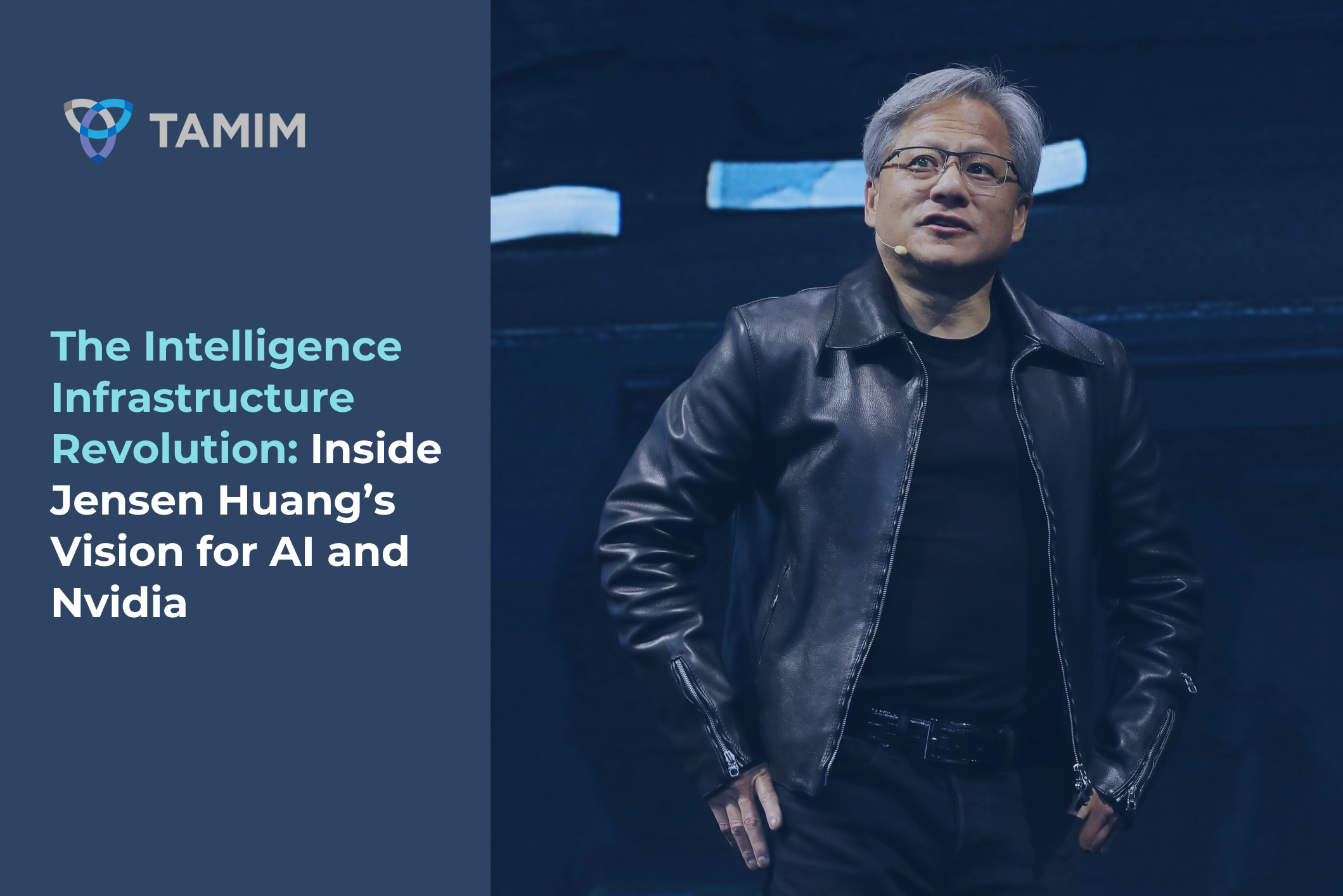
If you’re still thinking of AI as a nifty assistant or a threat to white-collar jobs, Jensen Huang wants to change your perspective, dramatically. In a captivating conversation at the Milken Institute, the Nvidia founder and CEO laid out an audacious but clear-eyed roadmap: artificial intelligence isn’t just a tech wave. It’s the next industrial revolution. And Nvidia? It’s not a chipmaker anymore. It’s the backbone builder of this new era, a $200B/year AI infrastructure powerhouse.
Three Layers of the AI Revolution
AI as a Digital Workforce Forget the old metaphor of computers as tools. According to Huang, AI is a digital robot. It doesn’t just sit there waiting for commands, it performs work autonomously, whether it’s translating languages, solving problems, or synthesising new proteins. This means the AI economy is tapping into the $100 trillion global economy, not just the $1 trillion IT sector.
AI Factories are the New Industrial Backbone Huang’s most mind-bending metaphor? AI isn’t just software. It’s manufactured. And the manufacturing takes place in giant, energy-intensive “AI factories” that process data and generate “tokens”, which can become words, images, videos, drugs, or robot instructions. Nvidia is now building these factories at gigawatt scale, with price tags of $50–60 billion each. Tens of these facilities will be erected globally in the next decade.
A New Global Infrastructure: Intelligence In the past, we built infrastructure around energy or information. Now, we’re building the “intelligence infrastructure.” Huang compares AI’s role today to the early days of the internet, hard to define, but soon to be utterly essential in everything from healthcare and finance to logistics, manufacturing, and entertainment.
From Displacement to Empowerment: AI & Jobs
Yes, jobs will be affected. But Huang is adamant: AI won’t take your job, someone using AI will. He frames AI not as a threat, but as a profound equaliser. Programming has long been the domain of 30 million specialists. But AI makes computing accessible to anyone. Just ask it how to help you, whether you’re a 12-year-old or a PhD.
Huang sees AI as a tool to close the technology divide, not widen it. Whether you’re a teacher, a doctor, or a farmer, AI can now be your co-pilot.
Why Nvidia Won (and Intel Didn’t)
Nvidia’s story isn’t just one of vision, it’s one of relentless perseverance. While Intel stuck to its script, Huang and his team chased hard problems no one else wanted, like solving computing challenges traditional chips couldn’t. Nvidia built its entire computing stack from the ground up: architecture, chips, systems, software, and ecosystem. Today, that “stack” powers everything from ChatGPT to cutting-edge drug discovery.
Their culture? A heady mix of long-suffering, constant innovation, and humility. Huang jokes they’ve been “always going out of business for 30 years.” It’s this paranoia that keeps them hungry.
The Trillion-Dollar AI Industries of Tomorrow
Today’s AI industry mostly powers the consumer internet. But the future? Huang sees AI transforming:
Healthcare & Life Sciences – From virtual proteins to virtual cells.
Manufacturing – Gigantic robotic systems orchestrating robotic sub-assemblies.
Industrial Robotics – What Huang calls “Physical AI.”
This is the trillion-dollar runway Nvidia is building toward. Robots building robots building robots? That’s not science fiction, it’s near-term vision.
The Geopolitics of AI: Should the US Export?
On the topic of export restrictions, Huang walks a diplomatic tightrope. While he understands national security concerns, he believes banning AI tech exports cedes ground to rivals like Huawei. The better strategy? Export American standards. Dominate the global ecosystem. Build AI on U.S. terms, not in isolation.
And oh, by the way, China is a $50 billion market Nvidia is currently restricted from. That’s like “leaving an entire Boeing” on the table, he says.
Key Traits of Nvidia Staffers.
If you’re wondering who the amazing people are who drive this powerhouse business, here’s Huang’s criteria for Nvidia employees:
Domain expertise (robotics, biology, finance, you name it)
Curiosity and general intelligence
And most importantly? A love of hard work and suffering.
Yes, suffering. Because at Nvidia, building the future isn’t glamorous. It’s just… really hard. But worth it.
The TAMIM Takeaway
At TAMIM, we believe AI is not just a vertical, it’s a horizontal that touches every industry. Jensen Huang’s vision reinforces our thesis: the companies that understand how to build, adopt, and deploy AI infrastructure are the ones that will shape the next economy.
Whether you’re investing in listed equities or private secondaries, understanding how the AI ecosystem scales, from tokens to trillion-dollar factories is key. Nvidia may be at the centre of it now. But the web of opportunity around it is vast and only beginning.
Disclaimer: As at the date of publication, TAMIM Asset Management does not hold any of the companies mentioned in this article. This information is provided for general informational purposes only and does not constitute investment advice.
This week’s TAMIM Reading List dives into a world quietly reshaped by pressure, disruption, and innovation. AI isn’t just transforming workflows; it’s already eliminating jobs, while bots are gaming the music industry for millions. In physics, scientists are chasing a new class of particles that could redefine our understanding of matter. We also explore how the icy past sculpted Canada’s present and why some economists believe the U.S. is trapped in a state of stalled growth. From sky-high forests reimagining urban living to rising employee stress threatening business performance, each piece reveals how the systems we rely on are either adapting or reaching their limits.
Global energy markets today sit at the intersection of volatility, policy shifts, and long-term transformation. From the unpredictability of fossil fuel supply to the growing (but not unchallenged) role of renewables, investors face a landscape rich in opportunity but fraught with complexity. Within this complexity, however, lie a number of fundamental certainties: the need for secure energy, resilient infrastructure, and pragmatic decarbonisation.
At TAMIM, we invest in these certainties through companies that combine diversified energy sources with infrastructure expertise. In this piece, we profile three companies, Engie, A2A, and Quanta Services, that embody this balanced approach. These businesses are positioned to benefit not from a single energy ideology, but from the realities of the evolving global energy architecture. As Jensen Huang recently hinted at the Milken Institute, success in the modern era will come from those who build essential infrastructure, both physical and digital, and adapt quickly to systemic shifts.
ENGIE SA (EPA: ENGI): The Pragmatic Decarboniser
Engie, the French multinational utility giant, offers one of the most realistic blueprints for energy transition. With operations in electricity generation, natural gas, and energy services, it combines legacy infrastructure with modern renewables and innovation. Crucially, it has not fallen into the trap of betting entirely on one technology or region.
The firm has doubled down on hybrid energy development, maintaining its natural gas and nuclear backbone while accelerating solar and wind expansion. This balanced energy strategy means it can adapt flexibly to policy changes and demand shifts, an echo of Huang’s point that resilient systems are built through modularity and diversified capability.
In 2024, Engie reported strong cash flow from its thermal and nuclear assets while increasing investment into green hydrogen and energy efficiency solutions. Revenues topped €95 billion, with EBITDA margins improving year-on-year thanks to higher regulated returns and cost efficiencies. It’s this dual-engine of legacy earnings and future-forward investment that gives us confidence in its resilience.
Moreover, Engie’s grid and flexibility services make it a linchpin of the wider energy transition. As electricity networks become more dynamic, balancing intermittent renewable sources with constant baseload power will require infrastructure that can absorb complexity. Engie’s expertise in demand-side management and decentralised energy aligns well with this need.
A2A S.p.A. (BIT: A2A): Local Strength with Global Relevance
Italy’s A2A might not be a household name, but its strategic importance to regional energy resilience and its alignment with broader EU energy trends make it a standout holding. A2A is a vertically integrated utility, managing power generation, distribution, waste-to-energy, and water systems primarily in Northern Italy.
Like Engie, A2A benefits from a pragmatic energy mix: natural gas and hydro provide baseload stability, while renewables like solar and wind are layered in as policy and economics allow. In 2023, A2A reported revenues of €22.2 billion, with net income growing by 11%. Its investment plan of over €18 billion by 2030 is heavily weighted toward decarbonisation and infrastructure upgrades.
What makes A2A particularly interesting is its integration of circular economy principles into core operations, waste-to-energy, district heating, and closed-loop water management are not just ESG window dressing, but contributors to bottom-line stability. This kind of “real asset” infrastructure thinking, layering resilience, efficiency, and regulatory alignment, is the hallmark of companies that thrive in uncertain times.
As Jensen Huang has articulated in broader discussions of industrial transformation, the new economy rewards those who combine physical infrastructure with data and optimisation. A2A’s use of digital grid management, smart metering, and predictive maintenance makes it more than just a utility, it is a systems company, and one that the market continues to underestimate.
Quanta Services (NYSE: PWR): Building the Backbone of the Grid
While utilities produce and distribute energy, someone has to build and maintain the physical systems that underpin it. That someone is often Quanta Services, a North American powerhouse in engineering and construction for power, telecom, and pipeline infrastructure.
Quanta plays a key “pick-and-shovel” role in the energy transition. Its clients include utilities, government agencies, and private developers seeking to upgrade aging grids, deploy renewables, or extend broadband networks. From transmission line upgrades to substation retrofits, Quanta is on the frontlines of infrastructure modernisation.
Its most recent earnings saw revenue grow 9% to $19.4 billion, with a robust backlog of $31 billion. Importantly, Quanta is seeing accelerating demand for high-voltage projects and renewable integration. These projects often stretch over years and offer visibility into earnings and cash flow. The company’s operating margins remain stable despite inflationary pressures, testament to its execution and contractual pricing models.
Quanta’s projects provide the physical conduit for national digital and energy ambitions. It’s hard to digitise a grid, or decarbonise one, without digging, wiring, and integrating. Quanta enables this foundation.
Navigating the Energy Crossroads
Our investment in these three names reflects a view that the global energy market is undergoing a managed, not manic, transition. A few realities support this thesis:
“Drill, Baby, Drill” Has Limits: While U.S. political rhetoric often leans toward energy independence via hydrocarbons, capital discipline remains high among producers. Supply is constrained by cost, ESG pressure, and uncertainty about future demand.
OPEC’s Dilemma: Recent indications suggest that OPEC, particularly Saudi Arabia, is winding back production cuts to stabilise revenue. With global sporting events and ambitious economic programs underway, these nations need stable cash flow.
Renewables Reset: The narrative of 100% renewables is being revised. Spain’s recent grid blackouts and Orsted’s pullback from offshore wind projects highlight the limits of intermittent energy when not paired with sufficient baseload or storage.
In response, Germany’s inclusion of nuclear in its clean energy taxonomy is a signal that Europe is recalibrating. This creates an opportunity for companies with flexible and diversified power generation assets. It also positions companies like Quanta, which stitch these systems together, as essential economic enablers.
The TAMIM Takeaway: Investing Where Real Change Happens
As our PAR (Premium, Action, Resilience) model suggests, energy infrastructure names that score well across risk-adjusted valuation, news flow, and robustness deserve attention. Fundamental due diligence (ASG: Accounting, Strategic, Governance) then ensures we avoid the pitfalls of over-promised transformation. Infrastructure, especially that which enables flexibility, modularity, and adaptation, is the most valuable asset class in an age of systems change.
Our focus on Engie, A2A, and Quanta Services illustrates how patient capital can still earn compelling returns by owning essential businesses in flux-heavy sectors. These are not fads, they are foundational.
Actionable insights for investors:
Look for energy companies that blend legacy earnings with future-facing strategy.
Invest in enablers such as businesses that make the system work, not just those who supply or consume energy.
Embrace policy risk as a source of opportunity: regulation drives infrastructure spend.
Use macro uncertainty to build positions in quality, cash-generative names with multi-decade tailwinds.
Keep your eyes focused as next week we will be unveiling a new investment solution targeting global infrastructure, tailored to capture precisely this shift. As the global rollout of infrastructure accelerates across digital, transport, energy, and communications, we intend to be front and centre. Let the builders lead the way.
Disclaimer: ENGIE SA (EPA: ENGI), A2A S.p.A. (BIT: A2A) and Quanta Services (NYSE: PWR) are held in TAMIM Portfolios as at date of article publication. Holdings can change substantially at any given time. Source: Company ASX material, discussions with management, Tenva Capital Research.
This week’s TAMIM Reading List explores the strange, brilliant, and sometimes overlooked intersections of history, technology, and human behaviour. A Cold War-era decision to remain silent helped avert nuclear disaster and offers a timely lesson for the AI age. A witty collection of financial quotes reminds us that markets are as much about psychology as numbers. We unpack why equity markets tend to bounce back, and how Australia’s most venomous creatures are becoming unlikely heroes in medicine. The Chinese government’s approach to training deceptive AI raises big questions, while a guide to secure browsers helps you stay one step ahead in the digital age. We also take a surprising detour into the NBA’s obsession with hand care. Finally, a fresh perspective invites us to consider how modern life may be more luxurious than we realise.


 Sterling Infrastructure (NASDAQ: STRL) is a US-based engineering and construction group with its boots firmly planted in America’s re-industrialisation and digital infrastructure renaissance. Operating across E-infrastructure, transportation, and building solutions, Sterling is benefitting directly from three unstoppable forces: federal infrastructure stimulus, a manufacturing revival, and the exponential growth in data centre demand.
 Arrow Electronics (NYSE: ARW) is the unsung architect behind much of the world’s industrial and commercial electronics. With a global footprint and a client base that includes the biggest names in computing, telecommunications, automotive, and industrial automation, Arrow is the ultimate picks-and-shovels provider to the digital economy.
 Kajima Corporation (TSE: 1812), one of Japan’s oldest and most respected construction and civil engineering firms, is more than just a traditional builder. It is an operator, innovator, and problem solver with global reach. From coastal defences and earthquake-proof buildings to green energy systems and data centres, Kajima operates at the nexus of sustainability, resilience, and renewal.

 Engie, the French multinational utility giant, offers one of the most realistic blueprints for energy transition. With operations in electricity generation, natural gas, and energy services, it combines legacy infrastructure with modern renewables and innovation. Crucially, it has not fallen into the trap of betting entirely on one technology or region.
 Italy’s A2A might not be a household name, but its strategic importance to regional energy resilience and its alignment with broader EU energy trends make it a standout holding. A2A is a vertically integrated utility, managing power generation, distribution, waste-to-energy, and water systems primarily in Northern Italy.
 While utilities produce and distribute energy, someone has to build and maintain the physical systems that underpin it. That someone is often Quanta Services, a North American powerhouse in engineering and construction for power, telecom, and pipeline infrastructure.