This week the team at DMX review some of their portfolio holdings and the meetings they have had with the Small Cap companies they are invested in. Identifying these types of businesses is both the passion and the bread and butter of the manager of the TAMIM Australian Equity Small Cap IMA. We continue to believe that the addition of a small cap portfolio to your overall investment strategy adds a strong return and diversification benefit.
This week the team at DMX review some of their portfolio holdings and the meetings they have had with the Small Cap companies they are invested in. Identifying these types of businesses is both the passion and the bread and butter of the manager of the TAMIM Australian Equity Small Cap IMA. We continue to believe that the addition of a small cap portfolio to your overall investment strategy adds a strong return and diversification benefit.
September Small Cap Stock Review
Elanor Investors Group (ASX:ENN)
Elanor Investors Group (ASX:ENN) is busy securing assets for its two new funds (a $250m ASX listed retail property REIT and an unlisted commercial property fund) to be launched towards the end of 2016
Management have advised that they have a strong pipeline of potential asset acquisition opportunities across the hotel, commercial and retail property space.
ENN’s Hospitality and Accommodation Fund ( http://www.elanorinvestors.com/hospaccomfund.php ) is performing well, with ENN focused on implementing initiatives to continue to improve the operating performance of the underlying hotel assets. We expect at some point ENN to list this fund on the ASX, which would make it one of the few ASX hotel exposures, and, as such, would be likely to be well received.
ENN’s two operating businesses (Featherdale Wildlife Park and John Cootes Furniture) continue to have good growth outlooks. The challenge for ENN is to continue to identify and acquire attractive assets at good prices in order to continue their FUM expansion.
Konekt Limited (ASX:KKT)
Konekt Limited (ASX:KKT) reported a strong FY16 result, driven by strong organic and acquisition growth.As has been widely reported in the financial press, there has been a number of recent corporate transactions in the injury management sector as private equity and other corporate players look to build their presence.
Acquisition multiples and vendor expectations are likely to have risen as a result of this activity, which may impact the acquisition activity of the likes of KKT in the short term.
KKT’s management have a strong track record of generating organic growth. Management have a number of initiatives in place in order to continue to grow the business organically, including rolling out nationally their corporate mental health offerings, the opening of new offices to provide KKT with further scale; and targeting the provision of pre-employment services to corporates that attract high workers compensation premiums such as construction firms and aged care services.
KKT see themselves as an important provider of corporate health initiatives, servicing numerous large Australian corporates.
Pioneer Credit Limited (ASX:PNC)
Pioneer Credit Limited (ASX:PNC) reported a strong FY16 result, although it was masked somewhat by PNC’s investment in new products and overhead support.
When we met with PNC they reiterated the difference in their business model versus others in the sector – PNC is focused on acquiring debts with ‘long dated’ collection profiles (primarily personal loans and credit cards) to enable PNC to develop deeper relationships with their customers over a longer period of time (this is in contrast to telecommunication and utility debts which are often one off in nature and don’t provide an opportunity to build a relationship with the customer). The other advantage of having a longer collection cycle is that it provides PNC with a lower turnover portfolio, meaning that PNC is not under pressure to constantly replace/purchase more ‘short dated’ utility type debts.
Over the medium term, PNC is focused on using these customer relationships to offer a wide range of financial services. PNC expect these financial services products (including personal loans and credit cards) to contribute meaningfully to its profit over time.
We also spent some time discussing with the MD and CFO PNC’s valuation approach for PNC’s purchased debt portfolio, and the discount rates they have adopted. We are comfortable with the valuation approach.
SDI Limited (ASX:SDI)
SDI Limited’s (ASX:SDI) Management team conducted a national roadshow following its annual results.SDI is focused on positioning itself in its markets as an innovative dental supply company with a strong technology focus (as opposed to the traditional amalgam supplier that many in the industry still see it). This corporate re-positioning is expected to be complete by the end of the calendar year.
To further its innovation, Management expect to invest approximately 5% of sales on research and development initiatives as they look to continue to develop high quality dental products to sell to their customer base in over 100 countries. As an example of their innovation and unique product offering, SDI note that a major multi-national competitor continues to purchase a high end glass product from SDI that is not available elsewhere.
SDI’s product portfolio will be enhanced during FY17 with the release of two new products that Management are positive about – a new LED curing light and a new Riva Glass Ionomer product.
SDI’s
share price continues to perform well on the back of its FY16 result, a positive outlook, improved investor relations and wider market recognition.
Happy Investing,The team at TAMIM
This week Vincent Cook, senior analyst with the fund underlying the TAMIM Australian Equity Growth & Income Individually Managed Accounts (IMA), takes time out to discuss the Australian Banks. There is a significant amount of negativity in the Australian press regarding the outlook for our banks however we see some positive signs with indications of consolidation appearing in the sector. Given the worry about Deutsche Bank and banks in general, it is timely to discuss our thoughts on the sector.
This week Vincent Cook, senior analyst with the fund underlying the TAMIM Australian Equity Growth & Income Individually Managed Accounts (IMA), takes time out to discuss the Australian Banks. There is a significant amount of negativity in the Australian press regarding the outlook for our banks however we see some positive signs with indications of consolidation appearing in the sector. Given the worry about Deutsche Bank and banks in general, it is timely to discuss our thoughts on the sector. Read on to find out more.
Time to Buy the Banks?
The major banks are currently trading at the largest PE discount relative to the All Industrials ex Financials since 2001, at 35%, which compares to a 10 year average of 20% (figures from UBS), reflecting fears including capital requirements and bad debts.
A case can be made that some of these concerns may be overplayed and we believe the sector is now discounting the fall in margins and ROE, a tightening in lending requirements to the property sector and Basel III changes. While it is too early to suggest we are back into an uptrend especially given the concerns around the European banking sector, it is certainly worth highlighting some positives on the Australian Banks.
Capital Adequacy:In terms of capital, the Financial System Inquiry recommended that our banks be unquestionably strong, with the benchmark being top quartile capital ratios relative to international peers. The banks have already achieved this, as illustrated by the below chart from CBA’s FY16 result presentation.
Revisions to the Basel III capital measurement framework are expected from the Basel Committee towards the end of this calendar year, which may push this benchmark somewhat higher. However, governments and central banks, particularly in Europe and the UK, have begun to push back against ever increasing capital requirements, which may mean that the new requirements are not too onerous. The oversight body of the Basel Committee said in a statement in September 2016 that they had “discussed the Basel Committee’s ongoing cumulative impact assessment and reaffirmed that, as a result of this assessment, the committee should focus on not significantly increasing overall capital requirements”. APRA’s Wayne Bayres also said in January 2016 that the changes in the pipeline will likely be “well within the capacity of the banking sector to absorb in an orderly fashion over the next few years”.
A key difference between the prospective changes and the situation in 2015 is that APRA is talking about a multi-year time frame, whereas the 2015 raisings were driven by a change to mortgage risk weights on only a 1 year horizon. A multi-year time frame gives banks the opportunity to accrete the additional capital organically, from retained earnings. A worst case scenario is probably capital raisings of a similar magnitude to those in 2015, which diluted shares on issue by around 5%, while organic capital generation combined with dividend reinvestment plan dilution of 1-2% may be a more likely outcome.
Bad Debts:
In terms of bad debt risk, the back drop to the current situation is that interest rates are at record lows and business and personal credit growth, historically the key drivers of impairments, have averaged 2.0% and 1.0% respectively since the GFC i.e. we have not had a systemic buildup of credit risks. There are pockets of weakness, such as the mining sector and a potential oversupply of residential apartment developments, however these represent a relatively small share of bank lending, at sub 2% each, with residential development lending also generally well secured. The banks were burnt by commercial property lending in the GFC and subsequently tightened up their risk standards. Hence the fallout from an oversupply of apartments may hurt the profits of some developers of lower quality stock, but have only a limited impact on the banks. Sector impaired assets as a percentage of loans have declined materially in recent years and remain at low levels, as shown in the chart below from CBA’s FY16 result presentation.
EPS and DPS growth is expected to be non-existent (or slightly negative) for the banks sector in FY16, driven by the capital raisings undertaken in 2015 and a modest increase in bad debt charges from record lows. However, system credit growth is continuing at a reasonable clip of 6.2% for the year to June 2016 and the banks are targeting costs. For example, WBC is aiming for cost growth of 2-3%. Assuming the banks concede 1-2% per annum of the revenue growth from increased loans to competitive pressure on margins, these drivers could deliver reasonable, mid-single digit EPS and DPS growth over the medium to long term.
Conclusion:
We are now less then 45 days out from the ex dividend dates of the major banks. Traditionally bank share prices will run into the dividends as income conscious investors buy the banks to comply with the 45 day rule. Assuming the European banks do not melt down this could be an opportune time to pick up some Australian bank exposure yielding 8 to 9%.
This week Michael Newbold, senior analyst with the fund underlying the TAMIM Australian Equity Growth & Income Individually Managed Account (IMA), takes time out to discuss Auckland International Airport (AIA.AX) – a solid defensive yield stock. AIA has been a strong performer for our growth & income portfolios in recent years. However, with a changing risk-reward profile we have begun to trim the position. Read on to find out why.
This week Michael Newbold, senior analyst with the fund underlying the TAMIM Australian Equity Growth & Income Individually Managed Account (IMA), takes time out to discuss Auckland International Airport (AIA.AX) – a solid defensive yield stock. AIA has been a strong performer for our growth & income portfolios in recent years. However, with a changing risk-reward profile we have begun to trim the position. Read on to find out why.
Stock Picking – Auckland International Airport Ltd (AIA.AX)
Auckland International Airport Ltd (AIA.AX) remains a solid defensive yield stock that is performing very strongly with traffic growth at multi year highs, helping to drive other areas of the business. Industry dynamics continue to be very positive for airports with the real cost of travel declining while disposable income and propensity to travel continue to increase, particularly in emerging economies.
Management seems very confident in the outlook for the business with traffic growth strong, the Auckland property market in an upswing, retail benefitting from the new duty free operators and revenue to step up over coming periods from the delivery of additional retail space and areas like car parking also seeing solid growth. Risks still exist around the pricing reset in 18 months’ time but management still seems comfortable that they have levers to pull to maintain an inflation level increase in aero-charges.
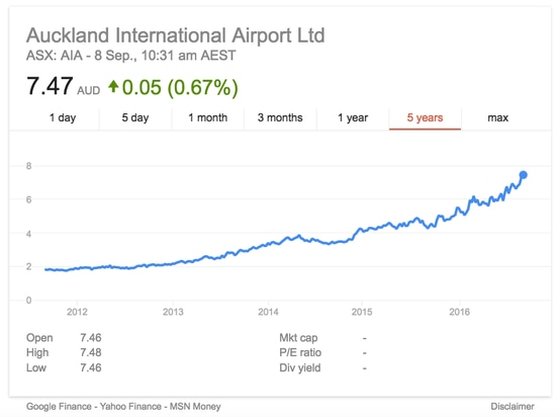
Our valuation (based on a blend of discounted cash flows (DCF) and multiples) and target price increases to NZ$7.03 (from NZ$5.92) reflecting a roll forward of the valuation and updated growth assumptions. This trails the current share price of NZ$7.68 and implies a -6% total shareholder return (TSR). Average 12 month forward broker valuation is NZ$6.12 (range from NZ$5.00-7.95). The street generally can’t get its head around the currently priced valuation on AIA and we are struggling too.
Trading on 22.8x FY17F EV/EBITDA (vs an historical average 14.5x, 18.8x 2-year average) and a 2.6% yield (vs 3.6%, 3.2%), AIA looks fully valued at current levels.
Auckland Airport is a quality asset that is well held internationally and is an important part of the NZ index. Given the quality of the business and solid outlook, we don’t see a significant catalyst for a derating in the short term (aero pricing outcome is the biggest issue) and we expect it to continue to trade at elevated multiples (especially with the NZ Reserve in a rate cut cycle). We also note that Sydney Airport Holdings Ltd (SYD.AX) is trading well ahead of historical multiples. However, interest rates are closer to the bottom and we are arguably starting to see a cyclical shift as the US moves to increase rates and further interest rate cuts are being seen as being more detrimental than beneficial.
We reduced our position after the last result and may look to reduce again from our current holding. While management is executing well, it is hard to argue that the largest portion of the +60% TSR over the 12 months to 2 September reflects the 21% earnings growth and 20% dividend per share (DPS) growth. The return is more reflective of global bond rate movements and these will normalise over time with the next US lift likely by the end of December. The Australian share market is heavily exposed to the yield trade and when it turns it is likely to be relatively rapid. Those investors blindly holding stocks for their ongoing yields will be hurt. Finally, those stocks that have rerated most through the cycle are at most risk of derating and AIA is a leading candidate in this regard. In this scenario, AIA could trade down to NZ$6.06-6.25 some 19-21% below current levels. If it were to rerate to long term multiples (unlikely) the downside is 28-44%.
The Australian smaller companies universe is home to a number of companies which are building global leadership positions in their respective niche markets, and yet somewhat surprisingly remain largely unrecognised in the local investment community. Identifying these types of businesses is both the passion and the bread and butter of the manager of the TAMIM Australian Equity Small Cap IMA. We are pleased to provide a profile of our investment in SDI Limited (SDI.AX).
The Australian smaller companies universe is home to a number of companies which are building global leadership positions in their respective niche markets, and yet somewhat surprisingly remain largely unrecognised in the local investment community. Identifying these types of businesses is both the passion and the bread and butter of the manager of the TAMIM Australian Equity Small Cap IMA. We are pleased to provide a profile of our investment in SDI Limited (SDI.AX).
Stock Picking – SDI Limited (SDI.AX)
SDI Limited (SDI.AX), a Melbourne based manufacturer and exporter of dental products. Established in 1972 by Jeffrey Cheetham, a trained metallurgist, SDI operates in the global dental equipment and consumables market, which is estimated to be in excess of $25 billion. SDI exports around 90% of its products to over 120 countries.
SDI commenced operations in Jeffrey Cheetham’s garage, producing amalgam fillings and selling the products direct to dentists. By 1975, the company had operations in New Zealand, United States and Greece. Following a decade of national and international success, the company listed on the ASX in 1985. A strong focus on research and development has seen SDI develop an extensive portfolio of innovative restorative and cosmetic dental products including fillings, cements, tooth whitening products and associated dental equipment, with market leading positions in various geographies.
SDI has offices and warehouses in Chicago, USA; Cologne, Germany; Dublin, Ireland and a recently commissioned packing facility in Sao Paulo, Brazil, and turns over in excess of $70m annually.
WHY IS SDI TRADING UNDER THE RADAR?
SDI is a relatively small family-controlled and family-run Australian company which competes against some large multinationals. The company has had an operationally challenging past few years with its performance subject to foreign exchange and commodity price fluctuations, and as a result, trades very much under the radar.
SDI has built its reputation as a supplier of high quality amalgam (silver and mercury based) dental products. However, as consumer preferences have shifted towards more visually appealing dental products, there has been a move away from SDI’s original core amalgam products. As a result, SDI has struggled to generate significant sales growth momentum in recent years.
Fortunately SDI’s more recent research and development initiatives have been focused on non-amalgam products, which is where the industry growth is. The company has been developing a more complex glass ionomer product range, as well as composite and whitening products. Given SDI’s historic reliance on amalgam products, the transition from amalgam to non-amalgam product sales has taken some time.
However, with amalgam sales now representing only 36% of total sales, SDI has successfully managed this product mix transition.
All of SDI’s sales growth in recent years has come from non-amalgam products as shown below:
While amalgam sales have essentially been flat since 2012, non-amalgam sales have increased by over 30%, and have shown consistently strong year on year growth. The more complex non-amalgam products attract a higher gross margin, which, together with the company’s increased scale, has helped to drive SDI’s net profit from $2m in FY12 to around $7.5m in FY16. COMPELLING VALUATION
Based on its recent guidance, SDI is trading on a FY16 p/e of around 11x, and on an Enterprise value / EBITDA multiple of 7x. It should be noted that SDI capitalise, rather than expense the majority of their research and development costs, which potentially overstates their reported net profit. However, these valuation metrics suggest to us that SDI is under-valued for a business with a strong global sales reach and solid growth prospects.
OUR VIEW
SDI is a great example of a small Australian company developing unique intellectual property and achieving global success in its chosen niche market. We believe the stock deserves its position in our emerging global leaders list.
A sell-down by one of SDI’s larger, long term institutional investors has recently provided some liquidity in this somewhat illiquid stock, and has enabled new institutions and shareholders to enter the register. Whilst SDI is very much perceived as being a family run company, there is the opportunity for a stronger non-family aligned shareholder base to now help change this perception.
For many years the company has demonstrated its ability to consistently bring innovative new products to market. With a strong culture of research and development SDI has excellent potential to continue to grow its sales by expanding its product portfolio and its customer reach, and to become a more robust and larger company. We are happy long term shareholders.
Darren Katz, TAMIM Asset Management’s Managing Director and Head of Investments, reviews a number of the Stock Picks we have presented over the course of the year to assess how they have fared through the recent reporting season. We review our original investment rationales and try to learn from the mistakes we have made through our investment journey.
Darren Katz, TAMIM Asset Management’s Managing Director and Head of Investments, reviews a number of the Stock Picks we have presented over the course of the year to assess how they have fared through the recent reporting season. We review our original investment rationales and try to learn from the mistakes we have made through our investment journey. Overall the year has been very good for our Australian Value and Small Cap strategies. With the Value underlying fund delivering a 13.9% return over the past 12 months and the Small Cap underlying fund delivering a 31.3% return for the same period.
Reporting Season Wrap-up – Part 2 Darren Katz – Head of Investments
With reporting season over, we bring you the second part of our reporting season wrap-up. Having spent the last 12 months providing you with a number of our best ideas and thoughts around a select group of Australian shares, I thought it was an opportune time to stop and look back at some of these stocks. It is always a good idea when investing to stop and look at your initial hypothesis with a view to learning from the good and bad decisions you have made. This is an extremely important lesson, and acts to make us all greater investors.
Duet (TAMIM Australian Equity Growth IMA): Current Poistion
Investment Rationale: Strong Growth prospects, Strong Yield Current Price: $2.63Read the original article here.
DUET Group (DUE.AX) is an owner of utility assets in Australia, the US and Europe. Since listing in 2004, DUE has evolved from being an externally managed asset owner/ investment fund to an internally managed asset owner/operator with an EV of over A$18bn. The catalysts for share price performance include contract wins in the DDG and EDL business units, better-than-expected outcomes from the DBP regulatory reset and United Energy regulatory reset (final decision due imminently). Activity in relation to SKI selling down its stake and potential corporate activity as underbidders in the NSW electricity privatisation process potentially looking to acquire other regulated asset holders were additional catalysts.DUE reported pleasing results on the 19th of August, the distribution for the year came in at 18c with the net year expected to be 18.5c. Proportionate earnings were 34.5% higher then the previous comparable period. The integration of EDL has been completed and it is apparent that that integration synergies are emerging. The company will continue to search for accretive acquisitions through the forthcoming year.
Joyce Corporation (TAMIM Australian Small Cap IMA): Current Poistion
Investment Rationale: Underfollowed, unloved, turn-around story Current Price: $1.49Read the original article here.
Joyce has a strong track record of partnering with businesses. The company acts as a business partner, providing capital and management expertise to good, profitable businesses that currently lack the capital and management to reach the next level. The key in this business partnership is to ensure that the risks and rewards are appropriately shared and incentives are aligned.Over the last several years, Joyce has been slowly building out a business of considerable scale, with the group’s total network revenue in the home improvement and furniture space now in excess of $125 million. The recent sale of a non-core property asset and the purchase of another property, together with the purchase of an interest in (and subsequent accounting consolidation of) a new business unit, has meant Joyce’s recent financial reporting is messy, and the Joyce story (and its potential) is perhaps poorly understood by the market. We expect the story to become clearer over the coming reporting periods.
Highlights for the financial year ending 30 June reflected a 62.8% increase of revenue to $56.5m. This was reflected in an NPAT from continuing operations of $3.46m. The full year dividend was 11 cents. Primary businesses (Bedshed and KWD) performed better than forecast and the company was also able to acquire Lloyds Online. JYC is forecasting sales of between $170m to $200m through the next financial year.