We have been attracted to Japanese equities for some time due to their robust balance sheets and notable improvements in governance. More recently, Japanese companies have weathered the economic headwinds to outperform global peers significantly. This is despite the Japanese Yen falling relative to the US dollar and in our opinion, becoming ludicrously undervalued.
Many Japanese companies we consider to be “true technology companies”. They are in the business of selling technology by using applied scientific knowledge to solve real problems. These companies spend significant sums on research and development to build competitive advantages based on intellectual property and manufacturing leadership. This differs from the likes of big tech in the United States. For example, Google-owner Alphabet (NASDAQ.GOOGL) might be classified as a technology business, however realistically it is a cyclical advertising company. Investors should be mindful of industry classifications, as they can provide a false representation of a business’s underlying business model or sector.
1. NGK Insulators (TSE.5333)
Nippon Gaishi Kaisha (NGK) translates to Japan insulator company in English. As an aside, many companies in Japan begin with either Nippon or Nihon, which means Japan in Japanese. NGK’s core technical expertise is in ceramics, which is known for its durability, non-conductivity and heat resistance. Historically the business provided ceramic insulators that safely delivered electricity but has since moved into new markets such as automobiles and semiconductors. NGK is the market leader in ceramic substrates and filters, which detoxifies harmful exhaust emissions and particulate matter from motor vehicles.
NGK is over 100 years old, has weathered multiple economic cycles and continues to innovate. The business is now moving away from fossil-fuel vehicles and towards energy storage and digital applications. Recent new products include the first megawatt-class NaS (sodium-sulfur) battery and an ultra-compact lithium rechargeable battery used in small electronics called EnerCera.
The business has over 7,800 patents filed globally against its intellectual property. It also spends 5 per cent of its revenue on research and development annually, with 70 per cent dedicated to future-facing industries. It’s built customer relationships over decades and is embedded deeply within end products. Regarding valuation, NGK trades at a 17 per cent discount to its book value and on an earning multiple of 8.5.
2. Amada Co. (TSE.6113)
Amada is a large manufacturer of metal working machinery in addition to providing automation systems, software and services. The company sells equipment for sheet metal fabrication, precision welding, cutting, grinding and press automation. This machinery is then used to build a wide range of end-use products including elevators, smartphones, bridges and road signs.The company has developed fibre laser machines that cut more accurately and safely than incumbent carbon dioxide laser machines. It also uses around a third of the energy, and while more expensive upfront, the operating costs of fibre machines are significantly less. Sectors such as manufacturing, aerospace and automotive are expected to drive demand for metal fabrication over the medium term. Amada will also benefit from falling population demographics in countries such as China, where machines will be needed to replace manual labour.
The business has offices and operations around the globe, with 61 per cent of sales from international markets. Amada has a conservative balance sheet, with a third of its market capitalisation in net cash. Valuation-wise, the company is trading on an earnings multiple of 10.5 and at a 27 per cent discount to its book value.
3. Shin-Etsu Chemicals (TSE.4063)
Shin-Etsu is the fourth largest chemical manufacturer globally, providing products to various sectors including; construction, healthcare, semiconductors and pharmaceuticals. It is the world’s largest supplier of PVC, a durable and hard plastic used in window frames, piping and roofing. Shin-Etsu is also the number one provider of semiconductor wafers, a thin slice of material used in semiconductor fabrication.
The company has built decades of proprietary insights and relationships with customers. It also has a vast international network of manufacturing facilities and intellectual property. New innovations include silicon monoxide anode materials for high-capacity and high-power lithium batteries in anticipation of the shift to electric vehicles. It has also developed equipment that can transfer micro-LED chips quickly and is now a one-stop shop for original equipment manufacturers.
Shin-Etsu is highly profitable, with an operating margin of 32 per cent. Moreover, its return on invested capital is 27 per cent and hasn’t fallen below 15 per cent over the past five years. Shin-Etsu has a conservative balance sheet with nearly a quarter of its market capitalisation in cash. The company trades on a price-earnings ratio of 10 and analysts have continued to upgrade earnings estimates over the past year.
Today we will be sharing three companies that have one common trait which is that they are ‘old’ businesses, with the youngest incorporated 96 years ago. Age alone doesn’t indicate a sound investment, but it does demonstrate that the company has been able to weather multiple economic cycles and emerge on the other side. This will be especially important in 2023 as we enter a more uncertain environment for economies and subsequently companies.
1. BWX Technologies (NYSE: BWXT)
Founded in 1867, BWX manufactures and engineers nuclear components and fuels. The company’s main operations centre on marine nuclear solutions for the US government, however, it is expanding into commercial applications, including nuclear medicine and commercial nuclear power.
It recently won a contract with GE-Hitachi to engineer its BWRX-300 small modular reactor (SMR) pressure vessel. SMR technology is akin to a smaller nuclear power plant, suitable for remote locations or industry applications as it can be factory assembled and transported.Sentiment and demand for nuclear solutions are strong, particularly in light of the Russian-Ukraine war, highlighting the importance of energy security. This is in addition to governments legislating net-zero emissions targets, for which nuclear will play a crucial role as a reliable source of baseload power.
During the month, the company released its third-quarter results. Revenue increased by 5%, with 22% growth in commercial operations. Free cash flow also increased by 24% during the quarter. Management noted that labour availability is constraining growth. The business has responded by streamlining the recruitment process, improving employee referral programs and providing more site-level resources.
In 2023 the company expects stronger growth with an acceleration over the medium term. BWX trades on an earnings multiple of 20 and a dividend yield of 1.5%. Given the aforementioned demand profile, we expect it to grow in its valuation.
2. Schlumberger NV (NYSE: SLB)
Schlumberger was founded by Conrad and Marcel Schlumberger in 1926 in Paris − then a part of the German empire. The two brothers pioneered electrical coring, which uses electrical measurements to identify geological formations. Before this, oil exploration relied on samples or cuttings from boreholes which were highly unreliable and frequently missed oil zones.Today, Schlumberger is a global leader in technology and services for the oil and gas sectors. Its largest division by profit is well construction, followed by digital and integration, reservoir performance and production systems.
Against the backdrop of Europe’s energy crises and a decade of underinvestment in oil and gas, there is a strong demand to increase investment and rebalance markets, create supply redundancies, and rebuild spare capacity — for which Schlumberger is a direct beneficiary.
The company is also making forward-facing investments via its new energy division, which includes carbon, sequestration and geothermal technologies to reduce and safely store carbon emissions.
At its investor day this month, management expects annual revenue growth to be 15% out to 2025, with upside should supply remain limited. It also surprised the market by increasing its quarterly dividend payment by 43%.
We are attracted to Schlumberger’s long-term growth profile as well as its clear capital allocation framework, which focuses on shareholder returns. It trades on an earnings multiple of 16 when looking one year out, which underappreciates the growth outlook.
3. Hillenbrand Inc (NYSE: HI)
Incorporated in 1906, Hillenbrand is a US-based industrial company that provides advanced equipment used to manufacture a range of products, including packaging, consumer goods, food and chemicals. The business also owns a legacy funeral casket business called Batesville.
Hillenbrand reported fourth-quarter results during the month, with revenue increasing by 7% in constant currency and net income up by 9%. The company has been able to offset inflationary pressures by pushing through price increases, demonstrating a level of pricing power. It’s also improved processes to maintain margins.
Despite the uncertain economic outlook, management noted a record backlog of orders for equipment in both the moulding technology and advanced process divisions.
Hillenbrand has recently completed three acquisitions to bolster its recycling and food solutions portfolio. The business will host an investor day in December, where we expect to hear more information regarding its growth strategy.
Hillenbrand is not a particularly exciting company. However, it sells essential equipment to a diversified customer base across several geographies, making its earnings reliable and defensive. The business is also exploring strategic options to create shareholder value, including the sale of Batesville.
Trading on an earnings multiple of 11, the market has priced it as a no-growth company. This leaves potential upside should it continue to improve margins and integrate recent acquisitions.
Disclaimer: BWX Technologies (NYSE: BWXT), Schlumberger (NYSE: SLB) and Hillenbrand (NYSE: HI) are currently held in the TAMIM Fund: Global High Conviction portfolio.
This week we review the recent influx of economic news and the implications for future monetary policy by the RBA.
Last week’s release of the June Consumer Price Index (CPI) told the market what it already knew: everything is more expensive. Headline inflation came in at 6.1%, the highest recording since the introduction of the GST in 2000. Trimmed inflation, which removes big price swings, hit 4.9%. The headline number was below economist expectations of 6.3%, but the underlying was above the expected 4.7%.
The major causes are well known but not easily fixed. Labour shortages have been exacerbated by two years of limited migration. Ongoing logistic constraints won’t be fully resolved until China ditches its zero tolerance to COVID-19 or Russia halts its invasion of Ukraine. Soaring commodity prices and abnormal weather are impacting input costs, which are subsequently passed on to consumers
Subsequently, fruit and Vegetables are up 7.3%. New housing for owner-occupiers increased by 5.4%. Small and large household appliances were up 7.1% and 5.7% respectively. Even the temporary six-month excise cut of 22 cents at the bowser couldn’t alleviate fuel pressures, increasing for the eighth consecutive quarter.
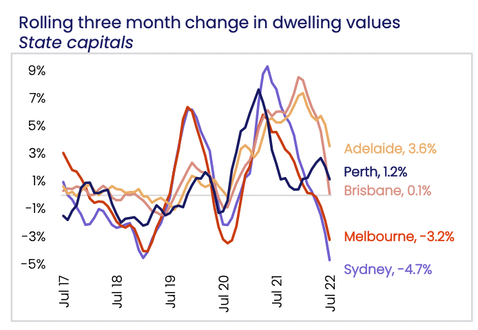
The weekly budget isn’t the only line item feeling the heat. Most superannuation account balances fell in the 2022 financial year, with just three MySuper products achieving positive returns. House prices are also beginning to roll over. Melbourne and Sydney are already contracting. Other capital cities are experiencing slowing growth.
Source: Corelogic
In summary, households have less money in their pocket and are less wealthy. The positive news is that there are signs of inflation pressures abating. Wholesale petrol prices are down 20%. Food and energy prices are retracing. Chip shortages and shipping rates are easing, albeit remain well above pre-pandemic levels. Purchasing Manager’s Indexes – a measure of economic activity – are retracing as corporates become more cautious.
US Fed alleviates market uncertainty
The CPI release wasn’t the only big economic news last week. The US Federal Reserve increased rates by 75 basis points last Thursday night to bring its benchmark rate to 2.25% – 2.50%. The Central bank has now raised rates by 225 basis points in just four months, demonstrating its commitment to bring down inflation. Again, the number was in line with economic forecasts. But what really caught markets attention was Chairman Jerome Powell’s shift in rhetoric.
He acknowledged current monetary policy is now at a neutral rate, i.e. neither stimulatory nor contractionary. Some further tightening will be required, citing prior Fed forecasts of 3.25% to 3.50% as an estimate, but also stating that the policy would be decided on a “meeting by meeting basis”.
Why is this important? Powell is giving certainty to the markets. The rapid increases are in the rear view mirror and the Fed will be more deliberate with its cash rate moves. Subsequently, the Nasdaq rallied +4.26% and the S&P/500 added +2.62%. Powell also toed the line that a recession is avoidable while acknowledging some pain will need to be felt:
“We need a period of growth below potential in order to create some slack so the supply side can catch up. We also think that there will be in all likelihood some softening in the labour market conditions, and these are things that we expect and we think are necessary to get inflation on a path back down to 2%”
Powell’s words rang true just 24 hours later when the US recorded its second consecutive quarterly decline in GDP growth and entered a technical recession.
The Fed faces a delicate balancing act. The more it wants to guarantee inflation is squashed, the further it will need to push the economy into a downturn. Fortunately, the economy is entering the recession from a position of strength with a strong US dollar and unemployment at just 3.6%.
The RBA blinks
With domestic inflation data and the Fed’s latest decision, it was time for the Reserve Bank of Australia (RBA) to step up. On Tuesday, Governor Philip Lowe announced a third consecutive 50 basis point increase, taking the cash rate to 1.85%. Just three months ago the cash rate was 0.10%. Similarly, none of this was very surprising. But like the Fed, there was a shift in attitude from the RBA.
Powell’s comments on reaching neutrality afforded Lowe the opportunity to slow the pace and severity of rate increases. And he took it with both hands. In the RBA’s monetary policy statement, the addition of two new lines demonstrates a more measured approach to future increases:
“The Board places a high priority on the return of inflation to the 2–3 per cent range over time, while keeping the economy on an even keel”.
“The Board expects to take further steps in the process of normalising monetary conditions over the months ahead, but it is not on a pre-set path”.
Most will interpret Lowe’s words as dovish. The RBA indirectly acknowledged the pain households and businesses are facing evident in the June CPI and highlighted it will balance both the economic and inflation considerations.
But what it implicitly says is that the economy is not as strong as once thought. The RBA downgraded its economic growth forecasts and also forecasted unemployment would rise. There was also no mention of the speech Deputy Governor Michele Bullock delivered just two weeks ago, that the vast majority of households can cope with 300 basis points worth of increases.
There is also a lot of scepticism around the RBA’s forecasts. Inflation is expected to peak at 7.75% before returning to 4% in 2023 and 3% in 2024. But we know inflation usually takes months if not years to flow through as fixed contracts roll over and businesses reset prices. After it backtracked on its own forecast that rates wouldn’t rise until 2024, how can one be sure the RBA has got it right this time?
To make sure households are able to cope with elevated inflation and rate rises, the RBA will be more measured and likely move in 25 basis point increments going forward. It could even pause towards the end of the year to evaluate how households are coping. This news will likely be a much needed reprieve for mortgage and asset owners. But it also signals that, should inflation linger for longer than expected, Australia will almost certainly experience an economic downturn as the RBA is forced to extinguish inflation.
This week we take a look at central bank guidance. What does it actually mean and what’s the point?
What is it good for?
Those of you of a certain age will know the next line from Edwin Starr’s 1970 hit song is “absolutely nothing!” He was talking about something far more serious, war. Nonetheless, the same sentiment is permeating markets after the recent performance of central banks.Let’s take a step back and look at what central bank forward guidance is and when it started. The Reserve Bank of Australia (RBA) defines forward guidance as “the central bank’s communication of the stance of monetary policy”. In layman’s terms, it is the RBA setting expectations as to its likely course of action regarding interest rates, through communication by its employees via speeches, interviews and other media engagements. If you recall hearing interest rates were not likely to rise until 2024 and are less than impressed by the rising cost of your mortgage in 2022; no, you didn’t imagine that. We will come back to that.
Forward guidance is considered an unconventional monetary policy tool and gained in popularity, following the Global Financial Crisis (GFC), from 2009. Many central banks had slashed interest rates to zero and were looking for other ways to stimulate their economies and provide confidence to markets, investors and consumers.
The aim of this is to influence the financial decisions of households, businesses, and investors by providing a guide for the expected path of interest rates. In the case of the post GFC period this was intended to spur economic activity and assuage fears of interest rates rises in the near future.
Forward guidance attempts to prevent surprises that might disrupt the markets and cause significant fluctuations in asset prices. This brings us to the most recent crisis which was cause by the outbreak of COVID-19. The RBA cut the cash rate, from 0.75% at the start of 2020, to 0.1%. With interest rates at zero and still seeking to provide stimulus it deployed unconventional monetary policies including asset purchases; the term funding facility and of course forward guidance.
Specifically, the RBA, through Governor Philip Lowe, began communicating that they did not foresee raising rates until 2024 at the earliest. This communication continued through 2021 and had the desired effect, keeping consumer spending strong and spurring lending which in turn translated to an increase in house prices.
As 2021 wore on the RBA’s communication began to be at odds with market expectations which began to forecast interest rate rises initially in 2023 and eventually 2022. In a speech to the Anika Foundation on Tuesday the 14th of September 2021 Governor Lowe lamented “I find it difficult to understand why rate rises are being priced in next year or early 2023”. As late as the 16th of November 2021 he remarked at a business event that “It is still plausible that the first increase in the cash rate will not be before 2024”.
Australia subsequently joined the rest of the world on the inflation freight train and, in a somewhat embarrassing turn of events, the RBA began lifting the cash rate rapidly. First on the 4th of May 2022 with a 0.25% hike followed by 0.50% on 8 June 2022; 0.50% on 6 July and another 0.50% earlier this week to take the cash rate to 1.85%. How many borrowed based on the notion of flat rates to 2024? How many spurned historically low 2-year and 3-year fixed mortgage rates under the assumption rates weren’t going to rise anyway?
We discussed earlier how one of the goals of forward guidance is to elicit activity without actually moving interest rates. This worked but the Governor admitted in May 2022 that holding the 2024 commitment as long as the RBA did was an “embarrassing error” and that the bank “should have done better”. As a consequence, the RBA will conduct a review into the forward guidance used during the pandemic period and publish the results later in 2022.
So, central bank forward guidance. What is it good for? As it turns out, a lot. Studies have shown the effect to varying degrees but it certainly exists. As the saying goes “with great power comes great responsibility” and central banks must wield their forward guidance responsibly to ensure they don’t cause what they are trying to prevent which is surprise to markets and consumers. Many Australians are contending with higher rates and mortgage repayments much sooner than they anticipated which is causing significant distress for some. The RBA will say it never “promised” but members of the public can’t really be expected to be fluent in central bank speak. In that context, perhaps a little more than an embarrassing error.
This week we visit a topic that has been persistent in recent headlines: coal. In doing this we will look at two large-caps that have delivered a seemingly extraordinary return in this bear market.
As always we begin with context.
Context
The story of coal is, as with all things this year, one of supply. The Russia-Ukraine war stands front and centre of recent price action, Newcastle coal futures climbing from circa. 151 USD/T to 385 USD/T now. So, what gives?
There are a litany of factors currently affecting the spot price of coal. As Russia is one of the world’s leading coal producers, the sanctions stemming from their invasion of Ukraine are definitely making their mark. But many may be unaware of the fact that, since the beginning of the crisis, Russian oil and coal revenues have both actually increased this year. Big net buyers, including India and China, have left no stone unturned in trying to obtain discounted crude and coal direct from the source (this discount still being a premia to the price at the beginning of the year). Given the assumption that Russian coal remains online, can we then conclude that the price action is overdone?
This is a little more complex. As usual, future expectations are also priced in. Longer-term, the global market is dealing with both the disentanglement of supply (i.e. as Germany is doing to avoid reliance on unstable players like Russia) and a broader shift in the energy mix resulting from the ongoing Green transition. In the medium term, price action may also be exacerbated as China comes out of lockdown, creating buying pressure. Short term, Europe is simply going into winter. These are just a few examples of the types of expectations affecting prices right now.
While the price action may very well be overdone right now there is every reason to believe that, after years of underinvestment and rising energy demand, we could have higher spot prices for longer. Where does that leave pricing? Our call is an average of 280-320 USD/T over the next two to three years before gradual declines over the following three. In doing so we make the following assumptions however:
Indonesian and Columbian production takes over the slack in Russian production. This could make up for around 70% of the Russian losses (i.e. substantially lower grade and energy content in both of these jurisdictions to recoup loss in absolute terms).
Russian losses are somewhat minimised as sanctions mature.
There is a ramp up of domestic Chinese production.
Take away any of these assumptions and the situation changes though. So, now that we’ve made a call on the spot price, let’s look to two securities that could be significant beneficiaries.
Whitehaven Coal (WHC.ASX)
This year, Whitehaven has actually been a pleasant investment for its long-suffering shareholders. The business has bought back around $70m of stock and paid out a further $80m in dividends. Even after this the business still sits on close to $161m in net cash. If those numbers aren’t enough, this implies $2.4bn in FCF for the year. What’s interesting about the latest set of results is that the realised price for the June Quarter was 229 USD/T, a substantial 18% discount to the average spot price over the same period. With FY22 guidance around production largely unchanged at 19-20.5 Mt (having now increased by 60%) on a ROM (Run-of-Mine) basis, we continue to see this business as substantially undervalued. This is even assuming shorter term gyrations in the spot price (though the price of the security may continue to closely track it in the short run).
On the flipside, costs driven by labour shortages and rising diesel costs continue to pose a threat. Current unit guidance ranges from $79-84 AUD/T. However, using our average price target for thermal over the medium term, we feel that FCF should more than offset any rises. At the current price of $4.91, this implies that the business trades at approximately a 40% FCF yield while the dividend yield of around 12% p.a. (again, assuming our base case for spot prices). Going to the actual valuation, it stands at an attractive 11% discount to NAV (which we estimate to be around $5.50 AUD).
To sum up, this is a capital return story and we expect a continuation of the strong share buyback and dividend program.
Note on the Queensland royalties: Many maybe aware of the new slate of royalties levied by the Queensland Government on coal. These were previously frozen for ten years. The new tiers (effective from 1 July) include an incremental rate of 20% for the value realized above A$175/t, 30% above A$225/t and 40% above A$300/t. This was previously capped out at 15% of realised value above A$150/t. Whitehaven’s primary exposure comes via the slated Winchester South Development which will not be online till 2026. While this does pose a potential longer term risk in terms of the actual profitability of the project, it is something to be monitored but a lot can change in four years.
Opinion on the Queensland royalties? Smart to take advantage of elevated prices but significantly hampers the overall sector in preference for less costly jurisdictions unless other states follow suit (mainly referring to NSW here).
New Hope Corporation (NHC.ASX)
New Hope is another security that has seemingly benefitted from the rise in spot prices. With production continuing to ramp up, especially with New Acland Mine (QLD) beating even the most optimistic estimates while NHC’s Bengalla (NSW) interest remained in line with expectations despite suffering substantially from wet weather.
Nevertheless, we feel that the business has continued to face significant headwinds from the external policy environment though the New Acland Stage 3 win at the Land Court offered some reprieve. Looking to the numbers, underlying EBITDA came in A$553m for 1H. Contract lags with South Korea, Taiwan and lower priced domestic contracts (which account for 3-5% of Bengalla sales) have proven to be hurdles. Add to this the royalty hikes, which put the company in the line of fire, and it appears to be less attractive than Whitehaven. Not to mention, from a valuation perspective, it trades at 1.1x NAV (i.e. compared to WHC trading at a discount).
Using our base case for spot prices and even accounting for the increase in royalty, we can still assume a forward dividend yield of approximately 10%. Thus, the company remains a reasonably attractive proposition. That said, this may be significantly dented by management’s stated M&A driven outlook. This is not perhaps as great a capital return story for the yield hungry investor.
Disclaimer: Both Whitehaven (WHC.ASX) and New Hope (NHC.ASX) are currently owned in TAMIM portfolios.