Australia’s unemployment rate has defied the doom and gloom predictions, falling to 3.6% in May from 3.7% in the prior month. Around 61,700 jobs were added across the country, most of which were full-time roles. The number of employed in Australia reached 14 million for the first time, and the participation rate also increased to 66.9% (meaning more people were looking for work).
While the numbers were boosted by a small decrease in employment during the preceding Easter period (when employment fell more than it usually does), the numbers provide another indicator that the economy continues to “run hot.” This is backed by still-high levels of inflation, with the consumer price index (CPI) recording 6.8% in April, up from 6.3% in March. Higher rents, increased travel costs as consumers and businesses increase their travel plans in a restriction-free world, and a rise in petrol prices following the end of the reduced fuel excise levy were the primary factors. Yesterday did see a lower than expected inflation print coming in at 5.6% for the year to the end of May 2023.
For the first time, the Reserve Bank of Australia (RBA) has openly admitted that it wants to see the unemployment rate rise in order to curb inflationary pressures. The RBA’s deputy governor, Michele Bullock, drew some criticism for these comments–which some may view as ironic at a business event in Newcastle entitled “Achieving Full Employment.” It’s never easy seeing job losses, and they can have a severe impact on people’s financial, physical and mental health – an important point that American politician Nancy Pelosi put forth strongly when the Chair of the United States Federal Reserve testified about recent rate increases in the U.S.
It’s important to keep in mind, though, that inflation impacts everyone in society (to varying degrees), while the impact of job losses is more directed to those who become unemployed (typically 3-5% of the population during steep recessions). Inflation also has very real and detrimental effects, particularly those with lower incomes who are less likely to own financial and real assets (such as property, as can be seen with the current rental crisis).
Source: Reserve Bank of Australia
We can see part of the impacts from inflation in the most recent consumer confidence data. The ANZ-Roy Morgan Consumer Confidence Index was released on June 14 and revealed that Consumer Confidence had fallen by 3.1 points over the prior week to 72.7–the lowest recording since April 2020 and among the lowest in the past decade. Consumer confidence has been extremely low for the past 15 weeks and has fallen 7.2 points in the last six weeks alone. The results saw higher confidence only in NSW, with declines in Queensland, Victoria, South Australia and Western Australia. The survey results followed the RBA’s increase to the overnight cash rate (OCR) by 0.25% to 4.1% just the week before, on June 6.
Source: ANZ
Data from the Westpac-Melbourne Institute Consumer Sentiment Survey (also released on June 14) showed similar results, with the index clocking in at 79.2. While this was a 0.2% increase from the prior reading, the recorded levels have been consistently amongst the lowest in the past 30 years–surpassing the Global Financial Crisis. Respondents ranked their most pressing concerns as inflation (62%), budget and taxation (43%), economic conditions (40%) and interest rates (28%). Interestingly, despite aggressive interest rate increases from the RBA over the past 12 months, mortgage costs do not appear to be the biggest concern–possibly because only one-third of households currently have a mortgage. Confidence around jobs declined significantly from the upbeat readings in prior surveys, with the unemployment expectations index increasing 21 points over the past 12 months.
Source: Westpac.
Cost of Living Crushes Consumer Spending
Weak consumer sentiment is yet to impact housing prices, which have remained strong despite the rapid rise in interest rates. It has, however, hammered the retail sector.
Homewares retailer Adairs (ASX: ADH) saw its share price plummet 20% on June 2 following a trading update that showed conditions had deteriorated further since the end of last year, which management attributed to the cost of living pressures. The Adairs share price is now almost 54% lower since the end of January and 73% below its all-time high in April 2021, when the Company was benefiting from a pandemic-induced trading boom.
The share price of fast-food retailer Domino’s Pizza Enterprises (ASX: DMP) has also been under pressure, falling almost 10% on June 13 following a press release that included FY24 store openings below the medium-term outlook (of 8-10%), the closure of all 27 stores in Denmark, and a series of aggressive cost cutting initiatives. While management reiterated the long-term growth outlook for 7,100 stores by 2033, the share price remains 16% lower than 5 years ago and a staggering 73% below the all-time high in September 2021. Another boom-to-bust beneficiary of the pandemic.
Even discount retailers are struggling, with clothing chain Best & Less warning on June 20 that its same-store-sales fell 13.2% in the prior 5 weeks. Discount stores often benefit during challenging economic periods as consumers trade down from more expensive retailers, but the cost of living crisis appears to be hitting low income households particularly hard. Best & Less is a private company (so there’s no public share price information available), but the 250-store network is currently an acquisition target of billionaire retailer Brett Blundy.
Will the Pain Persist?
The strong jobs numbers and persistently high inflation have increased the risk of further interest rate rises in the coming months. Market prices now imply a 64% likelihood of a further 25 basis point (0.25%) bump by the RBA at next month’s meeting, which is up from 36% before the latest employment data release. Should interest rates continue to rise and inflation remain stubbornly high, retailers are likely to remain under pressure from the devastating combination of lower sales and higher costs. The only exceptions appear to be the big supermarkets, namely Coles and Woolworths, where sales have proven resilient and profit margins have expanded–bringing accusations from the media about profiteering from the pandemic and inflationary conditions at the expense of the Australian public.
Think Long Term
Retail is a fundamental part of a well-functioning economy. The main risk associated with investing in consumer discretionary stocks is that they tend to be cyclical in nature. The value of cyclical shares tends to rise and fall with the economic cycle — meaning they typically outperform the market in good times but underperform in bad times. For the contrarian investor with the fortitude to withstand short-term pain, there will be opportunities to invest in high-quality ASX retailers that could provide outstanding results in the long run.
Disclaimer: Tamim does not currently hold any of the companies named in the article
This week’s reading and viewing list covers an end of year super checklist, a discussion about why this time might really be different, a throw back to an old favourite – Jim Rogers, the India growth engine and more…
📚 The ultimate superannuation EOFY checklist 2023 (Morningstar)
📚 This Time Might Be Different with Howard Marks and David Rosenberg (Oaktree Capital)
📚 Why India will replace China as the world’s growth engine this decade (Forbes)
📚 What Really Happened the Night the Nickel Market Broke (Bloomberg)
🎙️ Patrick Doyle, Executive Chairman of RBI on: increasing Domino’s share price by 23x; his vision for Tim Hortons and Burger King (Podcast, The World According To Boyar)
📚 AI’s Winners, Losers and Wannabes: An NVIDIA Valuation, with the AI Boost! (Aswath Damodaran)
This week’s reading and viewing list covers 3 attitude shifts, trying to figure if the market is cheap or expensive, a new perk called freedom, Tesla and Rivian forging ahead on charging as well as a crash course in Uranium amongst many others…
📚 UAE’s investment in China’s tech sector surges in 2023 (Pingwest)
📚 Rivian Accelerates Electrification through Adoption of North American Charging Standard and Access to Tesla’s Supercharger Network for Rivian Drivers (Rvian)
For the best part of 2022 investors could have been forgiven for thinking technology stocks only went down.
From a previous sea of red, some green shoots have begun to emerge in technology stocks marking a notably positive beginning to 2023. Several factors contribute to this shift, including speculation regarding the US Federal Reserve’s potential abandonment of its rate-raising strategy, mounting pressure on businesses to streamline expenditures and demonstrate a path to profitability, and the pervasive belief that artificial intelligence (AI) will dominate the global stage. Consequently, the downtrodden tech sector is now enveloped in an atmosphere of optimism.
When you think of large US tech generally the FAANG acronym comes to mind and these companies have been some of the bigger market movers, bolstering US markets forward.
In 2022 FAANG lost its bite and its name.
For those unaware, the original acronym FANG was created around 10 years ago by Jim Cramer (I guess he does get some stuff, right?) when he referred to the dominance of Facebook (NASDAQ: META), Amazon (NASDAQ: AMZN), Netflix (NASDAQ: NFLX) and Google (NASDAQ: GOOG). Since then, Apple (NASDAQ: AAPL) and Microsoft (NASDAQ: MSFT) have been welcomed to the group, Netflix was cut and now a more appropriate acronym has emerged: MAMAA. Additionally, after its recent rise, Nvidia could be considered an acronym candidate.
MAMAA is made up of the newly named Meta Platforms (formerly Facebook) Amazon, Microsoft, Apple and Alphabet (ex Google). This basket of shares has had an incredible 6 months with investors questioning whether it is too good to be true and if this is the beginning of a new bull market.
Leading the pack is Meta Platforms, showcasing an impressive surge of over 120% in the past half-year, rebounding from the broader downturn experienced by the MAMAA group. Meanwhile, the other major players have also enjoyed a prosperous period, with Amazon (+36%), Microsoft (+33%), Apple (+27%), and Alphabet (+31%) all demonstrating noteworthy gains. It is crucial to recognise that these companies collectively possess a market capitalization exceeding $8 trillion, accounting for nearly one-third of the entire Nasdaq index. Consequently, when these entities experience an upward trajectory, they significantly impact the index and potentially distort the overall perception of the technology share market.
Furthermore, it would be remiss not to acknowledge the prominence of NVIDIA Corporation (NASDAQ: NVDA). As a semiconductor behemoth, it is poised to join the ranks and further complicate the aforementioned acronym. Boasting a market capitalisation just shy of US$1 trillion, NVIDIA has witnessed an extraordinary surge of over 120% in six months. Notably, it experienced a staggering increase in market capitalisation of US$184 billion within a single day, owing to the surge in demand for artificial intelligence and the heightened anticipation of increased earnings.
What about the ASX?
Enough about the US though, has this enthusiasm for tech translated to some of the ASX tech favourites?
Continuing the trend of acronyms, a few years back, the term “WAAAX” emerged as an attempt to classify Australia’s most successful technology stocks. The WAAAX group, comprised of WiseTech Global (ASX: WTC), Afterpay, Altium (ASX: ALU), Appen (ASX: APX), and Xero (ASX: XRO), has experienced a blend of outcomes since the formation of this quintet. Notably, Afterpay was acquired by the US-based company Block (ASX: SQ2; NYSE: SQ) in August 2021, a development that could potentially symbolise the pinnacle of the post-pandemic surge in cash-intensive technology stocks.
So with the ‘A’ of Afterpay gone, how have the remaining WAAX companies performed recently?*
WiseTech Global
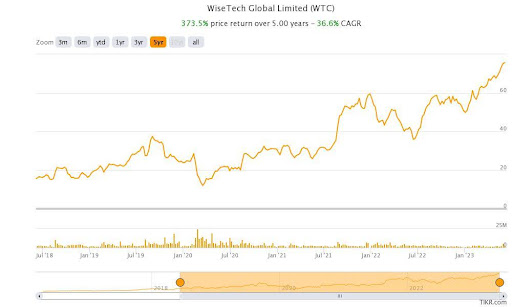
WiseTech Global, a provider of software solutions to the logistics industry has mirrored the performance of US tech counterparts up over 40% in the past 6 months. This is nothing new for WiseTech though, with a 5 year price return of 373% equivalent to a 5 year compound annual growth rate (CAGR) of 36.6%!
WiseTech has seen its revenue growth return after a difficult period through the pandemic reporting an organic increase of 35% in the first half of 2023 and converting that into a 52% increase in free cash flow compared to the prior period. At the time of writing, WiseTech is trading at a 12 months price to sales multiple of 29 as of the end of March 2023, which is at the higher end of technology valuations.
Altium
Unfortunately for Altium shareholders the company hasn’t enjoyed the same price appreciation that WiseTech has experienced, relatively flat for 6 months.
Altium is in the business of development and sale of computer software. The company lays claim to some of the MAMAA businesses as customers as well as Tesla (NASDAQ: TSLA), Spacex and NASA. Altium has emerged from declining revenues during the early stages of the pandemic to now showing growth in the top line again. In its 2023 Half-Year results presentation the company displayed an increase in revenue of 17% compared to the prior corresponding period as well as 30% growth in profit after tax.
While these are solid numbers it would appear that a lot of this is baked into the current valuation.
At time of writing, Altium currently trades at around 14 times its last 12 months revenue which is down from a 5 year high of 24 times at the end of December 2021 and off a low of 10 times in March 2020.
Appen
The second lot of the A’s, Appen’s 6 month increase of 25% while positive, will do little to relieve long term holders of their pain.
Zooming out you get a better picture of how the AI data labelling business has performed with a 5 year price decline of over 70%. Appen has seen its revenue and gross margins decline, taking the share price with it.
Perhaps the recent rebound is the start of a turn around for Appen, however the company might be swept up in the momentum of AI-mania. Time will tell.
Appen recently completed an equity raising with the proceeds to be used to fund one-off costs associated with a cost reduction program and provide support for its balance sheet and working capital. Like many tech businesses, Appen has seen the light and is focussing on cost reduction and claimed to have identified ~$10 million of cost savings in its 10 May 2023 announcement.
Xero
Finally, the X of WAAX being Xero.
The accounting software company’s shares more than halved during the 2022 calendar year, dropping from a peak of $146 in January and falling into the $60’s in November. Hindsight shows that the end of 2022 would have been a great time to buy with the share price appreciation over 50% to be the best performer of the group to date. Like Appen, Xero has shown a focus on cost cutting with their new CEO Sukhinder Singh Cassidy announcing in March 2023 that they would be cutting staff and streamlining Xero’s business.
This was followed by their 2023 earnings results which showed revenue growing by 28% and free cash flow increasing by $100 million to $102 million.
Xero did however report a net loss of $113 million up from a loss of $9 million in the prior period as Singh Cassidy and her team wrote off a number of previous acquisitions.
So who performed better?
In the battle of acronyms, it seems that MAMAA could surpass WAAX in terms of performance, with the US-based businesses all experiencing growth. However, some of the ASX-listed companies have still demonstrated commendable share price appreciation. As FAANG transformed into MAMAA, it raises the question: if this heralds the dawn of a new bull market, could we anticipate the emergence of fresh ASX acronym contenders?
So, who next?
Outside of the WAAX group there have been some other technology companies that have had great price movement over the last 6 months.
NEXTDC Limited (ASX: NXT), a provider of data centre outsourcing solutions has seen its share price grow 33% soaring above $12 per share well off its 52 week low of $8.22. Designer and manufacturer of electronic equipment Codan Limited (ASX: CDA) has doubled its price over the same period following a positive trading update in January. Finally, Weebit Nano Ltd (ASX: WBT) has had a remarkable increase in price of 78.8% which is impressive given the business has no revenue as of 31 December 2022 or cash receipts within the March 2023 quarter.
While one swallow doesn’t make a summer, the last 6 months have been welcome relief for some tortured tech investors. As the nightmare of 2022 is beginning to disappear into the rearview mirror, is there a sustained bull market on the horizon? Or perhaps a trap for those tech inclined investors who are just seeking some relief in the rally? Either way, we’ll only know in hindsight but it is encouraging to see that after a significant sell off there is some life in the sector and it’s not completely isolated in America.
*Disclaimer: we do not currently hold these companies in the TAMIM portfolios.
This week’s reading and viewing list covers the new Apple Vision, the birth of Bulls (markets), the value of good ideas and walking away with Peter Lynch, amongst other ideas we are sure you will find interesting and useful…