This week’s reading and viewing list covers Elon Musk’s X Factor, The four-hour work day and Samo Burja discussing the The Great Founder Theory of History.
The Wall Street Journal recently published a personal finance column entitled “America’s Retirees Are Investing More Like 30-Year-Olds” that showed a marked change in the investment preferences of older Americans.
In particular, it showed a strong trend towards a higher allocation of stocks in older investors’ portfolios over the past decade:
Nearly half of active Vanguard 401(k) investors (similar to an Australian self-managed superfund) aged over 55 held more than 70% of their portfolios in shares, a dramatic increase from the 38% in 2011.
Approximately 40% of Fidelity Investments investors aged 65 to 69 hold two-thirds or more of their portfolios in shares.
In Vanguard’s taxable brokerage accounts, around 20% of investors aged 85 or over (and 75 to 84) have nearly all their money in stocks, up from 16% in 2012.
Conventional investment advice suggests that having such a high allocation to shares is risky at this life stage. If by chance the investor needs to make a withdrawal during a market crash, they’ll have to sell at heavily reduced prices–receiving less funds than they expected and experiencing the disappointment when markets inevitably rebound. Even those supporting themselves with income from a portfolio can suffer, as we saw during the pandemic when even the large and well-known companies restricted or suspended their dividends. This is part of the reason the “60/40” portfolio (consisting of 60% equities, 40% bonds) has become the go-to for financial advisors.
So what’s causing the shift towards stocks, and will it continue?
Interest Rates Below Inflation
There’s no doubt that one of the biggest drivers of higher stock ownership among seniors has been the decline in interest rates, which has driven down the returns on cash and fixed income investments. In 1982, 10-year U.S. treasury bonds yielded a near-unthinkable 14.2%, while in 2021 it was unthinkable for the opposite reason, recording less than 1% at year-end.
Inflation targeting is an economic concept pioneered by the New Zealand central bank, but is now applied in the U.S., Europe, Australia and the United Kingdom, among others. While the targets differ slightly, these central banks typically target long-term inflation rates in the range of 2% to 3% (this is the target in Australia, while the U.S. targets approximately 2%).
Assuming that the central bank achieves this inflation goal, an investor purchasing a 10-year government bond returning 1% per annum is locking in a real loss of 1% to 2% per year for the next decade. And that’s assuming inflation remains at the low levels we saw for the decade after the Global Financial Crisis (GFC).
Unfortunately, the past couple of years has seen the highest rates of inflation in around 40 years, fueled by several different factors: supply chain challenges due to the pandemic, labour shortages, and the war in Ukraine, to name a few. Fixed income securities have even less appeal in such an environment, particularly if investors feel the inflation will persist (or even worsen, as those who were around for the 1970s will remember).
Success In the Stock Market
Baby boomers in particular have had a terrific ride on the share market for the past few decades. Not only have asset prices risen at a healthy rate, investors have been able to opportunistically put money to work at very favourable prices–especially during the Global Financial Crisis, for example. Investors with decades of success in the share market are likely to understand the investing process quite well, and to be very attracted to this method of wealth creation–something that’s unlikely to change significantly in a short space of time.
This confidence in the share market has only been enhanced by the actions of central banks during the previous economic crises–particularly the GFC and the recent coronavirus pandemic. Central banks around the world provided an unprecedented level of support, both in scale and the approaches used, including slashing benchmark interest rates (making bonds and cash even less appealing) and engaging in “unconventional monetary policy” such as quantitative easing. This has only reinforced investors’ mindsets about the long-term success of owning equities.
As Robert Shiller, the Nobel Prize-Winning economist at Yale University most known for the Shiller PE ratio, said “The spirit of the times is ‘Don’t worry about the markets crashing. They will come back up and set new highs. Index funds such as Vanguard also support this notion, publishing long-term charts showing the resilience of the stock market despite economic, political and other challenges, and providing information about strategies such as dollar-cost averaging for amateur investors.
Low Fees, Low Maintenance, Tax Benefits
Countless people have been successful investing in property of various kinds, including land, residential and commercial real estate. One downside of property ownership however, is the much higher costs compared with shares. There are fees to the agents when buying and selling, council rates, maintenance and repair costs, and stamp duty or land taxes–not to mention the time required to manage tenants or meet with buyers/developers (there can be a bit of paperwork too, particularly with some of the more traditional banks). Many people also are put off by the idea of taking on substantial debt, which is usually required for most real estate deals.
The costs of share ownership, on the other hand, have been declining precipitously for decades. Accounts can be opened quickly and easily, onerous fees such as monthly account and custodial fees have gone by the wayside, transaction costs reduced to single digit dollars ( even free, under certain circumstances), and trading and deposits/withdrawals can be done at the click of a button (Robin Hood is even trying to move it to 24-hours). Long gone are the days of “I have to call my broker”, with interfaces so intuitive that Robin Hood has even been accused of “gamifying” the process (a topic for another day).
With professional management, diversification, low fees, and transactions at the click of a button, there’s a lot of appeal to retirees wanting to simplify their money management. Franking credits are the icing on the cake, particularly for retirees who may have their tax affairs structured to receive a refund for the corporate tax paid by their portfolio holdings.
The TAMIM Takeaway
Today’s older investors have shunned the conventional wisdom of the 60/40 portfolio, and it’s easy to see why. By and large, they’ve had a long and successful history in the share market, buying on any weakness and holding on for the rich rewards that share ownership can bring.
As interest rates have risen, the yields on savings accounts and bonds have become more attractive. Some pundits are even suggesting that 2022 signalled what may prove to be the end of a 40-year bull market in bonds (suggesting that bond yields will continue to rise). While this might encourage some older investors to diversify their portfolios a bit more, it seems unlikely that the trend of higher share ownership will change anytime soon.
Equities are designed to provide higher long-term returns than bonds (because of the greater risk that an investor takes with each individual investment), and they provide much greater inflation protection–something retirees might have in mind thinking back to the 1970s. Additionally, the low fees and low maintenance are of great appeal to people wanting to make the most of their time after a lifetime of paperwork. Certainly, the greater transparency and regulation that has brought more integrity to the markets hasn’t hurt either.
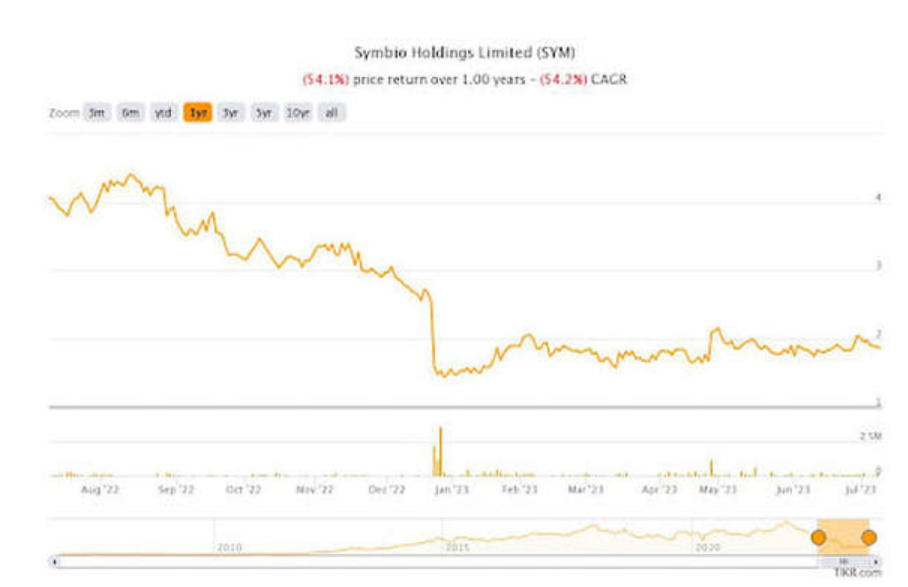
Symbio Holdings (ASX: SYM) dropped a stunning 37.5% in a single session following a trading update on 20 December 2022.
The communications software provider announced a sharp decrease in its expected FY23 operating earnings (EBITDA) with a decrease in the midpoint guidance of 25% to between $26 million to $30 million. The plunge in expectation was largely due to the Communications Platform-as-a-Service (CPaaS) division where US customers had been returning excess inventory as well as a number of deals with its Australian customers taking longer than expected to finalise.
In response, Symbio has looked internally to reduce expenditure in an attempt to reduce its cost base.
At the time it announced that it would defer selected product development and projects into the second half of 2023 while also reducing discretionary spending in travel, marketing and pausing recruitment all together.
But what has happened since?
Toward the end of April 2023 the company re-confirmed its guidance to be between $26 million to $28 million citing stabilised market conditions and improving domestic and global demand. The Symbio share price has also seen a resurgence from its 52 week low of $1.34 shortly after the December update and has lifted almost 40%. Great news for short term holders although zooming out the one year and three year price performance there has been little relief.
The Company
Symbio provides communication services to software companies, telecom providers and enterprise customers globally.
It is positioning itself as a disruptor of legacy physical networks with the mission to convert customers to cloud based infrastructure and provide faster, easier ways to deliver communication services. The company is experiencing significant tailwinds following increased adoption of cloud based telephone and remote conferencing communication.
Symbio’s customers include some serious global players including Alphabet Inc. (NASDAQ: GOOGL), Microsoft (NASDAQ: MSFT), Zoom Video (NASDAQ: ZM) and Cisco (NASDAQ: CSCO) to name a few.
Symbio 1H23 Results Presentation
The company operates through three divisions which were established in the 2022 financial year as part of its “Vision 2030” strategy, these divisions are:
CPaaS – Communications Platform as a Service
The CPaaS division targets global software companies and larger infrastructure based service providers with the aim to enable calling and messaging via Symbio hosted phone numbers. As part of its strategy Symbio is targeting 100 million phone numbers on its network.
UCaaS – Unified Communications as a Service
The UCaaS division operates cloud calling services and includes partnerships with Microsoft Teams, Cisco WebEx, Twilio and other enterprise software specialists. UCaaS purchases infrastructure from CPaaS with its mission to enable the roll-out and self-service management of enterprise collaboration services across Australia and Asia-Pacific.
TaaS – Telecom as a Service
The TaaS division provides a digital platform for small Australia service providers to operate their own, fully branded, telecom and managed services business. TaaS operates under the Telcoinabox subsidiary and like UCaaS purchases infrastructure from CPaaS as well as other vendors of complementary telecom services.
Post COVID blues
Symbio was not immune to the risk-off trade that played out during 2022.
After soaring to high’s above $7 per share in November 2021 on the back of increased demand for remote communication solutions during the pandemic, the company’s share price fell, feeling the pressure of rising interest rates and inflation in a market where technology stocks were significantly out of favour.
This culminated in the December 2022 revised guidance where it was emphasised that orders were reverting back to normal pre-pandemic operating levels and a softer economy was having an impact on growth.
Looking ahead
As mentioned Symbio confirmed its FY2023 EBITDA guidance in April with the expectation that the initiatives it has put in place should continue to lower the cost run-rate in the 2024 Financial year.
The market lapped this up with a 25% share price increase in the session, appreciating the news that the expansion into Singapore, Malaysia and Taiwan could increase its total addressable market by 170% to 100 million people by 2024.
Co-Founder and CEO Rene Sugo commented:
“It is pleasing to see the global technology sector improve in Q3 and return to a growth focus. Symbio’s strong balance sheet and clear strategic vision will allow us to capitalise on the supportive mega-trends that underpin our long-term growth, both domestically and in Asia.”
Is it a takeover target?
In the small to mid-cap space of the market, there has been a significant rise in merger and acquisition (M&A) activity recently. This trend has caught our attention, and we believe it presents an opportunity worth exploring. Particularly, Symbio, currently trading at a depressed valuation, has the potential to become an appealing target for acquisition by a larger suitor.
Two prominent contenders in this potential acquisition scenario are Aussie Broadband (ASX: ABB) and Superloop (ASX: SLC). Each company brings distinct motives to the table, offering different yet compelling reasons for considering a deal with Symbio.
Aussie Broadband, having recently acquired Over the Wire (OTW), competes directly with Symbio. It appears that substantial synergies, amounting to over $10 million, could be unlocked through the proposed deal. The addition of Symbio to Aussie Broadband’s portfolio could boost its EBITDA by approximately 40%, showcasing the potential for considerable growth.
On the other hand, Superloop sees an opportunity to leverage complementary services and synergies from a potential deal with Symbio. During their recent investor day, the company emphasised the significance of M&A in their growth strategy. Highlighting their strong financial position and long-term earnings ambition, Superloop’s Managing Director, Paul Tyler, hinted at the possibility of exploring opportunities that could be “very accretive” for the company. Integrating Symbio into Superloop’s operations is estimated to increase their EBITDA by up to 80%, significantly advancing their three-year target of doubling the size of their business.
The current M&A activity in the market has led us to closely examine the prospects of Symbio and other small caps as potential acquisition targets. Symbio’s current valuation and strategic positioning could attract the attention of key players in the industry and deserves some second-level thinking.
Watch this space.
Disclaimer: Symbio Holdings (ASX: SYM) and Aussie Broadband (ASX: ABB) are held in TAMIM Portfolios as at date of article publication. Holdings can change substantially at any given time.
This week’s reading and viewing list covers the market at mid-year 2023, why a Japanese company banned late-night work and Kyle Bass On China: ‘We Sit At A Hinge In History Right Now’.