Qualcomm, short for Quality Communications, is the global leader in mobile connectivity. The company’s hardware and systems are ubiquitous across both Android and Apple handsets with the technology enabling billions of users to call, text and stream every day.
“Hard” technology companies such as Qualcomm are our preferred exposure in the technology sector. The business possesses true intellectual competitive advantages that are difficult to replicate, even with the world’s leading engineers and abundant financial resources (as you’ll see below). The company remains a long-term holding for the fund, a quiet winner in the tech arena.
The Mobile Era
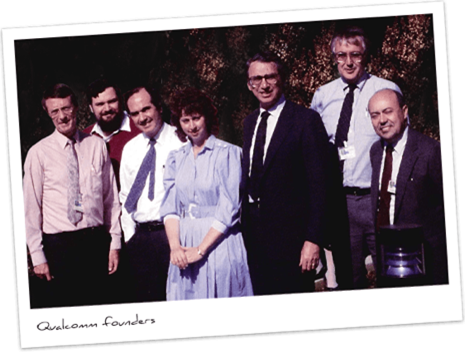
Founded in 1985 by Irwin Jacobs and six co-founders, the business initially conducted communications research. Its first products were satellite phones for trucking companies, however the research team had greater ambitions. Qualcomm had patented a new cellular technology called code division multiple access (CDMA), allowing several users to simultaneously transmit data across the same frequency.
This was more efficient than the incumbent Time Division Multiple Access (TDMA) system, where users could only transmit data during a given time slot. Despite the incumbent technology being simpler, and in the initial years more reliable than CDMA, it was not suited to high-capacity communications. Over time cellular networks and handsets adopted the CDMA system entrenching Qualcomm as the standard for mobile connectivity.
Demand for the company’s modems – the small chip that enables a phone to connect to cellular towers – proliferated as mobile phone adoption grew. Handset manufacturers were eager to include the latest modems, and later semiconductors, in their products to capitalise on the emerging personal electronics market.
With the best communications hardware, Qualcomm became a cost of doing business. And while hardware sales were booming, Qualcomm had another equally lucrative profit engine. The company patented and subsequently licensed its intellectual property to competing modem and handset manufacturers, earning a royalty on every mobile device sold.
That intellectual property would continue to serve the company, providing the foundation for 3G, 4G and 5G mobile communications, and with it more patents and licensing deals.
Apple Takes A Bite
Qualcomm had built an unassailable lead in mobile. So much so that competitors, customers and regulators have been keen to dent the company’s market leadership. The fiercest battle has been with Apple, which has previously litigated Qualcomm for anti-competition practices and in 2017, began work on an in-house modem. Given Apple represents ~20% of Qualcomm’s revenue, this has been a dark cloud over the company. For several reasons, however, the Apple-Qualcomm rift is likely overblown.
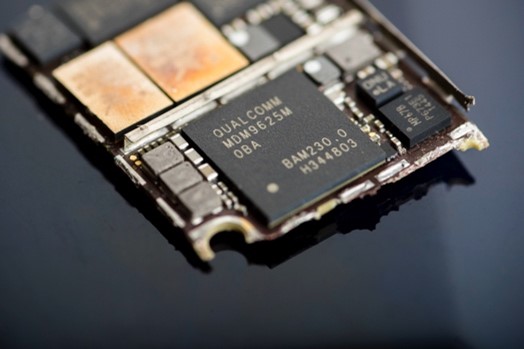
After the processor, the modem (pictured) is the most important component of a phone. Qualcomm’s chips are the best and have been battle-tested for decades across several platforms. From an iPhone user standpoint, there is limited functionality upside and tremendous downside should the components prove less robust than Qualcomm. More simply, users don’t mind who makes the modem, as long as it works.
Moreover, building modems is not a simple exercise, with Apple themselves acknowledging it’s “very difficult”. Apple has since extended supply agreements with Qualcomm until at least 2027. And even assuming Apple succeeds, we expect Qualcomm will have made strides to diversify away from handsets (and Apple) to new revenue streams.
The Future
Qualcomm recently announced that Microsoft Copilot personal computers, produced by several vendors including Dell, Acer, Lenovo, HP and Microsoft itself, would be exclusively powered by the company’s proprietary SnapdragonX system-on-chip.
Meta is already using Qualcomm chips for smart glasses and powering Llama2 – ChatGPT’s closest competitor. Snapdragon processors have been modified for automotive applications including facial recognition, cloud-connected content and digital chassis. The latter has a sizable runway for growth given cars have been a laggard in adopting consumer consumer-facing tech. In the latest quarter, automotive revenue increased 87% to US$811 million.
The Tamim Takeaway
The future remains bright for Qualcomm, irrespective of if (or when) Apple produces its modems. The market has largely agreed with us, with the Qualcomm share price doubling over the past five years. Still, the business remains modestly valued on 20x earnings and a 2% dividend yield, despite several growth vectors and the rise of artificial intelligence applications.
Disclaimer: Qualcomm Incorporated (NASDAQ.QCOM) is held in TAMIM Portfolios as at date of article publication. Holdings can change substantially at any given time.
This week’s TAMIM Reading List delves into the intersection of technology, creativity, and health. We explore how machines are revolutionising drug discovery and the fluctuating journey of Pixar’s success. Discover the rising popularity of Ozempic, the app Signal’s bold stand against surveillance capitalism, and the science behind achieving a flow state for heightened creativity. We also present predictions for AI’s next big moves, a musician’s AI-powered streaming heist, and the amusing error where Google thought Beethoven resembled Mr. Bean. Each article offers a unique take on the forces shaping our world.
EML Payments Limited (ASX: EML), a global leader in payments solutions, is in the midst of a strategic overhaul. With the release of its FY24 results and a thorough investor briefing, EML is making significant strides toward a brighter future. The company’s focus on debt reduction, operational efficiency, and renewed growth signals a positive transformation that could redefine its trajectory.In this update, we’ll explore the key highlights from EML’s FY24 performance, examine how recent strategic decisions—such as the sale of Sentenial—are setting the stage for future success, and look at what lies ahead for this innovative payments company.
Strong FY24 Results and Strategic Milestones
EML’s FY24 results brought much-needed optimism to investors- although that wasn’t readily seen from the share price reaction post the results. The standout figure was an underlying EBITDA increase of 34%, reaching $57.1 million, at the higher end of guidance. Revenues rose 18% to $217.3 million, fueled by a 6% bump in customer revenue. This growth was particularly evident in EML’s General Purpose Reloadable (GPR) and Digital Payments segments.This performance is largely due to EML’s focus on cost optimisation and its success in securing new business toward the end of FY24. Notably, the company’s regulatory remediation in the UK has been completed, removing growth cap restrictions, which now allows EML to expand in this key market.
Key Segment Performance: Gifting, GPR, and Digital Payments
All three of EML’s major segments—Gifting & Incentive, General Purpose Reloadable (GPR), and Digital Payments—performed well in FY24 although were skewed to the 1H, showcasing the company’s ability to diversify its revenue streams.
Gifting & Incentive: Gross Debit Volume (GDV) increased by 5% to $1.8 billion, with revenue rising 9% to $81.5 million, driven by the success of corporate incentive programs.
General Purpose Reloadable (GPR): A core business area for EML, the GPR segment saw a 3% rise in GDV to $7.8 billion, and customer revenue grew by 7%. This was largely due to strong demand in the government and human capital sectors.
Digital Payments: Recorded a 19% increase in GDV, reaching $236.8 billion. This was supported by EML’s Sentenial business, which has now been fully divested in early September and removes a loss making and non core division from the group.
Sentenial Sale: A Game-Changer for EML’s Balance Sheet The sale of Sentenial, including its Nuapay business, to GoCardless for €32.75 million (~AUD $53.4 million) has been a transformative move for EML. This transaction allowed the company to shift from a net debt position of $48 million to a net cash position of approximately $5 million post FY24 balance date. There is an additional earnout kicker for EML if Sentenial delivers better growth than expected next 12 months.This improved liquidity provides EML with the flexibility to focus on its core operations and invest in new growth areas. Additionally, the company now has access to a $70 million debt facility, giving it further financial headroom for future initiatives.
Future Growth Strategy: EML 2.0
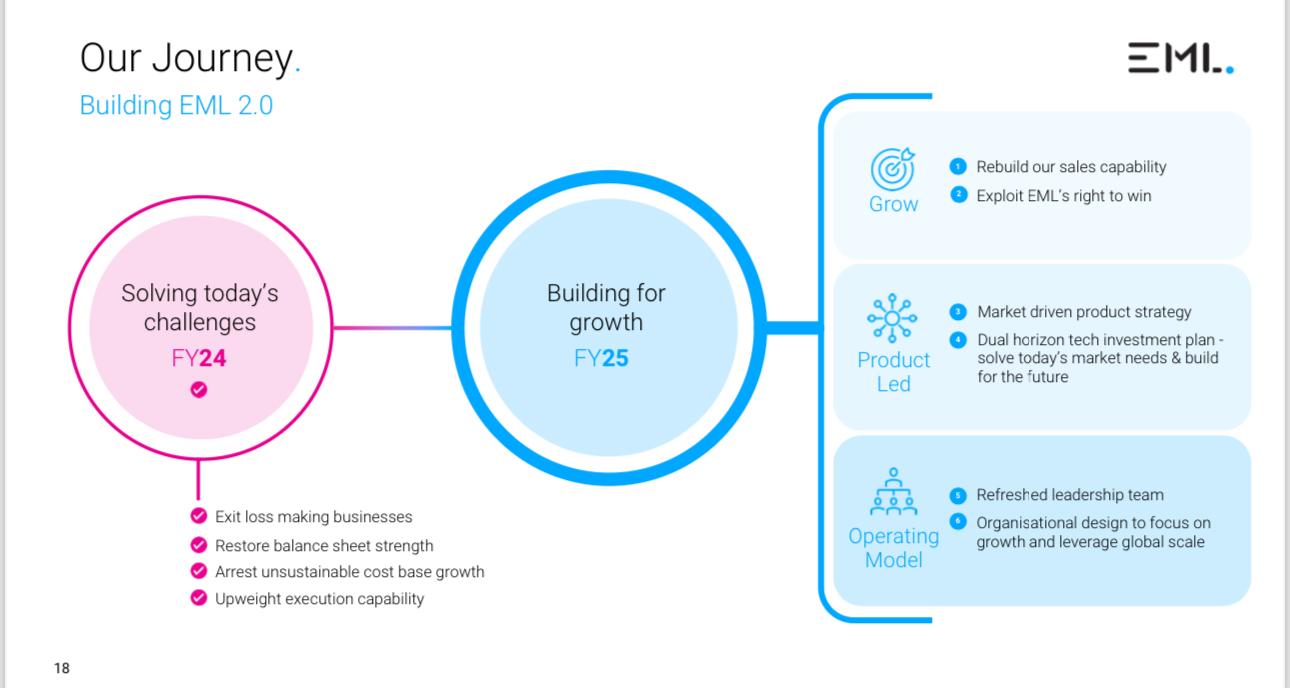
Under the leadership of CEO Ron Hynes, EML’s “EML 2.0” strategy focuses on three core areas:
Reinvigorating Growth: EML is doubling down on organic growth, enhancing its sales and go-to-market strategies to expand its customer base, particularly in the UK, where growth restrictions have been lifted.
Product-Led Innovation: The company is aligning its product roadmap with evolving customer needs, leveraging data analytics and artificial intelligence to offer more innovative payment solutions.
Uplifting Organisational Capabilities: EML is streamlining its operations and bringing in new talent to ensure its growth strategy is executed effectively. Key hires in sales and other critical areas are expected in the near future.
Customer Churn: Addressing North American Challenges
While EML’s outlook is generally positive, challenges remain, especially in North America, where customer churn has impacted performance in the shopping mall gift card division. This churn is attributed to the financial difficulties of certain customers. However, EML is rebuilding its sales pipeline and improving customer retention strategies to mitigate these challenges.
Long-Term Outlook and the Road Ahead
Looking ahead, EML’s guidance for FY25 estimates underlying EBITDA between $54 million and $60 million which compares well versus the $49 million EBITDA for FY24 excluding PCSIL contribution. The company will focus on cost optimisation, responsible growth, and technology investments as part of its long-term strategy. EML is expected to provide a more comprehensive medium-term strategy at its November 2024 AGM, giving investors more insights into its future financial and operational metrics. We believe this will be a key catalyst for the trajectory of the stock in the short term.With regulatory challenges behind it, a revitalised leadership team, and a strengthened balance sheet, EML is well-positioned to take advantage of the growing global payments market.
The Tamim Takeaway
EML Payments has made meaningful strides in its turnaround journey, with FY24 results indicating a stronger financial position and a more focused growth strategy. The sale of Sentenial and the lifting of growth caps in the UK are critical milestones that set the stage for future expansion. While challenges like customer churn remain, EML’s strategic initiatives provide confidence in its ability to deliver long-term value to shareholders. Trading on an undemanding 4.8x EV/Ebitda, we believe a takeover of EML in the near term is likely. _______________________________________________________________________________________
Disclaimer: EML Payments Limited (ASX: EML) is held in TAMIM Portfolios as at date of article publication. Holdings can change substantially at any given time.
On his 94th birthday, Warren Buffett, the “Oracle of Omaha,” remains one of the most respected and influential figures in the world of finance. While many might choose to slow down in their later years, Buffett continues to captivate investors with his timeless wisdom and disciplined approach to markets. More than seven decades into his career, Buffett’s influence goes far beyond the monumental successes of Berkshire Hathaway, his investment conglomerate, and stretches into the hearts of everyday investors seeking to emulate his strategies and learn from his philosophy.
Berkshire Hathaway’s $1 Trillion Milestone
In 2024, Berkshire Hathaway, the investment vehicle that Buffett has managed since the 1960s, achieved a historic milestone, surpassing $1 trillion in market value. This is a particularly notable achievement because Berkshire is the first non-tech company to reach this valuation. In a world dominated by tech giants like Apple, Amazon, and Microsoft, Berkshire’s achievement underscores the power of a diversified investment approach rooted in strong fundamentals.Berkshire Hathaway’s rise to prominence is a testament to Buffett’s ability to invest in businesses that generate sustainable profits over the long term. His strategy has consistently emphasised value over growth, patience over excitement, and a focus on understanding businesses rather than chasing trends. As Buffett famously says, “The stock market is a device for transferring money from the impatient to the patient,” a principle that has guided Berkshire’s expansion into one of the world’s largest and most successful companies.
Lessons from Buffett’s Investing Philosophy
Buffett’s investing career is characterised by an unwavering commitment to value investing, a strategy pioneered by his mentor, Benjamin Graham. Value investing emphasises buying stocks that are undervalued by the market, with the understanding that their intrinsic value will eventually be recognised. This approach is predicated on patience, discipline, and a deep understanding of a company’s fundamentals.One of Buffett’s most famous quotes encapsulates this mindset: “Be fearful when others are greedy, and greedy when others are fearful.” This philosophy encourages investors to avoid the herd mentality that often leads to bubbles and crashes, and instead focus on buying quality assets at reasonable prices during times of market distress. It’s a reminder that successful investing requires not just knowledge, but emotional fortitude to stay the course during turbulent times.Buffett’s success is also rooted in his commitment to simplicity. He famously avoids complex financial instruments and speculative assets, favoring straightforward businesses that he can understand. Whether it’s Coca-Cola, American Express, or GEICO, Buffett’s investments are typically in companies with strong brand recognition, consistent earnings, and a durable competitive advantage. In an age where cryptocurrency and meme stocks dominate headlines, Buffett’s focus on “boring” companies serves as a reminder that steady, predictable businesses often deliver the best long-term results.
The Power of Compound Interest
One of Buffett’s most powerful tools has been his ability to harness the magic of compound interest. He often describes compounding as the “eighth wonder of the world” and credits much of his wealth accumulation to its long-term effects. By reinvesting earnings and allowing them to grow over time, Buffett has demonstrated the exponential benefits of patient investing.Consider this: A $10,000 investment in Berkshire Hathaway stock in 2010 would be worth nearly $60,000 today, a 500% return over 14 years. That translates to an annualised return of 13.4%, a remarkable achievement in a market that has seen its fair share of volatility. This example highlights the importance of staying invested over the long term, allowing compound interest to work its magic.For investors, the lesson is clear: time in the market is far more important than timing the market. Trying to predict short-term market movements is often a losing game, whereas holding quality investments for decades can yield substantial rewards. As Buffett says, “The stock market is designed to transfer money from the active to the patient.”
Buffett’s Humility and Learning Mindset
One of Buffett’s most admirable traits is his humility and willingness to admit mistakes. Despite his legendary status, Buffett is quick to acknowledge when he gets things wrong. He has openly admitted to misjudging certain investments, such as his foray into the airline industry, where he sold his stakes at a loss during the COVID-19 pandemic.This humility is a cornerstone of Buffett’s success. Rather than stubbornly clinging to failing investments or trying to “prove” his intelligence, Buffett embraces the reality that no investor is infallible. His focus is always on learning from his mistakes and using those lessons to make better decisions in the future. In a world where egos often drive financial decisions, Buffett’s approach serves as a reminder that self-awareness and a willingness to adapt are critical to long-term success.Buffett’s passion for learning is also evident in his daily routine. Even at 94, he spends hours reading each day, consuming newspapers, books, and financial reports. His voracious appetite for knowledge has allowed him to stay ahead of the curve in a rapidly changing world. For investors, Buffett’s example underscores the importance of continuous learning and intellectual curiosity in navigating the complexities of the market.
Patience and Emotional Control
In addition to his intellectual prowess, Buffett’s emotional control is a defining characteristic of his investment approach. The stock market is a rollercoaster of emotions, with prices fluctuating based on news, rumors, and sentiment. However, Buffett has consistently demonstrated the ability to remain calm and rational, even in the face of market downturns.During times of panic, such as the 2008 financial crisis or the COVID-19 pandemic, Buffett didn’t rush to sell his holdings. Instead, he viewed these crises as opportunities to buy quality companies at discounted prices. This ability to control his emotions, rather than react impulsively, has been one of the key factors behind his long-term success.Buffett’s approach to risk is also instructive. He doesn’t shy away from risk, but he carefully evaluates it. His famous rule is, “Rule No. 1: Never lose money. Rule No. 2: Never forget Rule No. 1.” While this doesn’t mean that Buffett has never experienced losses, it speaks to his focus on capital preservation and his meticulous evaluation of the downside in every investment decision.
A Legacy of Generosity
Beyond his investing prowess, Buffett is equally renowned for his philanthropy. In 2006, he pledged to give away more than 99% of his wealth to charitable causes, with the majority going to the Bill & Melinda Gates Foundation. Buffett’s generosity is a reflection of his belief that wealth should serve a higher purpose. He often emphasises that money is merely a tool and that success should be measured not just by financial gain, but by the positive impact one can have on the world.Buffett’s philanthropic efforts extend beyond his personal giving. He has encouraged other billionaires to follow suit through the Giving Pledge, an initiative he co-founded with Bill Gates. The Giving Pledge invites the world’s wealthiest individuals to commit to giving the majority of their wealth to charitable causes, either during their lifetimes or in their wills. This initiative has inspired over 200 billionaires to make similar commitments, further cementing Buffett’s legacy as a force for good.The TAMIM TakeawayAs Warren Buffett celebrates his 94th birthday, his principles of value investing, patience, and emotional control remain as relevant as ever. His humility, relentless pursuit of learning, and commitment to philanthropy set a powerful example—not only for investors but for anyone seeking to lead a meaningful life.For modern investors, the key takeaways from Buffett’s career are clear: focus on long-term value, embrace simplicity, stay patient, and never stop learning. While markets may change, these principles stand the test of time, offering a steady guide in the ever-evolving world of finance.