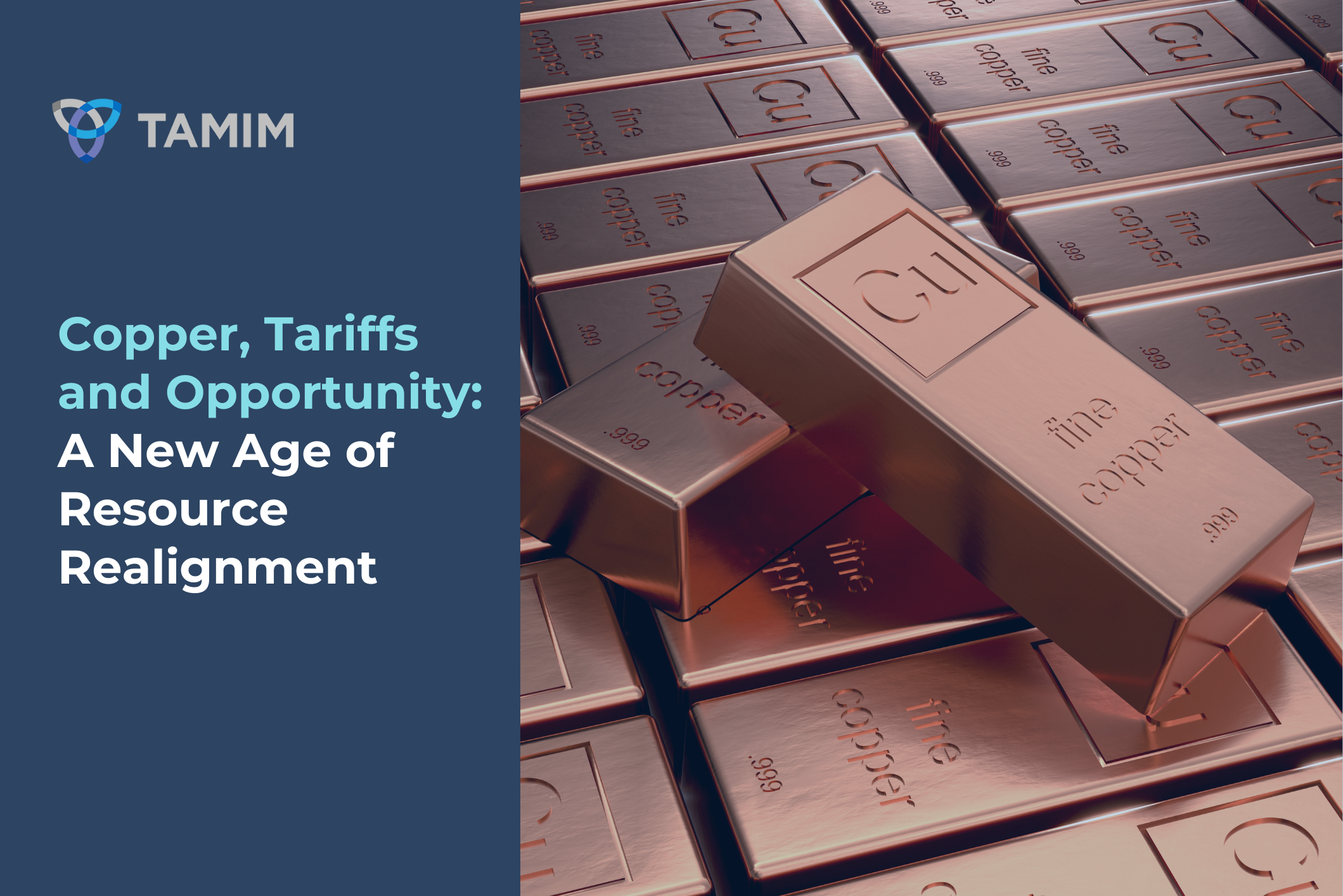
It has long been said that copper is the metal with a PhD in economics. As a bellwether for industrial growth and technological advancement, copper demand tends to precede major shifts in global economic trends. In this context, the United States’ recent imposition of a 50% tariff on copper imports signals more than a mere trade policy adjustment, it represents a geopolitical inflection point, one that could define the next decade of resource strategy, industrial policy, and investment.
The move, widely seen as a counterstrike against China’s midstream dominance in copper refining and value-added processing, introduces volatility but also opportunity. For Australian investors, particularly those with exposure to resource and infrastructure themes, understanding the implications of this tariff is crucial.
Trump’s Copper Gambit: Rewiring the Supply Chain
Despite minimal direct copper imports from China to the US, the broader reality is that China controls over 40% of global refined copper production. It has spent the past two decades building a near-monopoly on midstream processing. The US, in contrast, remains dependent on copper products from global supply chains, particularly in electronics, automotive, defence, and power infrastructure.
The 50% tariff, therefore, is less about protecting US miners and more about forcing a re-evaluation of where copper comes from, who processes it, and how secure that chain really is. In essence, this is about reshoring. It’s also about hedging against future geopolitical risks, from Taiwan to semiconductors, and making domestic supply chains more resilient.
Whether or not the tariff achieves these goals remains to be seen. But it has already introduced a new dynamic to the global copper market: unpredictability.
Winners and Losers: Short-Term Volatility, Long-Term Themes
From a macro lens, tariffs typically distort trade flows, increase costs for end users, and redirect capital toward domestic substitutes. But copper is no ordinary commodity. It sits at the heart of both the old economy (construction, machinery, transportation) and the new (electric vehicles, renewable energy, AI data centres).
If tariffs successfully curtail refined copper imports from China, they could unintentionally drive up prices globally as demand pivots to producers outside the Chinese sphere of influence. This could benefit diversified miners like BHP and Rio Tinto, despite their initial surprise at the announcement.
Smaller ASX-listed copper developers and producers such as Sandfire Resources, 29Metals, and Aeris Resources, could also gain from heightened investor interest in local and allied-source supply. Meanwhile, midstream investments (smelting and refining) in North America and Australia may enjoy a renaissance if policy starts to favour local value-add.
However, this comes with risk. China is still the dominant buyer and refiner. Disruptions to trade flows could dampen treatment charges and complicate existing supply agreements for Australian producers exporting concentrate to Chinese refiners.
Strategic Metal, Strategic Stakes
What makes copper different today is its relevance to the energy transition. AI servers, wind turbines, solar panels, EVs, all of them need copper, and lots of it. The International Energy Agency (IEA) estimates that copper demand could double by 2040 under a net-zero scenario.
This puts copper in the same strategic category as lithium, rare earths, and semiconductors. Any attempt to control its pricing or supply will have ripple effects far beyond resource companies. Expect increased diplomatic jockeying, as nations seek to secure long-term supply via trade agreements, sovereign deals, and strategic reserve building.
Trump’s move might just be the first shot in a longer resource war.
Implications for Australian Investors
Australia sits at an enviable position in the copper value chain. While our midstream capabilities are underdeveloped, our upstream resources are world-class. Projects such as BHP’s Olympic Dam and Oak Dam, OZ Minerals (now also BHP), and potential developments in Queensland and Western Australia are all likely to become more valuable in a world scrambling to secure friendly-sourced copper.
For Tamim investors, the message is clear: volatility brings opportunity. In the short term, markets may overreact to headline risks. But over the medium term, companies that offer scale, jurisdictional safety, and optionality across the value chain will outperform.
TAMIM Takeaway: Invest in Certainty Amid the Chaos
At Tamim, we believe the copper tariff is emblematic of a larger trend: the weaponisation of trade policy in the service of industrial strategy. It reflects a world where resource nationalism, decarbonisation, and technology all intersect.
Investors would do well to:
Monitor copper-exposed businesses with scalable reserves and strong balance sheets
Consider infrastructure enablers and equipment providers as indirect beneficiaries
Stay cautious on companies overly exposed to China for midstream processing
Keep an eye on sovereign developments around strategic reserves and trade flows
While the copper trade may be volatile in the near term, the long-term story remains intact. The world will need more copper, not less. And the reconfiguration of global trade may ensure that the next decade rewards those who align capital with strategy.
Disclaimer: Companies and stocks mentioned in this article are not held in TAMIM Portfolios as at the date of publication. Holdings may change substantially at any time.
This week’s TAMIM Reading List captures a global moment shaped by acceleration, friction, and recalibration. Microsoft’s latest AI model is now outperforming doctors at diagnosing disease, offering a glimpse into a future where machines may lead in medicine. Nvidia crosses the $4 trillion mark, setting a new benchmark in tech dominance, while Telstra announces sweeping job cuts that signal deeper structural shifts. High-end electric vehicles continue to struggle with market fit, and satellite internet ventures face a crowded race for space and scale. In sport, PSG is rising as a new powerhouse while Real Madrid shows signs of strain, and the F1 paddock is rattled by emotional fallout surrounding Christian Horner. A collection of stories where progress is anything but linear.
When Marc Andreessen speaks, the tech world listens. But so too should investors, especially those who want to get ahead of the curve. Andreessen, the co-founder of Netscape, is not just one of the architects of the modern internet but also the visionary behind Andreessen Horowitz (a16z), arguably the most influential venture capital firm in Silicon Valley. From backing Facebook in its early days to shaping today’s AI and defence tech ecosystems, Andreessen has consistently been ahead of the market’s thinking, often by years.
He doesn’t just invest in startups. He helps architect the future.
In a wide-ranging recent podcast conversation, Andreessen shared his outlook on everything from artificial intelligence and national security to venture investing and the changing dynamics of global power. It wasn’t just an exercise in tech evangelism, it was a deeply strategic view of where the world is heading and what kinds of companies will shape (and profit from) the future.
For investors seeking to navigate a decade of disruption, the key is to focus not just on what’s popular now, but what will be essential next. Here’s how Andreessen’s ideas translate into actionable themes for our portfolios.
Theme 1: AI as the Next Industrial Revolution
Andreessen likens the rise of artificial intelligence to the steam engine and electricity, technologies that didn’t just change business models, but rewrote the rules of society. He believes AI will become foundational across sectors, augmenting human capabilities rather than replacing them outright.
In his view, AI is not about a single ChatGPT moment, it’s about embedding intelligence into everything. That’s cloud infrastructure, semiconductors, data pipelines, enterprise software, robotics, and automation. The real winners? Companies building the tools and infrastructure that others depend on.
TAMIM takeaway: Focus on the “picks and shovels” of AI. While consumer-facing AI gets the headlines, it’s the infrastructure, data centres, chips, grid upgrades, and digital supply chains, that powers everything.
Theme 2: From Globalism to National Resilience
Andreessen was blunt: globalisation is breaking down. The illusion of infinite offshoring and just-in-time supply chains has been shattered by pandemics, geopolitics, and wars. He sees the pendulum swinging back to national resilience, particularly in the US, but with echoes worldwide.
What this means is clear: nations will spend big on infrastructure, energy security, local manufacturing, and defence tech. Andreessen notes the “return of the state” as a critical economic actor, especially in areas like semiconductors, AI regulation, and physical infrastructure.
TAMIM takeaway: Look for investment opportunities where the public meets the private, companies enabling modern industrial policy, like grid resilience, defence supply chains, and regional infrastructure build outs.
Theme 3: The Rise of ‘Little Tech’ and The Death of the Middle
According to Andreessen, the future will be a tale of two extremes. On one end, massive incumbents (Google, Apple, Microsoft) have scale, distribution, and compute advantage. On the other end, lean and agile startups are using AI to compete without needing big headcounts or capital. What gets squeezed? The middle.
This bifurcation of the corporate landscape has major implications for investors. The winners will be large-scale platforms or highly specialised, capital-efficient operators. Everyone else will struggle to stay relevant.
TAMIM takeaway: Don’t chase middle-of-the-road tech. Focus on companies with scale or unique moats and avoid those stuck in between.
Theme 4: The Rebirth of Defence and Strategic Tech
A major part of the discussion was defence, not just as a sector, but as a moral imperative. Andreessen highlighted how Silicon Valley is increasingly rediscovering its roots in helping nations solve hard problems. Space, cyber security, autonomous drones, and AI-driven defence systems are no longer fringe, they’re core.
He referenced a changing mindset: one where venture capital doesn’t just back “cool” consumer ideas, but companies solving existential problems. As global tensions rise, governments are deploying capital and talent into defence at scale.
TAMIM takeaway: Strategic tech is back. Investors should track the intersection of AI, aerospace, defence, and national security, and look for dual-use technologies crossing over from military to civilian applications.
Theme 5: Long-Termism, Patience and the Real Economy
Andreessen is also a fierce critic of short-termism in markets. He argues that truly transformative companies often look “overvalued” by traditional metrics until they dominate their sector. Amazon, for example, looked expensive for years before Wall Street finally understood its scale.
His advice? Back real businesses solving real problems and give them time. The next Apple or Nvidia won’t look like a sure thing at the start. They never do.
TAMIM takeaway: Stay focused on long-duration compounders in sectors undergoing structural change, especially infrastructure, energy, and industrials.
TAMIM Takeaway: Investing in the Era of Strategic Infrastructure and AI
What does all this mean for Tamim investors?
It reinforces the core thesis behind our Global strategies and especially the new Global Infrastructurefund: that the next decade belongs to companies enabling the rebuilding, re-securing, and re-industrialising of our economies. From AI infrastructure to energy transition, from defence tech to resilient logistics, the new economy is being built before our eyes.
Marc Andreessen has made a career of seeing around corners. If he’s right (again), the opportunities won’t just be in the apps we download but in the companies rebuilding our physical and digital foundations.
In the world of superannuation, the battle lines have long been drawn between Self-Managed Super Funds (SMSFs) and Industry Super Funds. One side touts scale, simplicity, and passive investing prowess. The other champions control, flexibility, and tailored strategies.
For years, Australians have been nudged towards industry funds by default. These behemoths have invested heavily in advertising, spent billions on infrastructure and private markets, and held the moral high ground as “low-fee, member-first” organisations. But what happens when the cracks in that narrative start to show?
A recent article in the Australian Financial Review has peeled back the curtain, revealing uncomfortable truths about governance failures, opaque decision-making, and a stubborn reluctance to change within some of the nation’s largest industry funds. For anyone still undecided in the SMSF vs Industry Super debate, the revelations should prompt a moment of reflection.
The Industry Fund Mirage?
The recent governance reviews into BUSSQ and Cbus, both prompted by APRA due to concerns over CFMEU-linked spending and director suitability, highlight an inconvenient truth: some industry funds still lack the governance rigour you’d expect of entities managing billions in retirement savings.
The BUSSQ review by KPMG found that:
Director appointment processes were undocumented, with qualifications and referee checks not properly verified.
Significant spending on CFMEU sponsorships lacked sufficient business case analysis.
Director training was minimal, with even a basic AICD course deemed an appropriate next step.
Reporting of union-linked payments and board fee reviews were deemed insufficient.
In short, the fund may have passed the “fit and proper” test for its directors on paper, but the systems, processes, and culture underpinning these decisions were described as lacking. The governance process, not just the outcomes, fell short.
The reaction? Instead of welcoming scrutiny and striving for improvement, BUSSQ took the regulator to court. And when that failed, its executives dismissed the report’s findings with a baffling level of self-congratulation.
These aren’t isolated incidents either. The Super Members Council, an industry fund lobby group, argued that APRA’s tighter oversight might distract boards from their core responsibilities. One might ask: if better governance is distracting, what exactly have the boards been doing until now?
SMSFs: Imperfect, But Empowered
Now, SMSFs aren’t perfect either. They require time, effort, and attention. Mistakes can be made. But the key difference is this: SMSF trustees are accountable to themselves.
They don’t need to fight for access to reports, wonder about conflicts of interest, or question where their retirement savings are being allocated behind closed doors. If you’re in an SMSF, you’re at the table, not on the menu.
Critics of SMSFs often point to costs, complexity, or sub-scale issues. But these are increasingly outdated concerns. Platform technology, digital record-keeping, and low-cost trading options have made SMSFs significantly more accessible. In fact, for balances north of $300,000, SMSFs are now highly competitive on a cost basis, and far superior in terms of control, transparency, and flexibility.
You can tailor your asset mix, control your tax strategy, and even allocate to niche or thematic investments, something industry funds still struggle with unless it’s wrapped in private equity jargon and a seven-year lock-up period.
And unlike industry funds, your SMSF won’t spend millions on union sponsorships, stadium naming rights, or advertising campaigns starring cheerful retirees on bicycles.
The Governance Gap Is an Investment Risk
Why does this matter? Because at its core, bad governance is a risk to returns.
If directors aren’t being properly vetted, if spending lacks justification, if performance and accountability are brushed aside, how confident can members be that decisions are being made in their best interests?
SMSFs offer a counterbalance. They embody the principle that no one cares more about your money than you do. In a well-structured SMSF, you know what you own, why you own it, and what it costs. You can avoid exposure to opaque unlisted assets, manage your liquidity, and maintain clear oversight on capital preservation.
Moreover, SMSFs allow investors to apply their own values. Whether it’s ESG, income generation, small caps, or infrastructure, you can build a portfolio that reflects your worldview and financial needs, not those of a boardroom committee with external affiliations.
A Wake-Up Call for the Sector
The AFR piece should serve as a wake-up call. As the super industry swells past $4 trillion in assets, the stakes are too high to tolerate mediocrity in governance. Australians are right to expect more, not just from returns, but from process, transparency, and accountability.
That doesn’t mean all industry funds are flawed. There are well-run, high-performing options in the mix. But the assumption that bigger is always better, and that the default option is also the best, is increasingly worth challenging.
TAMIM Takeaway: Consider the “S” in SMSF
For too long, the industry conversation has focused on performance and fees. But governance is the silent ‘S’, the structure behind every investment decision that determines outcomes over the long term.
If the cracks are showing in some of Australia’s most storied super funds, perhaps it’s time for more investors to ask the uncomfortable questions. SMSFs may not be for everyone, but for those who want control, transparency, and accountability, the appeal is growing by the day.
The tools, platforms, and advice now exist to help trustees run highly efficient, well-governed SMSFs. And unlike some boards, they don’t need a regulator to remind them why governance matters.
This week’s TAMIM Reading List reflects a world caught between rapid change and enduring questions. We explore when consciousness begins in babies and how artificial intelligence is deepening the hiring crisis for young workers. Housing affordability takes centre stage, with even $300,000 salaries falling short in parts of suburban Australia. Gold is moving toward record highs, while cybersecurity concerns grow following the Qantas data breach. At the same time, nature is quietly reclaiming space in our cities, and Bruce Springsteen’s long-lost albums resurface with a wave of reflection and nostalgia. Each article offers a different lens on the tension between what’s evolving and what remains constant. This collection is curated for those who enjoy reading between the lines of modern life.