
By Ron Shamgar
One of the more reliable patterns in small and mid cap investing is that ASX takeover targets rarely appear out of nowhere. Long before a bidder turns up with a premium, the target has usually done something to make itself easier to buy. It has sold the awkward division, cleaned up the balance sheet, fixed the cost base, or found itself with a shareholder register that wants a result. Buyers like simple stories and clean structures, and they like them even more when the price is low.
This week, two stocks we hold proved the point within 24 hours of each other. On Tuesday, Mayne Pharma (ASX: MYX) agreed to be acquired by Hungary’s Gedeon Richter for $6.40 a share in cash, a 99.4% premium to the previous close. On Wednesday morning, Nuix (ASX: NXL) granted US private equity firm Haveli Investments exclusivity over a $2.75 a share proposal, a 73% premium. Neither bid came from nowhere. Both companies had spent 2026 quietly turning themselves into exactly the kind of business a buyer wants to own.
Why M&A was always coming back
The backdrop matters. The ASX technology sector had a brutal 2026. The S&P/ASX All Technology Index fell into a drawdown of around 40%, with Xero and WiseTech each down more than 60% from their peaks, as fears about AI disruption repriced software multiples across the board. In many cases earnings barely changed. What changed was the multiple investors were willing to pay.
At the same time, private equity has plenty of capital and a thin private pipeline. Law firm Clayton Utz noted this month that take privates of ASX listed companies have surged over the past 12 to 24 months, because quality, cash generative listed businesses are trading at conservative multiples. That leaves room for a bidder to pay a large premium and still hit its return targets.
Then there is the currency. The Australian dollar has slipped back into the high 60s against the US dollar, its weakest level since January. For an offshore acquirer, every Australian asset is on sale before anyone has negotiated a cent. A business valued at A$1 billion costs a US buyer around US$680 million at 68 cents, against US$750 million at 75 cents. That is a 10% discount for doing nothing.
Offshore buyers had been circling all year. In June, Topicus, the European arm of Constellation Software, offered $2.00 a share for ReadyTech, a 49% premium, which the board rejected as too low. The screen was flashing green. This week, two buyers acted on it.
Mayne Pharma: from blocked bid to agreed deal
Mayne Pharma has had a memorable couple of years. In February 2025, US based Cosette Pharmaceuticals agreed to acquire it for $7.40 a share. Cosette then tried to walk away, claiming a material adverse change. Mayne won in the NSW Supreme Court, only for the Federal Treasurer to object to the deal on national interest grounds. The scheme was terminated in December 2025, and the share price spent much of 2026 around $3, less than half the agreed bid price.
The instructive question was why the deal was blocked. Much of the national interest concern centred on Australian pharmaceutical manufacturing, namely the Salisbury facility in South Australia. A foreign owner of a US women’s health business is one thing. A foreign owner of a domestic medicine manufacturing plant is quite another.
The board changed, and so did the register
In January 2026, Mayne’s chair retired and the board was reduced in size, with Professor Bruce Robinson taking over as chair. A US pharma executive, Meghan Rivera, joined in June. Then, in August, Jacob Ma-Weaver of Cable Car Capital joined the board. His fund, Funicular, holds around 10% of the company.
Ma-Weaver is an investor with a track record of pushing for value realisation, not a typical board appointment, and his arrival came as frustration among the broader register was building. When a shareholder with 10% sits on the board and others are pressing from outside, management’s time horizon tends to shorten in a useful way.
The division sale removed the obstacle
Less than three months after Ma-Weaver joined, on 6 November, Mayne announced the sale of Mayne Pharma International to Evaris Pharma for $55.5 million in cash. The business sold includes the contract development and manufacturing operation, the Australian and international commercial activities, and crucially, the Salisbury facility.
The price was 0.79 times the division’s FY26 revenue of $70.7 million and 12.1 times its direct contribution of $4.6 million. The buyer is Australian, so that sale needs no FIRB approval. What remained was a pure US specialty pharma business: Women’s Health, Dermatology and the DistributeRx direct to patient platform.
From an acquirer’s perspective, the asset that triggered the national interest objection last time was gone. What was left was a US business with US products and US customers, in an ASX listed company trading at around $3.
Eleven days later, the bid
On 17 November, Mayne announced a scheme implementation deed with Gedeon Richter at $6.40 a share in cash, valuing the company at about $604 million. The price is a 99.4% premium to the 16 November close and a 124% premium to the 30 day VWAP. The board unanimously recommends the deal, subject to an independent expert’s report and the absence of a superior proposal. Mayne’s three largest shareholders, holding 22.14% between them, have voted in favour.
The detail that matters most is the condition list. The deal is conditional on completing the Evaris sale. In other words, the buyer wants the US business without the Australian factory, which is precisely the restructure the board delivered.
The buyer fits too. Richter is a 125 year old Hungarian group with a strong women’s health franchise, and it has said Mayne will strengthen its presence in the United States. This is a strategic buyer paying for a portfolio it understands, not a reluctant one looking for the exit.
The shares jumped as much as 86% to $5.98 on the news. Some holders will note that $6.40 is a dollar below Cosette’s price. That is fair, but Cosette’s price was for a bigger, more complex group and a deal that ultimately could not be completed. A cleaner deal at a slightly lower price, from a buyer that wants the asset, is a very different proposition.
Nuix: cheap software, meet patient capital
Nuix is a different story with the same conclusion. Since its troubled 2020 IPO, the company has been a byword for disappointment, with guidance misses, management turnover and legal disputes. The market has a long memory, and Nuix shares touched a low of $1.07 in 2026 as the software selloff hit.
Yet the FY26 result, released on 24 August, showed a business that had quietly turned the corner.
The numbers had caught up with the story
Annualised contract value (ACV) rose 13.9% to $260.0 million, within guidance. Revenue grew 18.8% to $263.2 million. Adjusted management EBITDA rose 60.4% to $59.8 million, lifting the margin from 16.8% to 22.7%. Statutory net profit swung to $16.4 million from a $9.2 million loss.
Cash flow was the real highlight. Free cash flow rose to $37.4 million from $4.0 million, and the company finished the year with net cash of $49.9 million after acquiring Linkurious, a French graph analytics business. The growth engine is Nuix Neo, where ACV rose 179% to $78.5 million across 135 customers, now 30% of the total. Management has guided to FY27 ACV of $285 million to $300 million.
Despite all of that, the shares drifted back to $1.59 by 17 November as tech sentiment soured again. At that price, Nuix had an enterprise value of roughly $490 million, or under 2 times ACV and around 8 times EBITDA, for a profitable, growing, cash generative software business with government and enterprise customers.
The bid
On 18 November, Nuix announced it had entered a process and exclusivity deed with Haveli Investments, a US software focused private equity firm, following an unsolicited, non-binding proposal at $2.75 cash a share by scheme of arrangement. The proposal values Nuix at around $945 million, a 73% premium to the prior close and a 51% premium to the three month VWAP of $1.82.
Haveli has five weeks of exclusivity to complete due diligence, and the directors have said they intend to recommend a binding offer at $2.75 or above, subject to the usual conditions. Importantly, this is not Haveli’s first approach. Nuix says it has received earlier proposals at lower prices since July, and the two sides have been negotiating since. The board held out for a better number, and got one.
The register helped. Macquarie holds around 28% of Nuix and supports the company entering the process. A large, concentrated holder makes a transaction considerably easier to execute, because a bidder knows exactly whose door to knock on.
The shares rose as much as 55% and were trading around $2.33 to $2.36 at lunchtime, still about 14% below the proposal price. That gap is the market’s way of pricing the risk that a non-binding proposal does not become a binding one.
The common thread
Put the two deals side by side and the pattern is hard to miss.
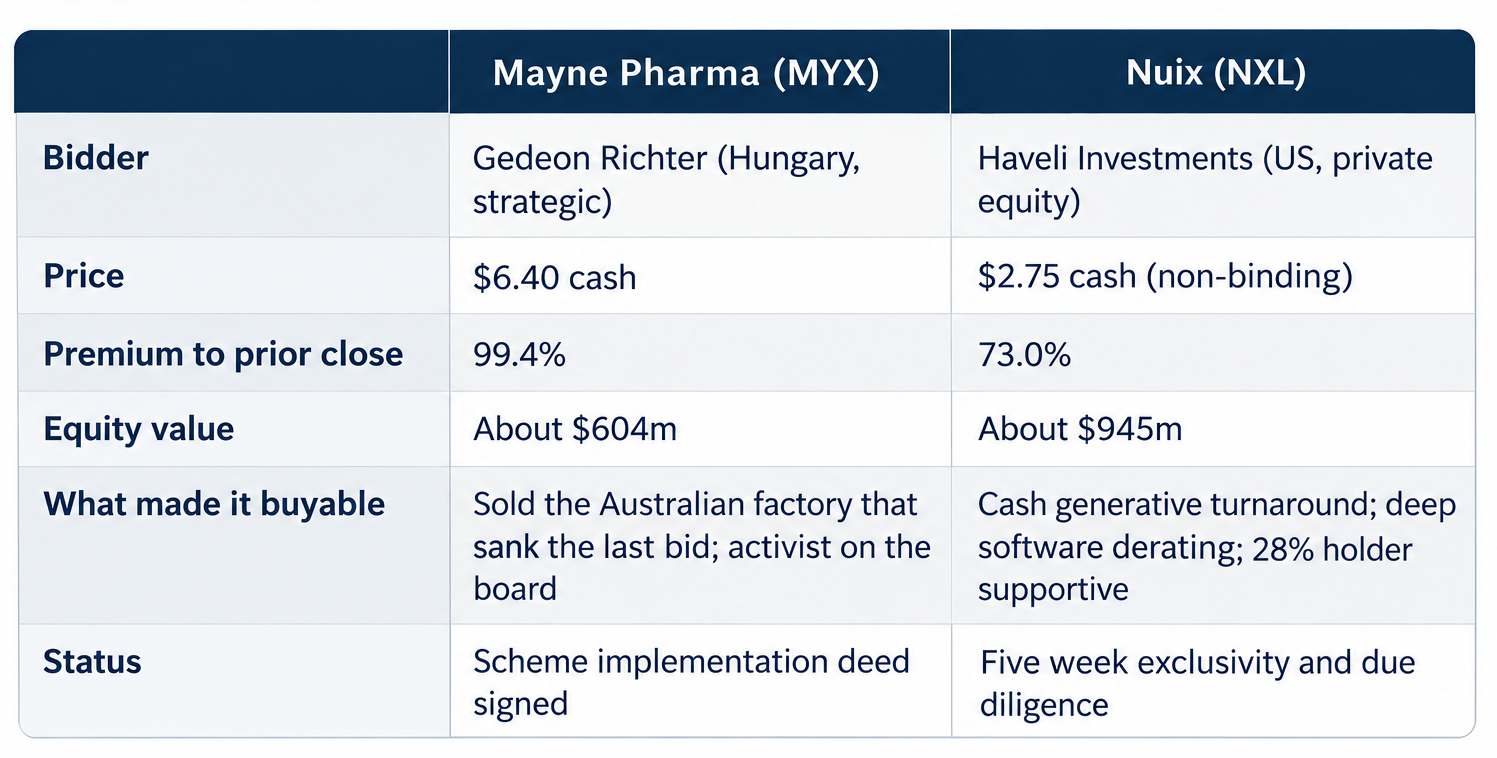
In both cases, the share price told you the market was focused on the past: a failed bid in one case, a disappointing IPO in the other. In both cases, the businesses had changed underneath. And in both cases, an offshore buyer with a weaker Australian dollar in its favour saw the gap before the market closed it.
What could still go wrong
Neither deal is done, and it would be a mistake to treat the current share prices as cash in hand.
For Mayne, the scheme still needs an independent expert’s report, a shareholder vote, court approval and regulatory approvals, and it depends on the Evaris sale completing, which in turn needs ACCC clearance. Mayne’s history is a reminder that signed deals can unravel. The Richter structure looks far cleaner than Cosette’s, with the Australian manufacturing asset removed, but foreign investment review is still likely to apply. Some shareholders may also argue that $6.40 undervalues the company relative to the earlier $7.40 price.
For Nuix, the risk is larger. The proposal is non-binding and conditional on due diligence, a binding agreement, a board recommendation and shareholder and regulatory approvals. Nuix’s customers include law enforcement and intelligence agencies, so a US buyer is likely to face careful FIRB scrutiny, and Mayne has shown how national interest considerations can derail a deal. If Haveli walks away, the shares could fall back sharply towards where they traded before the announcement. A shareholder class action relating to the IPO period also continues in the Victorian Supreme Court, which a buyer will need to get comfortable with.
What long term investors should take from this
The practical lesson is not to chase rumoured bids. It is to recognise the conditions that tend to precede them: a cheap share price, a simpler business, an improving cash flow profile, a register that wants an outcome, and a structural reason for buyers to look.
Mayne ticked those boxes because it deliberately removed the biggest obstacle to a sale. Nuix ticked them because the market sold the whole software sector without much discrimination, just as Nuix’s fundamentals were finally improving, and while the Australian dollar made everything on the ASX cheaper for offshore buyers.
We did not own either stock as a takeover lottery ticket. We owned a focused US pharma business with cash coming in, and a cash generative software company growing ACV in the mid teens at a modest multiple. Takeover potential was optionality on top of a sound investment case, not the case itself. This week, that optionality was exercised.
The same conditions still exist across parts of the ASX small cap market. There are more cheap, cash generative businesses with tidy balance sheets and motivated registers, and the currency has not moved. We doubt these will be the last bids of the cycle.
TAMIM Takeaway
In the space of two days, Mayne Pharma agreed to a $6.40 a share takeover by Gedeon Richter, a 99.4% premium, and Nuix granted Haveli Investments exclusivity over a $2.75 a share proposal, a 73% premium. Neither bid was luck. Mayne sold the Australian manufacturing asset at the heart of the national interest objection that sank Cosette’s bid, with an activist holding around 10% sitting on its board. Nuix delivered a strong FY26 result and net cash, yet traded at under 2 times ACV after the software selloff. A weak Australian dollar and patient private capital did the rest. For long term investors, the lesson is to look for businesses where the market is pricing the past while the company is fixing the future. Both deals still carry completion risk, and Nuix’s proposal remains non-binding.
_____________________________________________________________________________
Disclosure: Mayne Pharma Group (ASX: MYX) and Nuix (ASX: NXL) are held in TAMIM portfolios as at the date of article publication. Holdings can change substantially at any time.
This article contains general information only and does not take into account your personal objectives, financial situation or needs. It is not a recommendation to buy or sell any security. Past performance is not a reliable indicator of future performance.