
By Sid Ruttala
A strong result, and a share price that disagreed
Bank reporting season follows a familiar script. Profits arrive in the billions, dividends are declared and the headlines dwell on the size of the numbers. The more useful information usually sits in the share price reaction, and this season it has been unusually instructive.
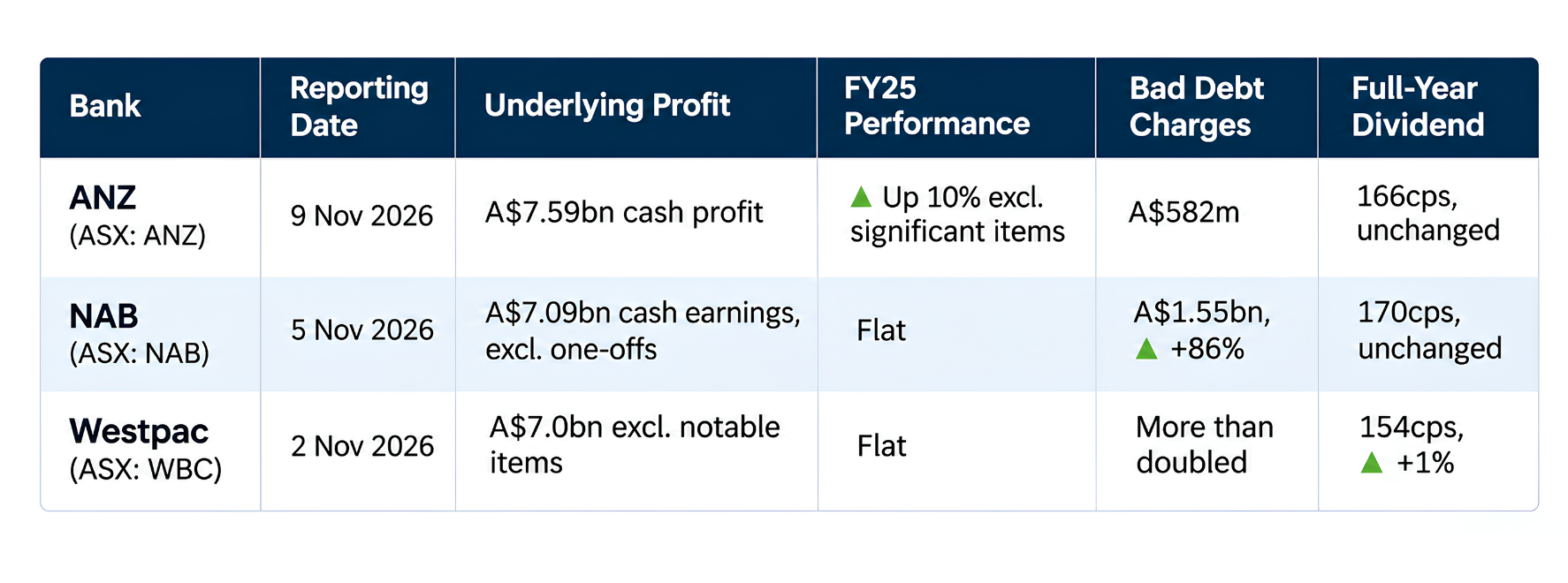
On 9 November, ANZ reported FY26 cash profit of $7.59 billion, up 31% on a year earlier and up 10% once last year’s significant items are excluded. Gross cost savings of $902 million exceeded the bank’s own upgraded target. By most measures it was the cleanest result ANZ has produced in years. The shares fell 3.2% to $39.05 on the day, a steeper decline than any of the other three majors.

That reaction did not come out of nowhere. On 2 November, Westpac reported net profit excluding notable items flat at $7.0 billion, with bad debt charges more than doubling. On 5 November, NAB reported a credit impairment charge up 86% to $1.55 billion, well above analyst forecasts, and its shares had their worst day since February 2025. In between, on 3 November, the Reserve Bank lifted the cash rate by 25 basis points to 4.85%, its fifth increase of 2026 and the highest level since 2008.
For investors who hold the major banks for income, and that includes a large share of Australian self managed super funds and family offices, the combination matters. ASX bank results are now being judged less on what was achieved last year and more on what the credit cycle may do to earnings over the next two.
Why higher rates are only half good news for banks
A common assumption among retail investors is that rising interest rates are good for banks. There is some truth in it. A higher cash rate tends to lift the return banks earn on low cost transaction deposits and on the capital they hold, and it can support net interest margins for a period. NAB’s margin, for example, rose 6 basis points to 1.80% over FY26.
The second order effects take longer to arrive but tend to matter more. Higher repayments reduce what households and businesses can borrow, so credit growth slows. Borrowers who were comfortable at lower rates come under strain, so arrears and impaired loans rise. Banks then set aside more capital against expected losses, and those provisions come straight out of profit.
The November results suggest the majors are moving from the first phase into the second. For the past two years the investment case rested on three supports: resilient margins, unusually low bad debts and disciplined costs. Margins are holding. Bad debts are now rising from a low base. And cost reduction, which carried much of the earnings growth, is largely in the price.
That is the central argument of this piece. The market is no longer paying for cost cuts. It is pricing the credit cycle and slower lending growth, and that changes how investors should assess Australian bank earnings over the next 12 to 18 months.
What each result actually told us
ANZ: the cost story delivered, the revenue story is still to come
ANZ’s result was the clearest evidence that its ANZ 2030 strategy is working on the cost side. Cash profit was $7.59 billion, return on tangible equity rose 109 basis points to 11.56% and the Suncorp Bank integration is 60% complete, with migration due by June 2027. The final dividend of 83 cents came with franking lifted to 80%, a small but welcome change for income investors.
The detail behind the share price fall is in the revenue line. Citi noted that cash earnings beat consensus because better cost control more than offset slightly below forecast revenue. Cost savings of this size are a one time step down in the expense base. Once delivered, they do not repeat, and from here ANZ has to grow revenue in a slowing credit market.
NAB: the first clear sign of credit strain
NAB’s headline cash earnings fell 13.4% to $6.14 billion, largely because of a $949 million after tax charge from a change in how it accounts for software investment. Excluding that, cash earnings were flat at $7.09 billion. Revenue rose about 6% on strong business lending, but higher operating costs, a near doubling of impairment expense and weakness in New Zealand absorbed the gain.
The more important comments were about the loan book. Management said it is already seeing an increase in watch loans and in early stage arrears. NAB is Australia’s largest business lender, and business lending has carried much of the sector’s growth this cycle, so strain showing first in that book deserves attention. NAB’s own economists expect system housing credit growth to slow to 2.5% in FY27, from 6.7% in FY26.
Westpac: steady, well capitalised, but not growing
Westpac’s result was the most even of the three. Net interest income rose 1% to $19.7 billion, operating expenses fell 1% and pre-provision profit rose 4% to $10.9 billion. Higher bad debt charges then absorbed that improvement, leaving profit excluding notable items flat at $7.0 billion.
Westpac’s strength is its capital. Its CET1 ratio of 12.5% sits well above its 11.25% operating target, equal to about $2.9 billion of surplus capital after the final dividend. That surplus gives the board room to absorb higher provisions without putting the dividend under pressure.
Commonwealth Bank reports on a June year and delivered FY26 cash profit of $10.98 billion, up 7%, in August. Its September quarter trading update is the next data point to watch, particularly for any movement in arrears and collective provisions.
Why the provisions matter more than the profit
Bad debt charges have two parts. Individual provisions cover specific loans that have already gone wrong. Collective provisions are a forward looking estimate of losses across the whole book, based on the bank’s view of unemployment, house prices and the economy. When a bank lifts collective provisions, it is telling investors something about the outlook rather than the past.
The Reserve Bank’s own forecasts give the banks reason for caution. In its November Statement on Monetary Policy, the RBA projected unemployment rising to a bit over 5% by the end of 2028, and said inflation is likely to stay elevated through much of 2027. With the cash rate already above the top of the RBA’s range of neutral rate estimates, borrowers are now facing genuinely restrictive conditions.
None of this points to a crisis. Australian bank loss rates remain low by historical standards, and much of the increase this year comes from very low levels. But the direction has changed. For the first time in several years, rising provisions are taking more from earnings than margins and cost savings are adding.
What it means for dividends
For income investors, the dividend question comes down to two things: earnings and surplus capital. On both counts, the majors look capable of sustaining current payouts, but not of growing them quickly.
ANZ and NAB held their full year dividends flat at 166 cents and 170 cents. Westpac lifted its payout by 1% to 154 cents. With underlying earnings broadly flat and provisions rising, payout ratios have less room to expand. The most likely path over the next year or two is steady dividends rather than growth. Banks with the largest capital buffers, such as Westpac, have the most flexibility to keep paying while provisions build.
Franking remains a meaningful part of the return for Australian resident investors, particularly in super funds in pension phase. ANZ’s lift in franking to 80% on its final dividend is a reminder that the after tax value of a bank dividend can change even when the headline cents per share do not.
What is already in the price
Large cap investing is rarely about whether a company is good. It is about whether the price already reflects how good it is. On that measure, the major banks enter FY27 with limited margin for error.
After its fall on results day, NAB traded on roughly 17 times FY26 cash earnings excluding the software charge. That is a full multiple for a business whose underlying earnings were flat and whose bad debts nearly doubled. ANZ’s share price sits above most broker valuations. Jarden retains an Overweight rating on ANZ but with a $35.50 target, below where the shares trade, and Morningstar’s fair value estimate of $33 implies the shares are overvalued. Commonwealth Bank continues to trade at a substantial premium to both its local peers and large global banks.
Part of the explanation is structural. Compulsory superannuation flows, index weightings and the appeal of franked income have supported demand for the majors for years, largely regardless of earnings momentum. That support is real, but it does not change the arithmetic. When earnings are flat, returns from here depend more on dividends and less on rising share prices.
The practical consequence is that results which merely meet expectations are no longer enough. ANZ beat consensus on profit and still fell. The market has moved from rewarding what banks did last year to questioning what they can grow next year.
Risks and counterpoints
The cautious reading of these results could prove too cautious. Several points argue the other way.
- Provisions may be precautionary. Banks often build collective provisions early in a downturn and release them later if losses do not eventuate. Those releases flow back into profit. If the economy slows without a sharp rise in unemployment, today’s provisions could become tomorrow’s earnings tailwind.
- The rate cycle may be close to its peak. Three of the nine RBA board members voted to hold in November. A split of that size suggests the bar for further increases is now higher, which would ease pressure on borrowers.
- Capital is strong. All four majors hold capital comfortably above regulatory requirements. That is a very different starting point from previous credit cycles.
- Margins are holding. Competition for mortgages remains intense, but NAB’s margin rose over the year and none of the majors reported a material margin squeeze.
- Australian banks have beaten bearish forecasts before. Expectations of rising losses and dividend cuts have repeatedly been too pessimistic over the past decade.
The risks on the downside are also real and should not be understated:
- Credit losses could rise faster than expected. NAB has already flagged rising watch loans and early arrears. Market commentary has also noted that the bank is preparing for slower growth and falling house prices.
- Revenue growth may stay weak. With housing credit forecast to slow sharply, revenue growth will be hard to find, and the cost savings that offset that in FY26 cannot be repeated indefinitely.
- Restructuring costs are not finished. NAB announced 2,500 role reductions in October, with about $300 million of restructuring costs expected in FY27. ANZ is still integrating Suncorp Bank.
- Valuation risk. At current multiples, a disappointment on credit quality could produce a larger share price reaction than the change in earnings alone would suggest.
- External shocks. The RBA has cited the Middle East conflict and higher oil prices as inflation risks. A further energy shock could keep rates higher for longer.
What long term investors should take from this
For long term investors, the practical question is not whether to own the banks. For most Australian income portfolios, the majors remain core holdings because of their market position, capital strength and franked dividends. The more useful question is what return to expect from them, and which risks to watch.
A reasonable starting point is to treat the banks as income assets with modest growth over the next couple of years, rather than as a source of strong capital gains. Earnings growth is likely to be slow while provisions rise and credit growth moderates. The dividend, rather than the share price, is likely to do most of the work.
Within the sector, the differences between the banks matter more than they did a year ago. Capital buffers, the mix between housing and business lending, and progress on cost programs will separate the results. Westpac’s surplus capital gives it flexibility. ANZ’s cost base is now much leaner, but it needs revenue growth. NAB’s business book is where the first signs of strain are showing.
Three indicators are worth watching over the coming quarters:
- Early stage arrears and watch loans, particularly in business lending.
- Collective provisions and the economic assumptions behind them.
- Revenue growth, as cost savings stop doing the heavy lifting.
This is not a call to sell or to buy. It is a reminder that bank shares are priced on what comes next, and what comes next looks slower than what came before.
TAMIM Takeaway
The major banks have just delivered results that were solid on the surface. ANZ’s cost program delivered, Westpac’s capital is strong and NAB’s underlying earnings held steady. Yet the share prices fell, because the market has shifted its attention from costs to credit. With the cash rate at 4.85% after five increases this year, bad debts are rising from low levels, housing credit growth is forecast to slow sharply and the easy cost savings have largely been made. For long term investors, the banks remain sound businesses and dependable sources of franked income. The sensible approach is to expect steady dividends rather than strong growth, watch credit quality closely and avoid paying a growth multiple for what is, for now, a low growth earnings stream.
___________________________________________________________________________________________
Disclaimer: ANZ Group Holdings (ASX: ANZ), National Australia Bank (ASX: NAB), Westpac Banking Corporation (ASX: WBC) and Commonwealth Bank of Australia (ASX: CBA) are held in TAMIM portfolios as at the date of article publication. Holdings can change substantially at any time.