






There is a comfortable assumption in Australian property investing that goes something like this. Put a full line supermarket at the front of a centre, sign a long lease, and the income takes care of itself. Groceries are non discretionary, people shop weekly, and the rest is detail.
The first part of that is true. The conclusion does not follow.
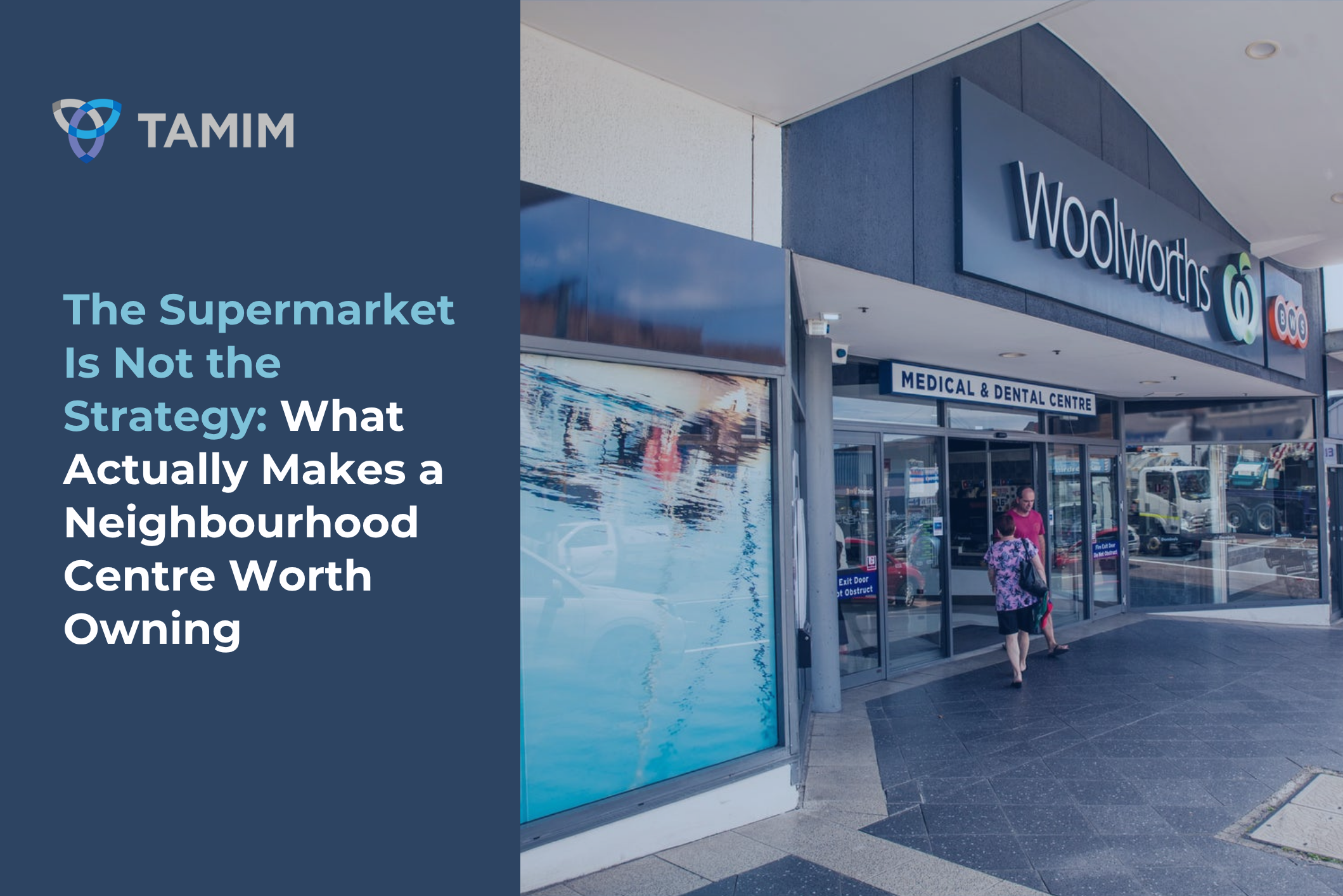
A supermarket anchor tells you what kind of income you are buying. It does not tell you whether that income is well positioned, whether the centre is the one shoppers will actually choose, or whether someone can build a competing offer down the road next year. Those are separate questions, and they are the ones that determine returns over a decade of ownership.
This matters right now, because the neighbourhood end of retail property has been performing well and the explanation usually offered for it is only half right.
The sector is leading, but not for the reason most people give
Dexus has just published its Australian Real Asset Review for the September quarter, and the headline number is striking. Retail has been the best performing sector in the MSCI Australian Wholesale Index since June 2024, with unlisted retail funds returning 10.8 per cent in the year to June 2026.
The usual explanation is scarcity. Nothing is being built, so what exists becomes more valuable. That argument deserves closer inspection, because it is true of one part of the market and not the other.
For large regional centres it holds. Construction costs have risen by roughly a third over five years, no new regional centres are planned in Australia, and what is happening instead is refurbishment and extension of what already stands. If you own a dominant regional mall, genuine new competition is unlikely to appear.
For neighbourhood centres it does not hold, and investors should be clear eyed about this. Dexus notes that new supply has largely consisted of smaller formats, with neighbourhood centres representing a significant share of completions in 2026 so far. Small format retail still gets built. A supermarket operator that sees a growing residential pocket will happily open a new store two kilometres from an existing one, because their catchment maths is about convenience and drive times, not about protecting somebody’s asset value.
So the honest position is this. If you are buying a neighbourhood centre, you are not buying protection from new supply. You are buying an income stream whose durability depends on things you have to assess directly.
What actually protects the income
Start with the nature of the income itself, because this part is genuinely strong.
A centre anchored by a supermarket, a pharmacy, a medical practice and the everyday services around them is not selling discretionary retail. It is selling the weekly shop, the prescription, the appointment and the haircut. Those categories carry on when households feel poor, which is exactly when discretionary retail suffers.
The current data makes the point. Dexus reports total retail spending grew 5.8 per cent over the year while consumer sentiment fell 13 per cent. Households are anxious, and yet grocery spending still grew 4.2 per cent, because people do not stop eating when confidence dips. They trade down within the supermarket rather than abandon it. That behaviour is the foundation of the whole asset class.
There is also less digital threat here than the headlines suggest. Online retail is growing faster than in store, but the categories moving online are overwhelmingly discretionary. You cannot get a filling, collect a script or pick up dinner on the way home through a screen. Proximity is the product.
That is the income. Now the harder part.
Position has to be earned, not assumed
If new competition can arrive, then the question that matters is whether shoppers will keep choosing your centre when it does. That comes down to a handful of unglamorous physical and commercial realities.
Location within the town centre, not merely within the suburb. A centre sitting on the main road with multiple street frontages captures passing trade that a centre tucked into a side street never will.
Access and parking. This sounds trivial until you watch how people actually behave. Convenience retail is a decision made in seconds. Undercover parking, easy entry and exit and generous bay ratios are not amenities, they are the reason someone turns in rather than driving on.
Depth of the non discretionary mix. An anchor plus a pharmacy plus a medical practice plus services generates multiple independent reasons to visit. A centre where the supermarket is the only real draw is a centre with a single point of failure.
Lease structure. Fixed annual rent reviews across the bulk of the rent roll deliver contracted income growth regardless of what the market does. A long anchor lease with options provides the base. The specialty tenancies around it need active management, and their expiry profile deserves genuine scrutiny.
Management capability. When a competitor opens nearby, the response is operational. Re-leasing, re-mixing, presentation, community engagement. Passive ownership does not answer a new entrant. Active ownership can.
None of these are exciting. All of them are the difference between a centre that keeps trading through a competitive shift and one that slowly bleeds foot traffic.
The pricing tells you something
If you want evidence that the market takes this income seriously, look at what buyers have been doing with their money in a difficult rate environment.
The cash rate sits at 4.35 per cent after the Reserve Bank held in June, following three increases earlier this year. Ten year bond yields are close to 5 per cent, and the major banks are split between another rise and a long pause, with most not expecting a cut before 2027.
Against that backdrop, retail capitalisation rates held firm through the quarter. The value of these assets did not fall away even though the safe alternative return was elevated. That is defensive behaviour, and it is more informative than any forecast.
Two further observations from the same report. Within retail, neighbourhood centres now trade at tighter yields than regional centres, which is investors paying up specifically for grocery anchored, defensive income. And direct property valuations have remained far less volatile than listed markets, with unlisted property returning around 9.7 per cent over the year in a steady line while listed property trusts swung 13.7 per cent in a single quarter. For an investor who wants income they can plan around, that difference in behaviour is the point rather than a technicality.
Transaction volumes are thinner, down about 20 per cent, so this is not a market where everything is clearing easily. The deals that are happening are landing on the assets with the most reliable income.
How a long term investor should think about it
The useful question is not whether rates will fall. It is whether the income can be relied upon through the cycle, and whether this particular asset is the one the catchment will keep choosing.
That reframing matters because it changes what you examine. A scarcity thesis invites you to buy the category. An income and position thesis forces you to assess the specific asset, its frontage, its parking, its tenant mix, its lease expiry profile, its catchment, and the capability of whoever manages it. The second approach is harder work. It is also the one that survives contact with reality, including the reality of a competitor opening nearby.
For long term investors, the practical conclusion is that supermarket anchored retail can be a genuinely defensive holding, and that the defensiveness comes from the income and the position rather than from an absence of competition. Anyone selling the category on scarcity alone is selling an argument that does not apply evenly across formats.
The risks, stated plainly
Lease expiry is the first. A long anchor lease can distract from a much shorter weighted average lease expiry across the specialty tenants, where income churns and vacancy can open up. Clusters of expiries falling in the same year are worth identifying before purchase rather than after.
Vacant space and value add components carry leasing and development risk. Where a centre has empty tenancies or an undeveloped pad earmarked for future income, that income is a forecast rather than a contract. It depends on securing a tenant and sometimes on planning approval, and neither is assured.
Illiquidity is a real constraint. Direct, unlisted property does not offer the daily exit of a listed trust. Capital can be committed for years, which matters particularly for retirees and self managed super funds who may need access to it.
The consumer can weaken further. Sentiment is already down 13 per cent, and while grocery spending is resilient, even non discretionary demand softens at the margin if unemployment rises. Discretionary specialty tenants feel that first.
And rates cut both ways. Higher for longer supports the case for reliable income, but it also caps the prospect of capital growth from falling yields and keeps borrowing costs high for any geared structure. Treat any property argument that quietly depends on rate cuts with suspicion, because that assumption has not been rewarded this year.
Tamim Takeaway
Supermarket anchored retail has been the best performing corner of Australian property, and the reason is worth getting right. It is not that these centres cannot be replicated, because at the neighbourhood end they demonstrably can. New small format supply is still being delivered, and a competing store can open nearby.
What actually does the work is the quality of the income and the strength of the position. Groceries, pharmacy, medical and everyday services keep trading when households tighten up, as this year’s data shows plainly. And the centres that hold their catchment are the ones with the right location, the right access, a deep non discretionary tenant mix and an owner willing to manage them actively.
For long term investors, the lesson is to stop buying the category and start assessing the asset. Ask what is being built nearby. Ask when the specialty leases expire. Ask whether the parking works. Those questions are less satisfying than a broad thesis about scarcity, and they are considerably more useful, because they are the ones that determine whether the income is still there in ten years.