






There is a familiar rhythm to how markets misread central banks. The headline says “rates unchanged”. The cameras pack up. The next news cycle moves on. Three days later, the underlying repricing finally shows up in portfolios, and by then most retail investors are scrambling to understand what just happened.
Yesterday afternoon in Washington, the Federal Reserve held rates at 3.50 to 3.75 per cent. Exactly as expected. Markets had priced 97 per cent odds of a hold. That part was a non-event.
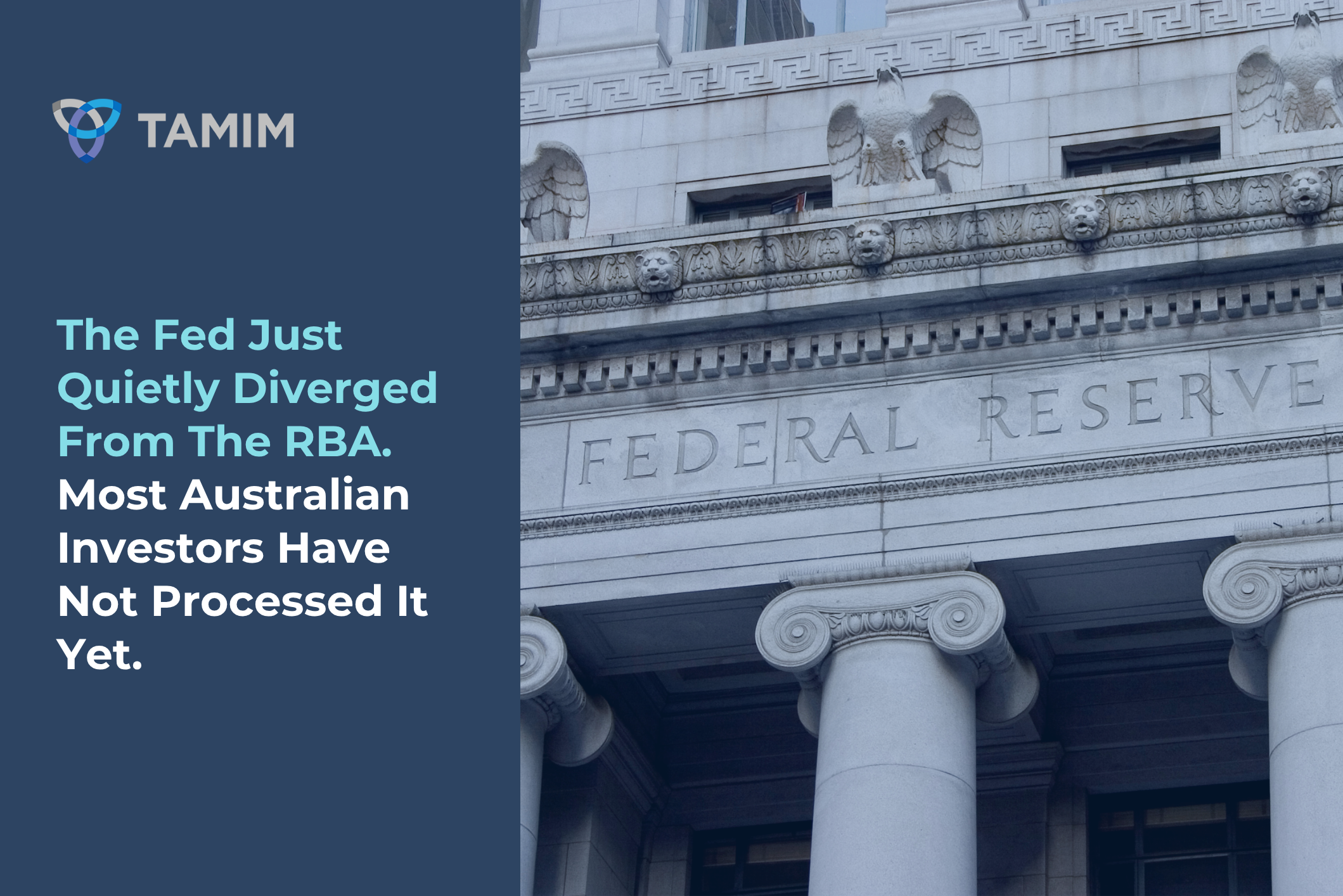
The interesting things happened in the small print. The post meeting statement was gutted of its easing bias, rewritten by new chair Kevin Warsh into what he described, with what we suspect was deliberate dryness, as “a bit shorter, a bit simpler”. The dot plot, which is the chart showing where each Fed official thinks rates are going, swung sharply hawkish. The median expectation for the cash rate at the end of 2026 jumped from 3.4 per cent in March to 3.8 per cent now, suggesting one rate hike rather than the previously implied one cut. Nine of the 18 voting members are now penciling in at least one hike this year. And the new chair, in his first press conference, refused to submit his own dot at all.
The market response was immediate. The S&P 500 closed down 1.06 per cent. The Nasdaq fell 1.34 per cent. Two year Treasury yields jumped 16 basis points to 4.21 per cent, their highest level in over a year. The US dollar gained roughly 1 per cent in its best session in almost a year. Gold fell more than 2 per cent.
For Australian investors waking up Thursday morning to read these numbers, the question is what happens next. The honest answer is that something more interesting than usual is going on, and most local commentary has not quite caught up with it.
The two central banks have just diverged
Three days ago in Sydney, the Reserve Bank of Australia held its cash rate at 4.35 per cent and signalled what most economists are now reading as a likely peak. CBA’s economics team is calling rates on hold for the rest of 2026. NAB has shifted to expecting the next move to be down, with timing uncertain. The Australian rate cycle, by domestic consensus, has plateaued.
The Federal Reserve has just told the market the opposite. The next move in the United States is more likely to be a hike than a cut. The energy shock from the Iran conflict has pushed US inflation to 4.2 per cent, the highest in three years. The US labour market is firmer than expected. The Fed is no longer in the business of preparing markets for cuts. It is preparing them for the possibility of more tightening.
This is a divergence that matters. When the world’s two most relevant central banks for an Australian portfolio start moving in opposite directions, three things happen.
The first is that the Australian dollar tends to weaken. A higher US cash rate relative to Australia means capital flows toward US assets in search of yield. The AUD has already softened against a rising USD overnight. That has implications for everything from imported inflation to the earnings of every ASX listed business with US dollar revenues or US dollar costs. Resources companies that sell into global markets benefit at the margin. Importers and businesses with US dollar denominated costs feel it the other way.
The second is that imported inflation pressure rises. A weaker AUD means more expensive imported goods, which feeds into the local CPI with a lag of three to six months. This is precisely the dynamic the RBA does not want to be facing if it has just decided the local cycle has peaked. It complicates the calculus for the Reserve Bank in a way that the futures market is only beginning to price.
The third is that long duration assets globally have just had their valuation framework reset. The discount rate applied to all future cash flows just moved higher. That hits growth stocks, tech, infrastructure trusts, listed property, and any asset where the value is weighted heavily toward earnings five or ten years out. The Nasdaq’s 1.34 per cent fall is the first indication of what that looks like in real time.
For Australian investors holding the ASX 200, most of which is resources, financials and defensives, the direct impact is more muted than for an investor holding the Nasdaq. But the secondary effects matter. Listed property, infrastructure trusts, quality growth names and the local technology sector are all exposed to the global discount rate, regardless of where the RBA goes.
Why Warsh refused to give a dot
This is the part of yesterday’s meeting that has not been properly digested yet, and it is the part that matters most for the next year.
Kevin Warsh declined to submit his own forecast for the dot plot. He stated explicitly that he does not believe in providing forward guidance. His policy statement was, in his own words, “curt”. His press conference was shorter than Powell’s. When asked detailed questions about the Fed’s reasoning, he frequently declined to elaborate. He told reporters: “I’ve got nothing more to say than the statement itself.”
This is a deliberate communication revolution. Warsh has long argued that the Fed should reduce its reliance on forward guidance and let markets do more of the work of pricing future policy themselves. He is now putting that philosophy into practice from his first meeting onward.
There are two ways to read this. The first reading is that Warsh is freeing the Fed from the trap of having to forecast its own behaviour, which has caused the central bank no end of grief over the past several years. By making the Fed less predictable, he is forcing markets to focus on actual data rather than on what officials might say. There is a school of central banking thought that views this as a genuine improvement.
The second reading is more uncomfortable. If markets can no longer rely on forward guidance, they have to price more uncertainty into every asset. Higher uncertainty means higher risk premiums. Higher risk premiums mean lower valuations, particularly for the most rate sensitive assets. The AI and technology sectors, where multiples have been propped up by the assumption of falling rates and accommodative central banks, are the most exposed. So are listed infrastructure trusts and long duration bonds.
In practice, the effect is the same regardless of which reading you prefer. The forward guidance era of the last 15 years is ending. Investors will need to make their own assessments about where rates are going, with less help from the Fed. The implications for portfolio construction are not trivial.
What this means for Australian portfolios
The temptation, on a piece of news like this, is to overreact in one direction or another. Sell everything growth oriented. Buy resources and defensives. Hide in cash. Run to gold. These responses are usually wrong, because the actual portfolio implications are more nuanced than the headlines suggest.
A few practical observations.
The Australian dollar weakness is genuinely useful for parts of the ASX. Resources companies with USD revenue (BHP, Rio Tinto, Woodside, the major gold producers) get a translation benefit. Healthcare names with US earnings (CSL is the obvious one, though the stock has had a brutal year for other reasons) get a similar benefit. Listed companies with substantial offshore earnings, including some industrials and global financials, see the same effect. This does not change the underlying business quality of any of these names, but it does affect reported earnings.
The flip side is also true. Australian businesses with USD denominated costs (anything that imports equipment, technology, hardware or pharmaceuticals) face higher input costs. Discount retailers exposed to global supply chains, technology businesses paying USD for cloud services, and certain industrial businesses face margin pressure. Some of this can be hedged, but the structural exposure is real.
For listed infrastructure and listed property, the message is more cautious than it would have been a week ago. The bond yield rise overnight is exactly the kind of move that compresses multiples on long duration assets. Goodman Group, Transurban, the major REITs, the listed utilities. All of these had benefited from the RBA peaking. They now face a headwind from the global discount rate moving the other way. Quality remains attractive but valuations are no longer drifting in their favour the way they were two weeks ago.
For technology and growth names, both globally and locally, the environment has just become more demanding. The AI capex story, which is being financed partly by cheap capital and partly by faith in falling discount rates, has just had one of those legs kicked. This does not break the long term thesis, but it does increase the demands placed on actual earnings delivery. Companies that have been priced for perfection will be tested.
For defensives and dividend yielders, the relative attractiveness has improved. When long duration assets re-rate down, the high yielding income compounders look better in comparison. The major banks, despite the obvious cyclical risks, are now yielding meaningfully above what is available offshore on a risk adjusted basis. Consumer staples, telecommunications, regulated utilities and other classic defensive sectors quietly benefit from the rotation, even though most commentators are not framing it that way.
What to do, and what to avoid
The single most important thing for Australian investors right now is to avoid overreacting to a single piece of news, however significant.
The Fed’s hawkish shift overnight is real and it is meaningful. But it is also just one data point in a longer story. The next few months will tell us whether the inflation pressure resolves quickly with an oil de-escalation, or whether it gets embedded in expectations and forces a hike. The data will tell us whether the US labour market continues to firm, or whether it softens. The next Fed meeting in late July will tell us whether yesterday’s hawkish tilt was the start of a tightening cycle or simply a re-centring of policy at the current level.
Long term portfolios should not be rebuilt around a single press conference. They should be stress tested against the regime that is now becoming clearer, which is one of higher for longer rates, persistent inflation, geopolitical tension, and central banks that are less willing to telegraph their next moves. The portfolio that handles that regime well is not exotic. It is a portfolio of quality businesses with pricing power, sensible balance sheets, durable cash flow and disciplined capital allocation. It has a sensible allocation to real assets and inflation linked income. It has enough defensive yield to compound through the noise. It does not depend on the discount rate doing the heavy lifting.
The investors who handle these moments best are not the ones who make the most dramatic moves. They are the ones who recognise the regime shift early, adjust gradually at the edges, and stay focused on quality. The market will do plenty of repricing without anyone needing to throw their portfolio in the air.
What could go wrong
A few risks are worth flagging.
The first is that the hawkish shift overnight could be overdone. Warsh’s reluctance to provide his own forecast suggests he may actually be less hawkish than the committee. The dot plot may turn out to be a high water mark rather than a starting point. If the oil price de-escalates, headline inflation falls quickly, and the labour market softens through autumn, the Fed could be back to neutral or even dovish by year end. Investors who position too aggressively for sustained hawkishness could give back gains quickly.
The second is the inverse. The Fed could actually deliver one or two hikes if inflation stays sticky. The 80 per cent probability now priced in swaps markets for at least one more US hike by year end is not trivial. If those hikes arrive, the AUD weakens further, imported inflation rises, the RBA’s job gets harder, and the local rate cycle peak may turn out to be temporary rather than structural.
The third is broader market volatility. New Fed chairs typically take time to establish their communication style, and Warsh has explicitly told markets to expect less hand holding. That means more volatility around economic data releases, more risk that markets misread Fed intentions, and more potential for sharp moves in either direction. Portfolios that depend on stable conditions or low volatility need to be stress tested for the new regime.
And finally, the geopolitical backdrop remains the most important wildcard. The Middle East situation has been the swing factor in inflation, oil and risk appetite for months. A genuine resolution would change the macro story overnight in a benign direction. A further escalation would do the opposite. Most portfolios are not positioned for either extreme, and that is probably the right place to be.
TAMIM Takeaway
The interesting things in markets rarely happen on the days when everyone is watching. They happen in the small print of statements, in the abstention of a single dot, in the quiet divergence between two central banks that no one has framed clearly yet.
The Federal Reserve and the Reserve Bank of Australia have just started moving in opposite directions for the first time in this cycle. The Fed is now signalling more tightening. The RBA is signalling the peak. That divergence has implications for the Australian dollar, for imported inflation, for the discount rate applied to every long duration Australian asset, and for the relative attractiveness of different parts of the ASX.
Most Australian investors will not have processed any of this yet. The local commentary will catch up over the next week. The market itself will reprice over the next month. By the time the headlines make the divergence obvious, the move will be well underway.
For long term investors, the practical response is the same one that works at every cycle turn. Recognise the regime shift early. Do not overreact to a single piece of news. Tilt portfolios thoughtfully toward quality, real assets, and defensive income. Accept that the path is uncertain and that no single forecast, including this one, will be exactly right.
The Fed has just changed the rules of how it talks to markets. Investors who keep waiting for clear forward guidance will be the ones most surprised by what comes next. The rest of us can keep doing what good long term investors have always done. Own quality. Pay sensible prices. Compound through the noise. And remember that the regime is always shifting at the margin, even when it looks settled.