
Australian Equities
Australia All Cap

October 2026 | Investor Update
Dear Investor,
We provide this monthly report to you following conclusion of the month of October 2026.
The TAMIM All Cap Fund was down -2.23% (net of fees) during the month, versus the Small Ords down -6.43% and the ASX300 up+1.11%. The Emerging Companies index (XEC) dropped a whopping -9.32%.
Smaller stocks suffered as the RBA continued hiking rates to combat sticky inflation, fuelled by elevated oil prices from Middle East tensions. Higher borrowing costs and risk aversion hit rate-sensitive growth names hardest, amplified by uncertainty ahead of US midterm elections.
By contrast, the ASX200 held up thanks to strength in the big banks (Financials sector +7%), which benefited from wider net interest margins in a higher-rate environment and investor preference for defensive large-caps and continuous flows from passive index funds into the largest stocks.
The month also saw an aggressive sentiment shift towards AI stocks and neo-clouds. It started from the overhyped but ultimately withdrawn IPO of Firmus, and cascaded to other global neo-clouds and their prospects of securing funds. Having taken profits and sold our positions in the sector earlier, our lack of exposure benefited us during the month.
As we look ahead into November, sentiment is beginning to improve towards small caps and growth companies. Following a sweeping win for the Democrats in the US midterms, political gridlock is a familiar setup. Markets have tended to respond well to this backdrop as it reduces policy uncertainty.
The prospect of a divided government could ultimately provide a more supportive backdrop for equities by limiting major policy changes and reducing uncertainty around fiscal spending. With control of Congress and the White House split, sweeping legislative change is less likely.
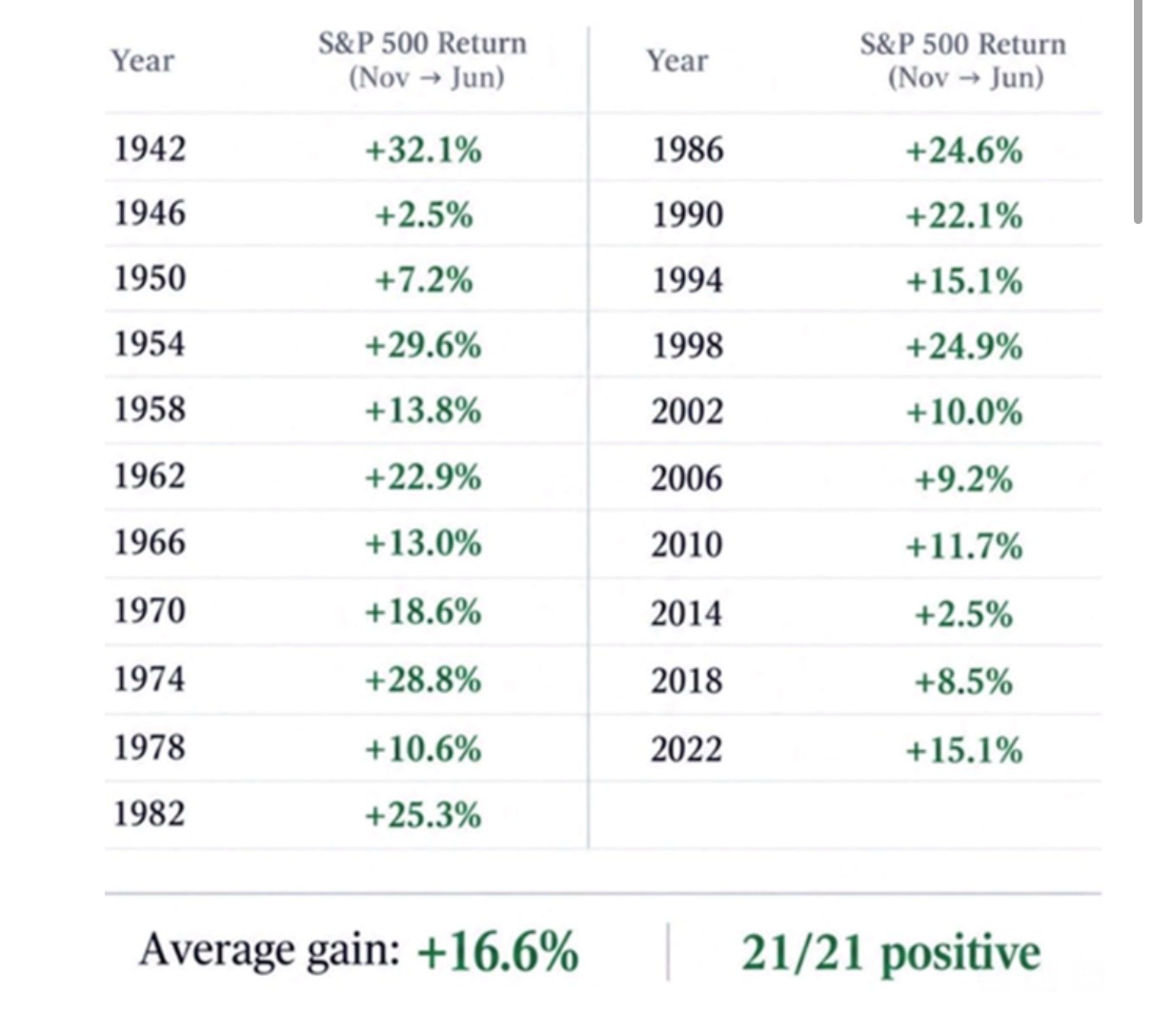
In addition, US–Iran peace talks are progressing and WTI crude is back to around US$85 (down about 20% in a week in early November). Markets have tended to do well after midterms, with the S&P 500 up an average of 16.6% from November to June after every midterm since 1942 (21 of 21 positive).
Finally we provide a brief commentary on portfolio updates during the month in the portfolio section of the report. We look forward to providing further updates in our next monthly report in December.
Sincerely yours,
Ron Shamgar and the TAMIM Team.
Fund Performance
Portfolio Highlights

Alcidion (ASX: ALC) entered the new financial year with clear sales momentum. In its late-October trading update the company reported $50 million of contracted FY27 revenue already locked in as at 30 September, a 38% increase on the prior corresponding period. That figure includes both new sales and renewals, and recent contract expansions (including further work with Health New Zealand) are expected to contribute additional revenue in the current year.
With quarterly cash-flow reporting no longer required, management is using regular trading updates to keep the market informed. Alongside the operational progress the board has proposed a 10-for-1 share consolidation and an on-market buy-back of up to 10% of issued capital, both of which form part of a broader capital-management framework.
The combination of a growing contracted book and a stronger balance sheet ($20m net cash) leaves Alcidion well placed as it continues to roll out Miya Precision across Australian, New Zealand and UK hospitals. We value the stock at 20 cents.

SiteMinder (ASX: SDR) At its AGM reaffirmed the consistency of its growth model. Since listing the company has delivered more than 20% constant-currency organic ARR growth every year while steadily lifting profitability. FY26 revenue reached $266 million on the same basis, and management now expects FY27 closing ARR growth in the mid-20s, again on a constant-currency organic basis.
Adjusted EBITDA margin is forecast to expand meaningfully this year, with a longer-term ambition of mid-20s margins by FY30. Early adoption of the Smart Platform is already showing through in transaction margins and in Dynamic Revenue Plus billings, which more than doubled in the September quarter versus the June quarter. With AI both expanding the addressable market and improving internal efficiency, SiteMinder sees a clear path to combine continued top-line growth with further operating leverage. We estimate FY30 ebitda of $190 million and free cashflow of $140 million. We think the upside is 100% next 12 months and consider the company an attractive takeover target.

Pureprofile (ASX: PPL) opened FY27 with another record quarter. Revenue rose 14% (19% in constant currency) to $18.3 million and EBITDA increased 27% to $2.4 million, lifting the margin to 13%. Growth was broad-based, with ANZ revenue up 21% and platform revenue more than doubling.
The company reaffirmed full-year guidance of $72–75 million in revenue and an EBITDA margin of 11–12%. Management continues to shift the mix toward higher-margin platform and technology services while expanding its US and UK presence. With operating leverage already visible and the cost base well controlled, Pureprofile expects the current trajectory to support further margin expansion as the year progresses.
The FY27 guidance implies $8-$9 million of Ebitda and $4-$5 million of free cashflow. For an EV of $40 million we believe the company is significantly undervalued. The key catalysts are a US based acquisition and potential large contract wins. These would setup FY28 towards $95-$100 million in sales and ebitda of $13 million. We believe the company is worth 6-8 cents.

Gentrack (ASX: GTK) brought two positive commercial developments even though full-year results are not due until 23 November. Momentum Energy selected the g2 billing platform to support more than 200,000 residential and business meter points across Australia after a competitive process that highlighted Gentrack’s delivery record, regulatory capability and Salesforce integration.
Separately, Horizon Power renewed a 16-year relationship and signed to the new g2 platform covering meter-data, customer-information and billing services. Both wins reinforce Gentrack’s position in the Australian utility market and add to the pipeline of implementations that will support revenue in FY27 and beyond. Investors will receive the full FY26 numbers and any updated outlook at the investor briefing in November which will be a key catalyst for the stock.

Baby Bunting (ASX: BBN) AGM update showed the Store of the Future programme continuing to deliver. Year-to-date underlying comparable sales were up 2.2% (Australia +2.0%, New Zealand +8.7%), with the recent moderation reflecting temporary store closures for refurbishment. The 17 refurbished stores now trading are generating cumulative average sales growth of 20%.
Management reaffirmed FY27 guidance for pro-forma NPAT of $19–21 million on total sales of $585–600 million, comparable sales growth of 3–5% and a gross margin of 42%. Capital expenditure of $33–37 million is expected to be fully funded from operating cash flow. With a further 10–12 refurbishments and three new large-format stores planned, the company remains on track to restore longer-term EBITDA margins above 10%. BBN trades on a PE of 8x whilst being the clear market leader in what is generally a defensive retail category. Historically the stock has traded on high-teens multiples and we believe once the rate hike cycle has ended the stock will re-rate higher.

Aroa Biosurgery (ASX: ARX) One of the enduring truths in small cap investing is that the market is very good at pricing what a company earned last year and rather poor at pricing what it is quietly building. Aroa Biosurgery is a good example. The business has just delivered five consecutive years of revenue growth, beaten its own guidance on both revenue and profit, finished the year debt free, and published a randomised trial for its next product. The share price has done very little about any of it, and is down for the calendar year.
Part of the reason is that Aroa is not an easy company to put in a box. It is a New Zealand soft tissue regeneration company listed on the ASX (ARX) that sells mostly into US hospitals, takes its raw material from sheep, and reports in New Zealand dollars. It is also about to report a lower EBITDA number in FY27 than it did in FY26, by choice. None of that suits a market that likes simple stories and rising lines, and we think that is exactly where the opportunity sits.
What Aroa actually does
Aroa takes ovine forestomach tissue and processes it into an extracellular matrix, essentially a natural scaffold that the body can use as a template for repair rather than a permanent synthetic mesh. Surgeons and wound clinicians use these bioscaffolds when soft tissue needs to regrow, in complex wounds, trauma, hernia repair and reconstruction.
The commercial portfolio is built around three lines. Myriad is sold directly by Aroa’s own US sales force for complex wounds, trauma and lower limb salvage. OviTex and OviTex PRS are manufactured by Aroa and distributed by Nasdaq listed TELA Bio into hernia and breast reconstruction Endoform is an older wound product. Symphony, a skin substitute that combines Aroa’s matrix with high molecular weight hyaluronic acid, is the next commercial bet, aimed at hard to heal diabetic foot ulcers and venous leg ulcers in the outpatient setting.
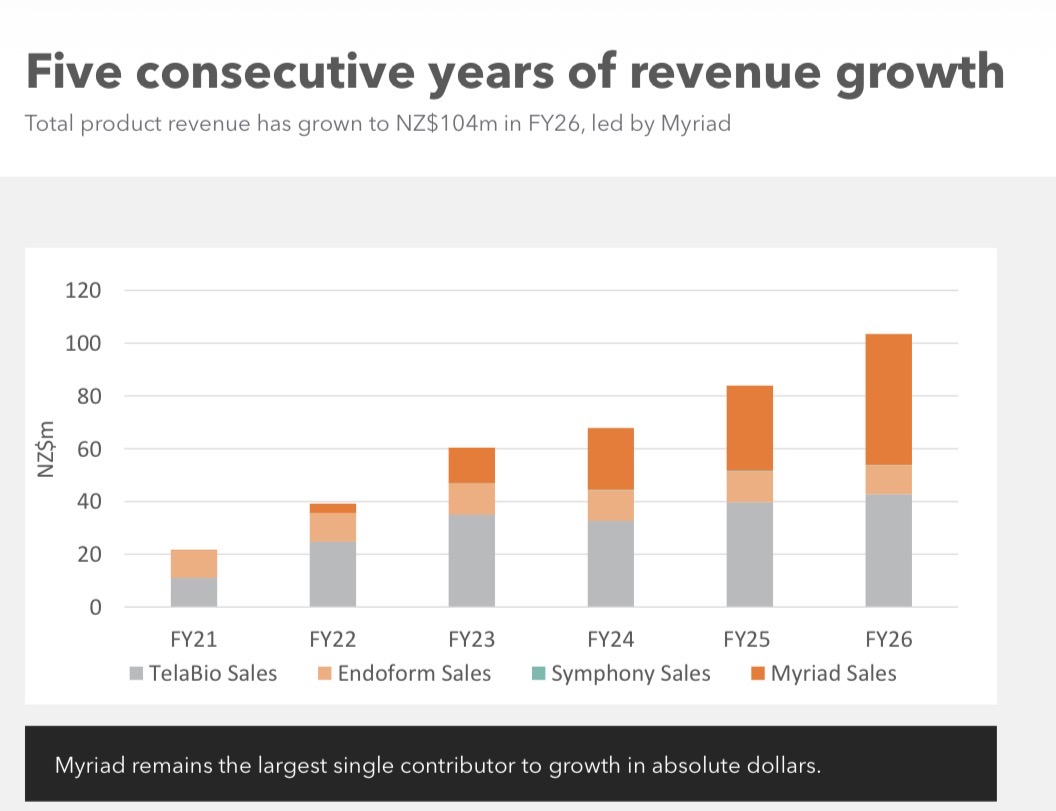
Source: Aroa Biosurgery, investor presentation, 19 August 2026. Product revenue has grown every year since FY21, with Myriad (dark orange) now the largest single line.
The FY26 result was a Myriad story
The financial story in the year to 31 March 2026 was Myriad. Group revenue rose 23% to NZ$103.9 million, comfortably above the constant currency guidance range of NZ$92 to 100 million. Myriad product revenue was NZ$49.5 million, up 54%, and for the first time larger than OviTex. Direct sales reached 59% of product revenue. Product gross margin held at 85.5%, almost unchanged on the year before.
The most telling detail is how that growth was achieved. Chief executive Brian Ward noted that Myriad’s 54% growth came with the same number of salespeople as the previous year. In small caps we spend a lot of time looking for evidence of operating leverage, rather than assuming it. This is evidence.
Mix matters here too. Management describes Myriad as a product family with a gross margin above 90%. OviTex, sold without a dedicated Aroa sales force, carries a lower margin, with the company citing about 75%. Every dollar of growth that comes from Myriad rather than OviTex makes the group a little more profitable.
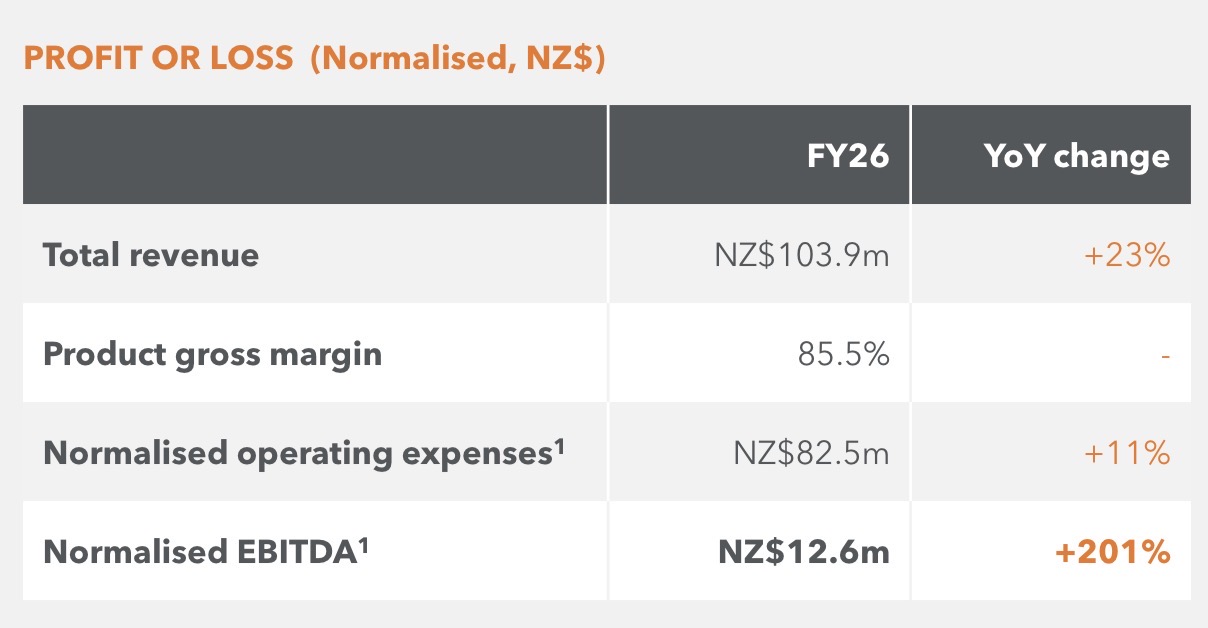
Source: Aroa Biosurgery, FY26 results. Normalised figures are non GAAP measures.
Normalised operating expenses were NZ$82.5 million, up 11% against 23% revenue growth. Normalised EBITDA was NZ$12.6 million, three times the NZ$4.2 million of FY25 and well ahead of guidance of NZ$5 to 8 million. Operating cash flow was NZ$10.5 million.
A clean balance sheet, and a deliberate investment year
Aroa finished FY26 debt free, with NZ$27.1 million of cash and term deposits and NZ$5.1 million of net cash generated during the year. For a medical device company of this size, that is an unusually comfortable position. It does not need the market’s permission to execute its plan, which in small caps is worth more than most investors give it credit for.
FY27 is deliberately an investment year. Guidance is revenue of NZ$115 to 125 million, 13% to 23% growth in constant currency, and normalised EBITDA of only NZ$8 to 11 million. The reason is that Aroa plans to put up to about NZ$9 million into commercial leadership, sales headcount and infrastructure for Myriad and the Symphony launch, of which roughly NZ$4 million relates to Symphony. Direct sales are expected to grow 24% to 40%, while sales to TELA Bio are assumed flat.
This is the part the market seems to have struggled with. A headline EBITDA decline looks like a step backwards on a screen. Read properly, it is a profitable, self funded company choosing to reinvest into a channel that has just shown it can grow 54% without extra heads. Those are very different things.
Significant upside, if execution holds
Brian Ward has said he expects revenue growth of more than 20% a year for the next three to four years, and a path toward roughly NZ$200 million of annual turnover. That is management’s ambition, not guidance, and it should be treated accordingly. It is still worth working through what it would mean.
At NZ$200 million of sales, a reasonable estimate of normalised EBITDA is NZ$40 to 65 million, with a central case near NZ$50 million, or a margin of about 20% to 30%. The arithmetic starts from a blended gross margin still in the mid 80s, which would put gross profit at about NZ$170 to 174 million. Operating costs should not double with sales. FY26 already showed leverage, and after the FY27 step up, commissions and some clinical costs stay variable while the sales force and overhead should scale more slowly.
The low end of that range assumes continued heavy commercial investment. The high end assumes better sales productivity and a richer Myriad mix. Aroa has not published an EBITDA target at NZ$200 million of revenue, so this is a scenario, not a forecast from the company.
If Aroa were delivering that earnings base and still growing at a solid double digit rate, a mid teens to low 20s EBITDA multiple would be the plausible market range, centred around 15 to 18 times. On NZ$40 to 65 million of EBITDA, that implies an enterprise value of roughly NZ$500 million to NZ$1.2 billion, before net cash.
Using about 346 million shares on issue, a New Zealand dollar around 90 Australian cents, and only today’s modest net cash, that equity value works out at roughly A$1.40 to A$3.20 a share. A central 15 to 18 times on NZ$50 million of EBITDA gives about A$2.00 to A$2.40.
The stock recently traded around A$0.57, a market value of roughly A$200 million. So the scenario implies a large re-rating rather than a small one, and it assumes little further dilution. The high end needs Myriad and Symphony still growing well and margins moving toward 25% to 30%. The low end fits if growth has slowed to high single digits or the market continues to treat Aroa as a niche wound care name.
Symphony: a disrupted market, and now the evidence
Symphony is the main external tailwind beyond Myriad’s scale up, and the timing has improved markedly this year.
From 1 January 2026, US Medicare set a single flat outpatient rate for most skin substitutes of US$127.14 per square centimetre. For years, outpatient skin substitute pricing had been something of a free for all, with Medicare spending on these products ballooning. The flat rate is expected to push high priced products and costly distribution models out of the market, and to shift more treatment into hospital outpatient departments, where Aroa already has inpatient accounts. A product that was built to be responsibly priced suddenly has a much fairer contest.
In July 2026, CMS proposed keeping that framework, including the same rate, for calendar 2027. That reduces the risk of another abrupt reset. Payers, meanwhile, are increasingly asking for randomised data before they cover advanced wound products routinely.
That evidence arrived on 5 October 2026. A 143 patient randomised trial published in the International Wound Journal found that adding Symphony to standard care closed 55% of Wagner grade 1 and 2 diabetic foot ulcers within 12 weeks, compared with 35% for standard care alone, and cut mean time to closure by 7.8 days, to 65.4 days. The improvement was statistically significant. The lead investigator was Dr David Armstrong, one of the best known names in diabetic foot research, which matters when sales teams sit down with hospital formulary committees.
Symphony is not yet a meaningful revenue line, and coverage decisions still have to follow the data. The tailwind is the combination of a disrupted, price capped market, a product already cleared and sensibly priced, and a published randomised result in a wound that too often ends in amputation.
What could go wrong
A thesis like this needs its risks stated plainly, and there are several.
TELA Bio is a real counterparty risk. OviTex revenue through TELA Bio was NZ$42.8 million in FY26, around 41% of group revenue. TELA’s own business has weakened. In its June quarter, TELA’s revenue fell 4% to US$19.3 million, OviTex PRS unit volumes fell 23%, its net loss widened and new chief executive Heather Getz withdrew full year 2026 guidance while she reassesses strategy. TELA reported cash of US$30.4 million at the time. Aroa’s FY27 guidance already assumes flat TELA sales, but a further deterioration, a restructuring at TELA, or any disruption to that relationship would hit both revenue and the cash flow funding Aroa’s own growth.
FY27 earnings will go backwards before they go forwards. Guidance of NZ$8 to 11 million of normalised EBITDA is below FY26’s NZ$12.6 million. If the new sales investment takes longer to become productive, the market may lose patience well before the leverage shows up. Bell Potter, which covers the stock, trimmed its EBITDA forecasts after the result while leaving revenue expectations broadly intact, which captures the tension well.
Symphony could be slower than hoped. A published trial does not equal coverage, and coverage does not equal sales. Outpatient wound care is crowded, hospitals are slow to change formularies, and Medicare policy in this area has changed sharply twice in two years. A third change is not impossible.
Currency and concentration. Aroa earns mostly in US dollars and reports in New Zealand dollars, so movements in the NZD/USD rate flow straight through reported revenue and margins. The business is also heavily exposed to the US hospital system and US reimbursement settings.
The valuation upside is a scenario, not a promise. It depends on management’s NZ$200 million ambition being met, on margins expanding, and on the market being willing to pay a growth multiple. Any one of those falling short would leave the outcome much closer to the low end, or below it. Further dilution, whether through employee options or a capital raise, would also reduce per share value.
Insider selling. Director John Diddams sold 200,000 shares on market at around A$0.63 on 26 June 2026. It is a modest sale relative to his remaining holding, but it is worth noting, and investors should form their own view.
What should long term investors actually do?
For long term investors, the practical question is not whether Aroa’s FY27 EBITDA line will be higher than FY26. It will not, and management has said so. The question is whether the company is spending its own cash on a channel that has already proven it can grow, and whether the next product has the evidence and pricing position to become a second engine.
On both counts the early evidence is encouraging. The half year result, due on 24 November 2026, will be the first real read on whether the new Myriad sales investment is translating into accelerating direct sales, and on how quickly Symphony is getting into hospital outpatient departments now that the trial is published.
This is a small, illiquid stock with genuine counterparty and execution risk. It is not suited to every portfolio, and position sizing matters. But the market appears to be pricing Aroa as a niche New Zealand wound care company with a struggling distributor, rather than as a profitable, founder led, cash funded device business with a high margin growth product and a newly validated launch.
TAMIM Takeaway
ARX is a founder led, industry leading, cashed up, growing and profitable business, with catalysts and a cheap valuation.
Brian Ward founded the business and still runs it. Myriad is the growth leader inside a high margin soft tissue niche, with OviTex providing partner revenue at no sales force cost. The balance sheet is debt free with NZ$27.1 million of cash, and the company is already growing and profitable on a normalised EBITDA basis, even while it reinvests.
The catalysts are the Myriad sales ramp, the reset in US outpatient skin substitute reimbursement, and the newly published diabetic foot trial for Symphony. The key risk to watch is TELA Bio. At around A$0.57, against a scenario value of roughly A$1.40 to A$3.20 if sales reach NZ$200 million, the entry is cheap relative to that outcome, provided the growth and the multiple both arrive. We think the risk reward is highly attractive.
Fund Facts
Investment Parameters
| Management Style: | Active |
| Reference Index: | ASX 300 |
| Number of Securities: | 20-50 |
| Single Security Limit: | 10% (typically 5%) |
| Investable Universe: | ASX (focus on ASX300 ex20) |
| Market Capitalisation: | Any |
| Leverage: | No |
| Portfolio Turnover: | < 25% p.a. |
| Cash Level: | 0% - 100% (typically 5 - 30%) |
Fund Profile
| Investment Structure: | Unlisted Unit Trust (available to wholesale investors) |
| Minimum Investment: | $100,000 |
| Management Fee: | 1.25% p.a. |
| Admin & Expense Recovery: | Up to 0.35% |
| Performance Fee: | 20% of performance in excess of hurdle |
| Hurdle: | Greater of RBA Cash Rate + 2.5% or 4% |
| Entry/Exit Fee: | Nil |
| Buy/Sell Spread: | +0.25% / -0.25% |
| Applications: | Monthly |
| Redemptions: | Monthly with 30 days notice |
| Investment Horizon: | 3 - 5 years + |
| Distributions: | Annual |